
Fashion & 3D Printing: VESSELS
Screen to object with Jariel Ann Tan
Jariel Ann Tan is founder of VESSELS, a 3D printing hobby-turned-studio based in Singapore. It all began with a series of vases she made in collaboration with Studio Wilt for Valentine’s Day in 2025. From there, Jariel made VESSEL 002, a caged lamp. This led to a footlighter, bags, paper bags, and later custom lighters with Caspar Bar, as well as collaborative pieces with BEAM.
Informed by her background in fashion advertising, branding and education, Jariel creates whimsically while fulfilling orders in a largely one-person operation. Most recently, she created tongue-in-cheek buttplug lip balms with the drag bar Tuckshop, with part of the proceeds going towards the T Project, the first trans-led social service for the transgender community in Singapore.
Jariel speaks about having fun with experimentations for VESSELS, its upward trajectory and working from a new studio space.
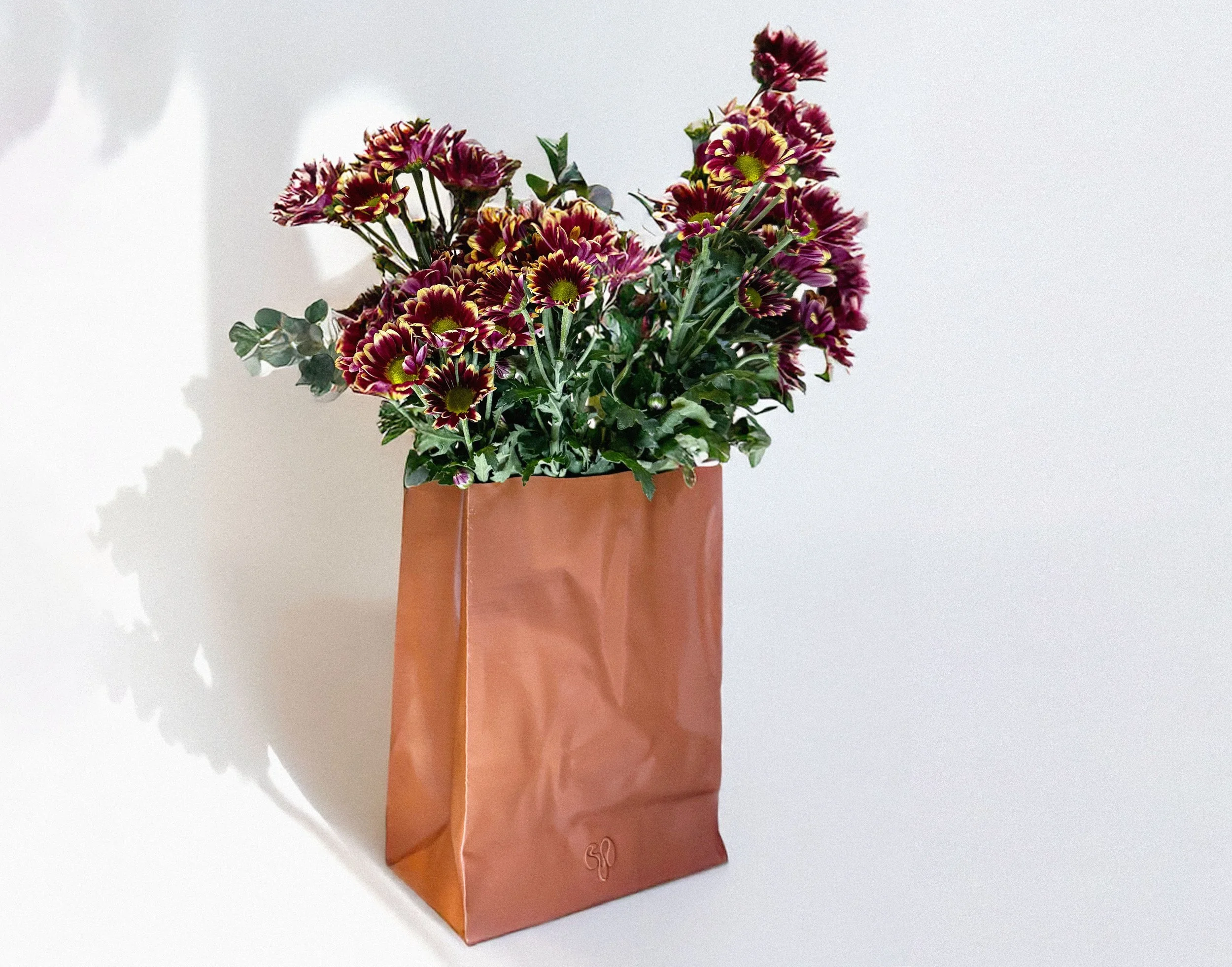
Photo of the Paperbag Vase. Image courtesy of VESSELS.
Could you please introduce your creative practice as a whole?
Hello! I’m the designer and founder of VESSELS, a 3D printing hobby-turned-studio. I am also an educator in the field of fashion. Before this, I worked in branding and advertising across London and Singapore, primarily in art direction and creative strategy.
Over time, those different strands began to converge. After moving back to Singapore and putting down roots here, VESSELS became a way for me to bring all of those experiences together into a practice that explores objects, and the relationship between the digital and the physical.

Jariel Ann Tan at the VESSELS workshop. Image courtesy of Jariel Ann Tan.
What motivated the creation of VESSELS, and how would you describe it?
VESSELS began out of curiosity. I had already been working with 3D modelling and digital assets for fashion campaigns, but I became interested in what would happen if those digital forms moved into the physical world. At the time, a friend helped me print some of my early designs because he had a 3D printer and I did not.
The first time I held one of those prints in my hands, it completely shifted the way I thought about the work. It felt exciting to see something that once only existed on a screen become an object that occupies space. Once I had my first physical print, I was hooked, and eventually bought my own printer to continue building the project from there.
“It felt exciting to see something that once only existed on a screen become an object that occupies space.”
How have elements from your myriad interests, skills and experiences past and present, including branding and teaching work, infused into VESSELS?
VESSELS is a natural extension of the different things I have been doing over the years. My background in branding means I am constantly thinking about how objects communicate something beyond their function. When I am designing a piece, I often consider what it references, the humour in it, or the cultural cues it carries. My time working in fashion has also shaped my sensitivity to form and image-making. In some ways, VESSELS sits somewhere between product and commentary, and is a space where all these threads can meet quite freely.
Teaching has also influenced it in a different way. Being in an academic environment means engaging with questions about how technology shapes culture, identity, and the way we experience the world. I am curious about what it means to be a physical being in an increasingly digital world, and that question sits at the core of VESSELS.

Photo of the Bao Incense Holder being lit by the Footlighter in the VESSELS workshop. Image courtesy of VESSELS.
Tell us about the product line at Vessels. There is a humor to the products you make, in its form, function or both. Could you tell us more about that?
I enjoy making objects that bring a sense of lightness, things that might make you chuckle or do a double take when you first encounter them. Anything from a foot-lighter to a bao-shaped incense holder.
With VESSELS, I am interested in objects that contain, carry, or hold something. Whether that is literally holding another object, or occupying space in a sculptural way. But within that framework, there is room for humour and play. Some of the pieces might look familiar at first glance, but then reveal something slightly unexpected in their form or function.
That cheekiness is quite intentional. I think humour can make design feel more approachable, and it opens up space for people to engage with objects in a more curious way.
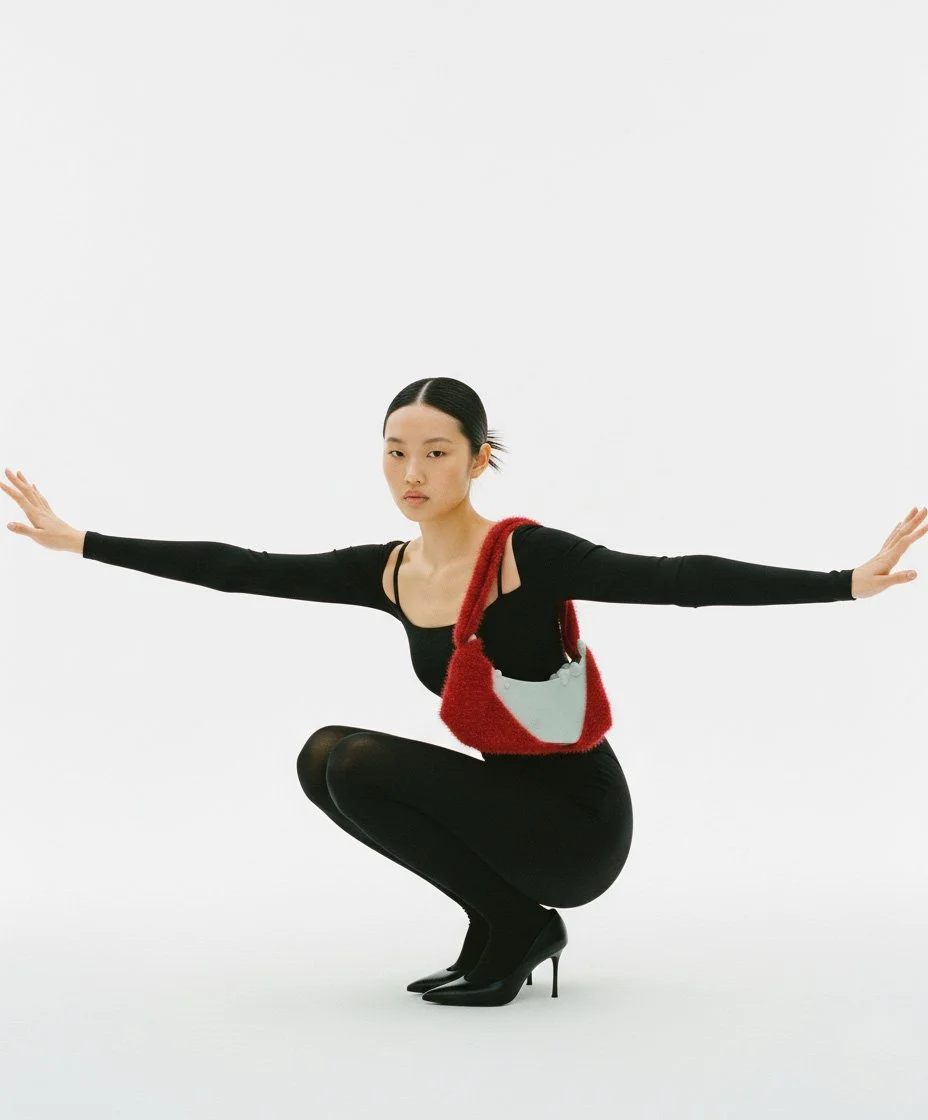
The Boat Bag is a 3D printed purse, the fabric for the handle is knitted together by Singapore knitwear designer Bryan Yeo using deadstock materials. Image created with GenAI.
How does fashion act as an influence or a key component of Vessels?
Fashion also influences VESSELS quite directly in some of the objects themselves. I have experimented with 3D printed purses, and its straps are knitted by local textilemaker, designer, and dear friend Bryan Yeo. I also make small trinkets that can be worn or attached as accessories. For example, I have created pieces like the lipbalm shaped like a buttplug, which is a collaboration between designer and yet another dear friend Vincent Loh, , or a foot-shaped lighter. Both come with carabiners, so they can be clipped onto a bag or a belt loop.
I like the idea that these objects can function like fashion accessories, and become small statement pieces that people carry with them. In that way, VESSELS overlaps with fashion not only conceptually, but also in how the objects are styled.
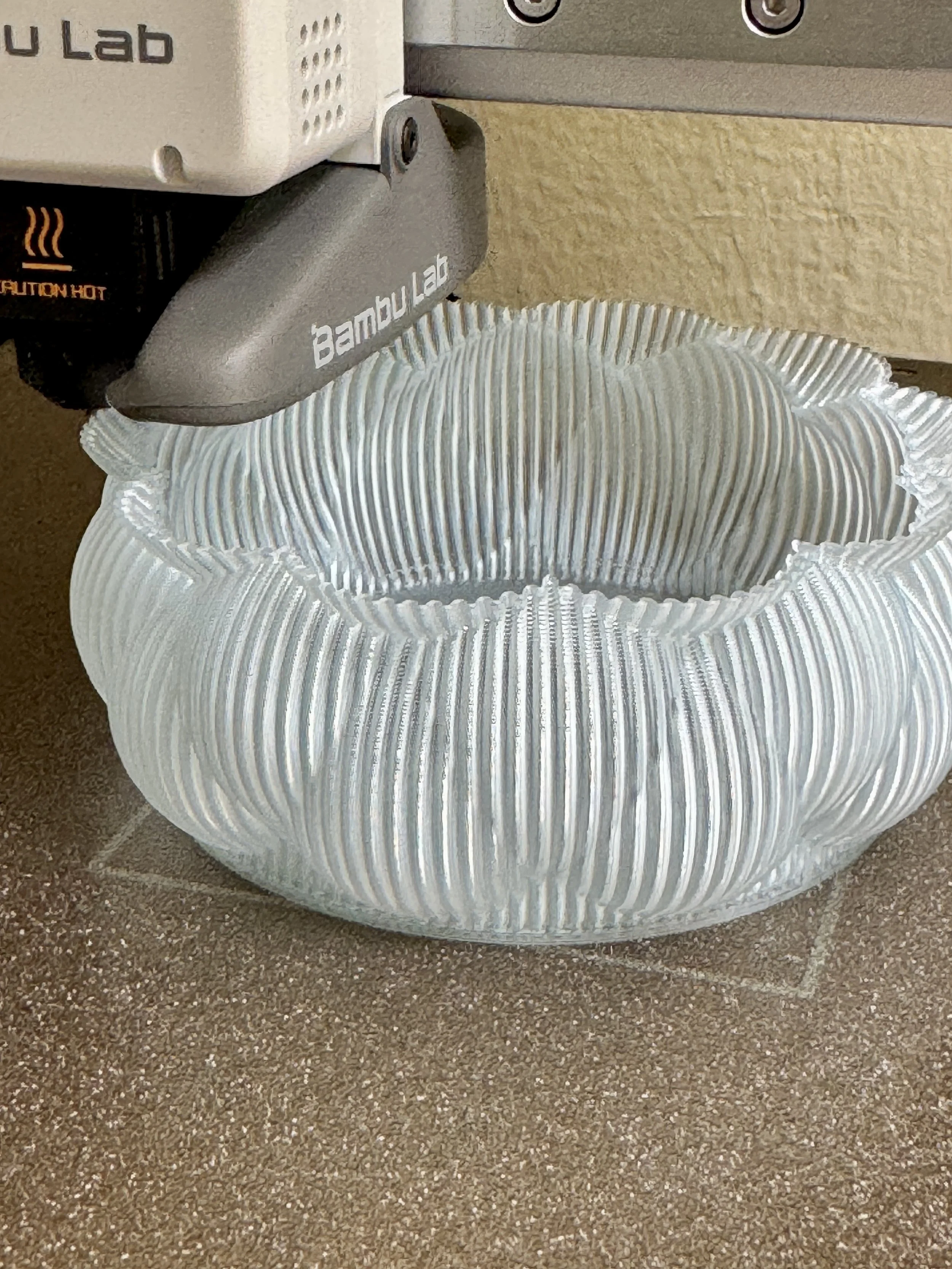
A prototype product in the process of being printed. Image courtesy of VESSELS.
Are you a one-person show at VESSELS? Or who else do you work with to bring VESSELS to life? Please explain your process from conceptualisation to execution, including technical details.
At the moment, VESSELS is largely a one-person operation. In the early stages, I worked with a technician who helped me with some of the printing, but over time I have learnt to handle most of the process myself. That said, I enjoy working within a community. I have collaborated with friends on specific ideas, and many of them come by to support my work at pop-ups or events. It has been nice to see an ecosystem slowly grow around the project.
My process usually begins quite informally. I keep a folder on my camera roll where I collect images of things I find interesting, primarily objects, shapes, or forms that feel “vessel-like” in some way. I often refer back to these references before starting with a rough sketch on paper. From there, I move into Blender, where I sculpt the object digitally in 3D.
I try to keep the process fairly organic, but 3D printing does come with certain technical constraints. For instance, objects ideally need a stable or flat base to print well. I actually enjoy working within those limitations, as they become part of the design challenge. During the printing stage, I also experiment with machine settings like the line width or layer height, which can change how the object looks and feels. Adjusting these settings can affect things like texture, strength, or even how translucent a print appears.
Once the print is complete, I will do some finishing if needed like sanding, cleaning, or occasionally applying a gloss spray depending on the piece.
From designing to printing, packing, and mailing orders, it is mostly me bringing each piece to life.

A VESSELS popup at Objects.re’s MINI MARKET in November 2025. Image courtesy of VESSELS.
You have participated in some pop-ups. What makes you say yes to them? And how do you engage with customers old and new aside from these physical activations?
Most of the pop-ups I have participated in have been organised by friends or within communities I’m already part of, so it usually feels quite natural to say yes, such as SANTAi, GULP and Objects.re. Since VESSELS does not have a physical store, pop-ups are a great opportunity to show the objects in person. There is a certain tactility to them, and people can pick them up and understand the forms in a way that online images cannot quite replicate. I also really enjoy meeting people in real life and seeing how they react to the pieces.
Outside of those physical activations, most interactions with customers happen online, often through DMs via my Instagram account @vessels_000. People reach out with questions and orders, or sometimes even ideas for custom pieces. We have had orders from outside Singapore as well, including a few commissioned pieces in London, which has been encouraging to see!
I am grateful for the momentum so far and hope to keep building on it. We are also tentatively planning our first larger-scale popup this November, though that is still in the works as I am figuring out the logistics.

A little corner for tools used during 3D printing post-production on the wall of the workshop. Image courtesy of VESSELS.
What are the challenges that you have met with, and how have you overcome them? In a similar vein, what have been the milestones that have carried you forward?
One of the biggest challenges has simply been scale. At the moment I run VESSELS largely on my own, so production can be quite slow. I also do not print at home, which means making multiple trips to the studio throughout the day to check on prints or start new ones. Balancing that with my job outside of this can be quite tiring at times.
At the same time, having a dedicated studio space has been a huge motivation. It is small, but it is somewhere I can experiment, make a mess, and really explore the craft. It is located at Pearl’s Hill Terrace, which has a vibrant community of artist studios and creative practices, and being surrounded by other makers has been incredibly energising.
In terms of milestones, one encouraging sign has been seeing a steady stream of orders coming in each week. I have also started opening pre-orders, which was something I had not imagined doing when I first started. Things have begun to pick up this year, especially over the past few months.
Collaborations have also been meaningful moments for the project. I have worked with BEAM, and more recently with Tuckshop, both communities that I am personally connected to, through yoga and through my love for queer performance spaces. Those collaborations feel particularly special because they allow me to engage with communities I care about. With the Tuckshop collaboration, we are also planning to donate a portion of the proceeds from each item sold to local queer charity organisations. It has been heartening to work with organisations that believe in the project and share similar values.
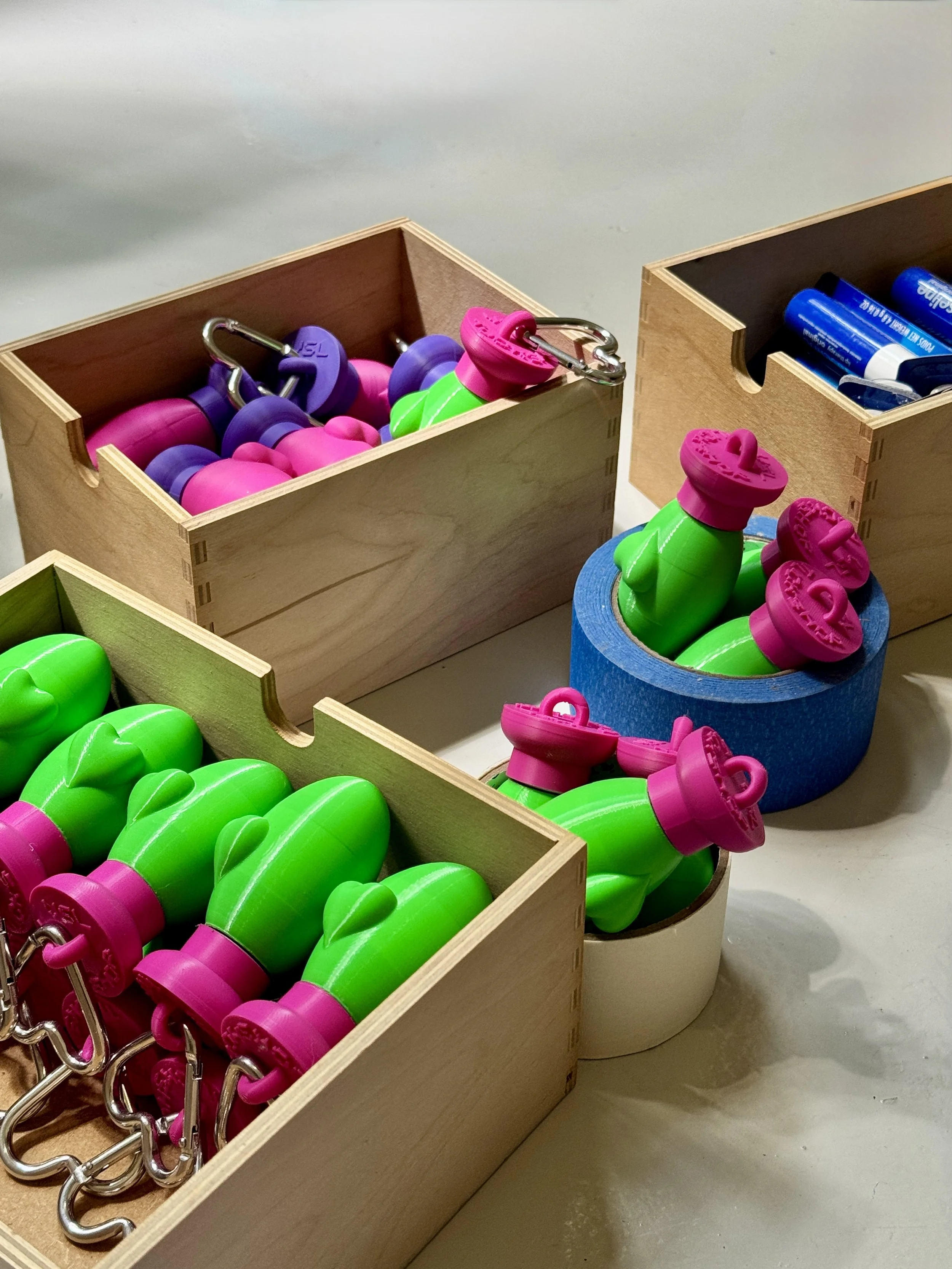
The making of the Buttplug Lipbalms in collaboration with TUCKSHOP. They’re made by 3D printing the separate components before attaching the Vaseline lipbalm and carabiner. Part of the sales goes towards supporting a local queer organisation. Image courtesy of VESSELS.

Performers backstage before their TUCKSHOP show, holding the lip balm by VESSELS. Image courtesy of VESSELS.
You now have a studio for VESSELS. What precipitated this move?
I realised quite quickly that I needed a dedicated space. As orders started coming in, my home was getting increasingly messy with prints and packing materials. I had already been looking around for a while, but someone recommended a space at Pearl’s Hill Terrace. I went down for a quick wander around the building and ended up deciding on the spot that same day, so it all happened quite quickly.
Though it is a very small space, I wanted somewhere I could properly experiment and make a mess without limitations. Having a studio means I can keep all the equipment there, run prints throughout the day, and treat it as a space for both production and exploration.
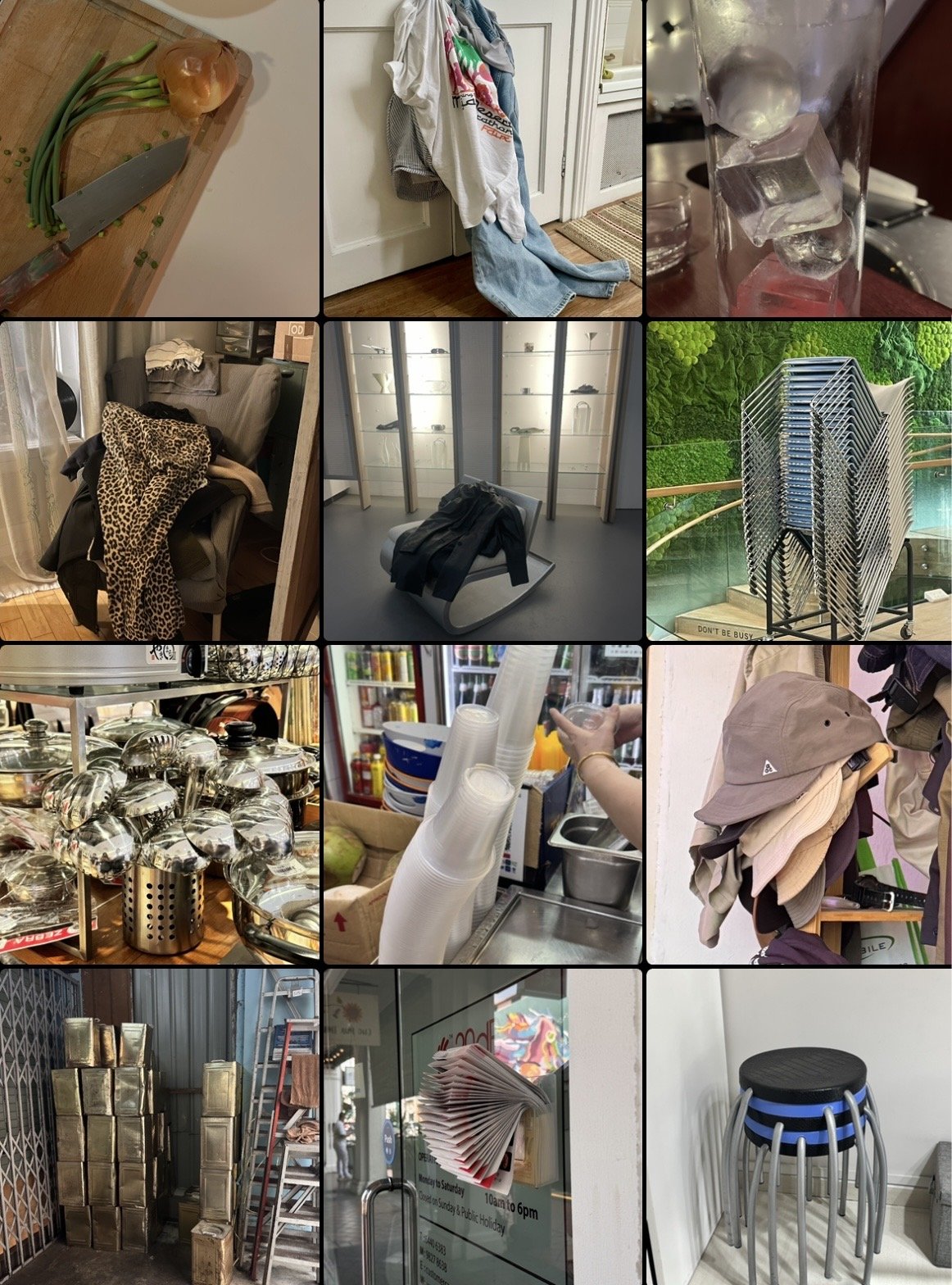
Screenshot of Jariel’s iPhone photo gallery, featuring snaps of vessel-like forms and everyday compositions that resemble accidental sculptures. Image courtesy of Jariel Ann Tan.
How do you plan for VESSELS to grow?
In the near future, growth will look like expanding production capabilities and continuing to experiment with new ideas at a larger scale. Having more printers (fingers crossed!) will allow me to produce work more efficiently while also creating space to test new forms and concepts.
I am also interested in developing more meaningful collaborations with communities and creative spaces that align with the spirit of VESSELS. Those partnerships have been some of the most exciting parts of the project so far.
Another goal is to develop a kind of “hero” product, something that gives the customer a bit more agency in the process. I like the idea of objects that people can assemble or personalise themselves, so they can engage more directly with the tactility of the piece and make it their own.
Sustainability is also something I will continue to think about as the project grows. Most of the pieces are currently printed in polylactic acid or PLA, which is a biodegradable material derived from renewable resources like cornstarch. I am also exploring ways to reuse the waste produced during printing, such as the excess filament or purge material, and turning them into new objects or materials, so the process becomes more circular over time.
Learn more about VESSELS here.