
Fashion & Memory: Alyssa Marie Groeneveld
Reimagining sportswear through emotion

Alyssa Marie Groeneveld with her sister Irene. Image courtesy of Alyssa Marie Groeneveld.
For Alyssa Marie Groeneveld, the most important influence on her work is not always visible in the finished garment. It is something more internal: a way of trusting intuition and energy over fixed formulas. That sensibility, she says, comes from her upbringing and especially from her mother, whose influence continues to shape how she makes clothes.
Groeneveld grew up in the Netherlands, between Rotterdam and Amsterdam, in a cultural duality that runs through her practice. Her mother, who is Filipino and Catholic, taught her to value spirituality and emotional awareness. “She taught me about believing in intuition and the emotional side,” Groeneveld reflects. “That is part of my character and it is implemented in the design making process.”

Central Saint Martins Graduate Collection by Alyssa Marie Groeneveld, 2022. Image courtesy of Alyssa Marie Groeneveld.
That sensibility took material form through Groeneveld’s fashion education. She first studied at the Willem de Kooning Academy in Rotterdam before pursuing her MA in Fashion Design Menswear at Central Saint Martins in London. It was during this period that the core language of her brand began to take shape: a zero-pattern, draped method of working directly with existing garments. What emerged was a sportswear practice defined by instinct, experimentation, and reinvention.
Draping remains central to that approach. Rather than beginning with a predetermined pattern, Groeneveld allows the garment to emerge through improvisation. “My draping process is meditative, and I have no idea what I am doing when I drape,” she says. “I surrender myself in the process. I am not necessarily calculating what I should do. I just let go.” In her explanation, design becomes one of release. At times, that surrender is overwhelming in its directness. “Sometimes I cry when I drape,” she shares. “Sometimes I am very happy. So the energy of myself goes into the process.” The finished collection, then, is a record of an emotional state.
This intuitive method also shapes how each collection begins. Groeneveld looks inward, reflecting on the previous six months of her life. What has she been moving through emotionally? Heartbreak, healing, uncertainty, renewal? From that reckoning, she constructs an imaginative environment: a public space charged with feeling and populated by fictional characters whose emotional lives mirror something of her own.

AMG Spring/Summer 2024 Collection. Photo by Emoji Sim. Image courtesy of Alyssa Marie Groeneveld.
One collection, for instance, took shape around the setting of a park, an open environment associated with release and new beginnings. It reflected a period in which Groeneveld felt herself returning to a sense of acceptance after a difficult stretch. Another collection unfolded through the London Underground: crowded, tense, and emotionally compressed. That setting became a way of working through her own discomfort after moving to the city. “That is how I create the stories,” she explains. “First I ask, where am I at? What environment reflects that, and what type of people are coming into that space?”
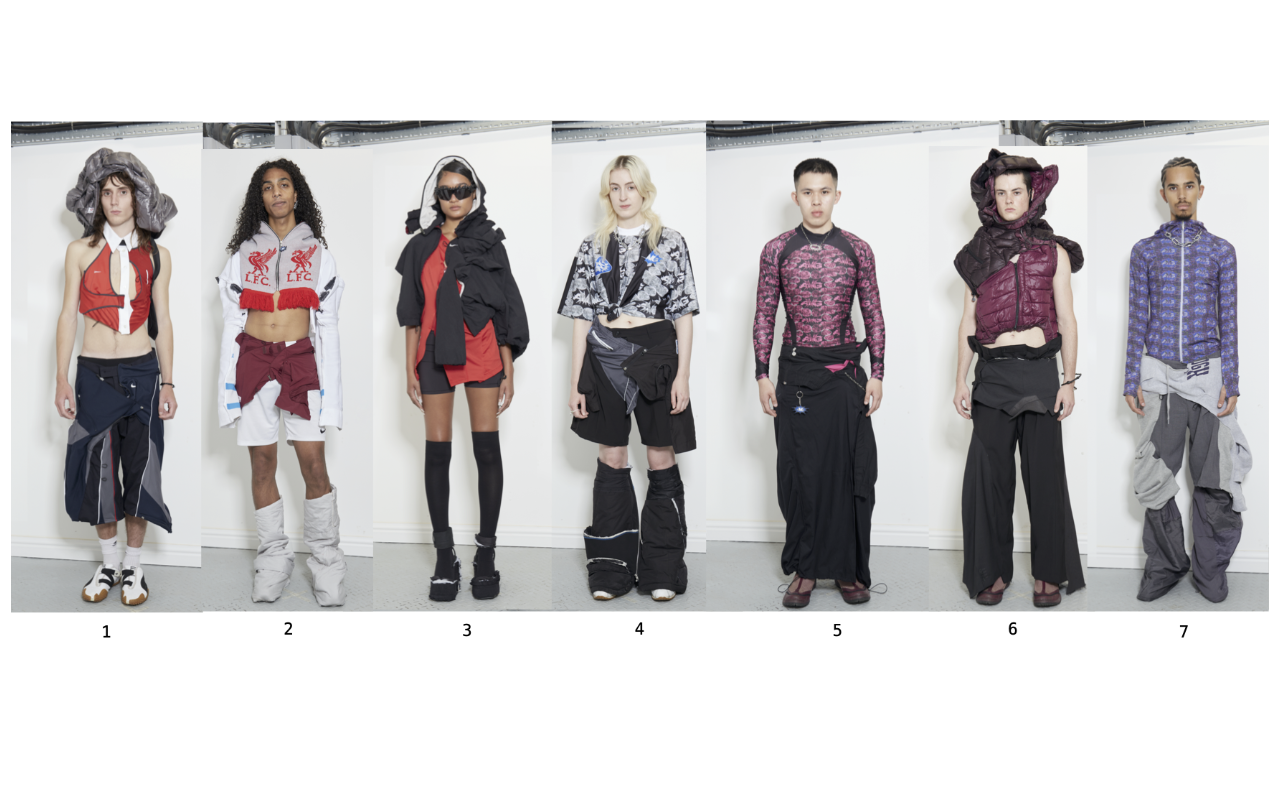
AMG Spring/Summer 2024 Collection. Photo by Emoji Sim. Image courtesy of Alyssa Marie Groeneveld.
The garments themselves also carry traces of prior lives. Groeneveld sources many of her materials secondhand through platforms such as eBay or Vinted, as well as through sponsorship from sportswear brands like Nike and Puma. “I try to create a new garment from the old,” she says. “It becomes something completely new.” For a practice so deeply concerned with emotional memory, this material process is significant. By working with clothes that have already circulated through other bodies and lives, she engages in histories that remain largely unknown, yet still persist in altered form.
That logic of continuity also shapes the evolution of her brand. Groeneveld describes her collections as a kind of “software update”: recurring silhouettes and techniques return from one season to the next, but in renewed forms, through different materials, colours, and emotional contexts. What she made before is not discarded entirely. It is carried forward and reworked, the way experience itself accumulates and shifts over time. This gives her work a particular coherence. Each collection feels connected to the last, continuing an ongoing internal conversation.

Fitting picture, AMG Autumn/Winter 2024 Collection. Image courtesy of Alyssa Marie Groeneveld.
Sportswear remains central to that conversation. As a child, Groeneveld moved through different sports and activities, including taekwondo and hip-hop dance, both of which continue to shape how she thinks about the body and movement. Her collections often lean visually toward masculine codes: unisex silhouettes, athletic forms, and menswear. Yet, she consistently complicates that surface. Groeneveld is interested in the points where masculinity becomes permeable, where it admits softness. “My aim is not to provoke men,” she says. “I want to highlight how men also have an emotional side.” In her work, masculinity and femininity operate as overlapping emotions and aesthetic registers.
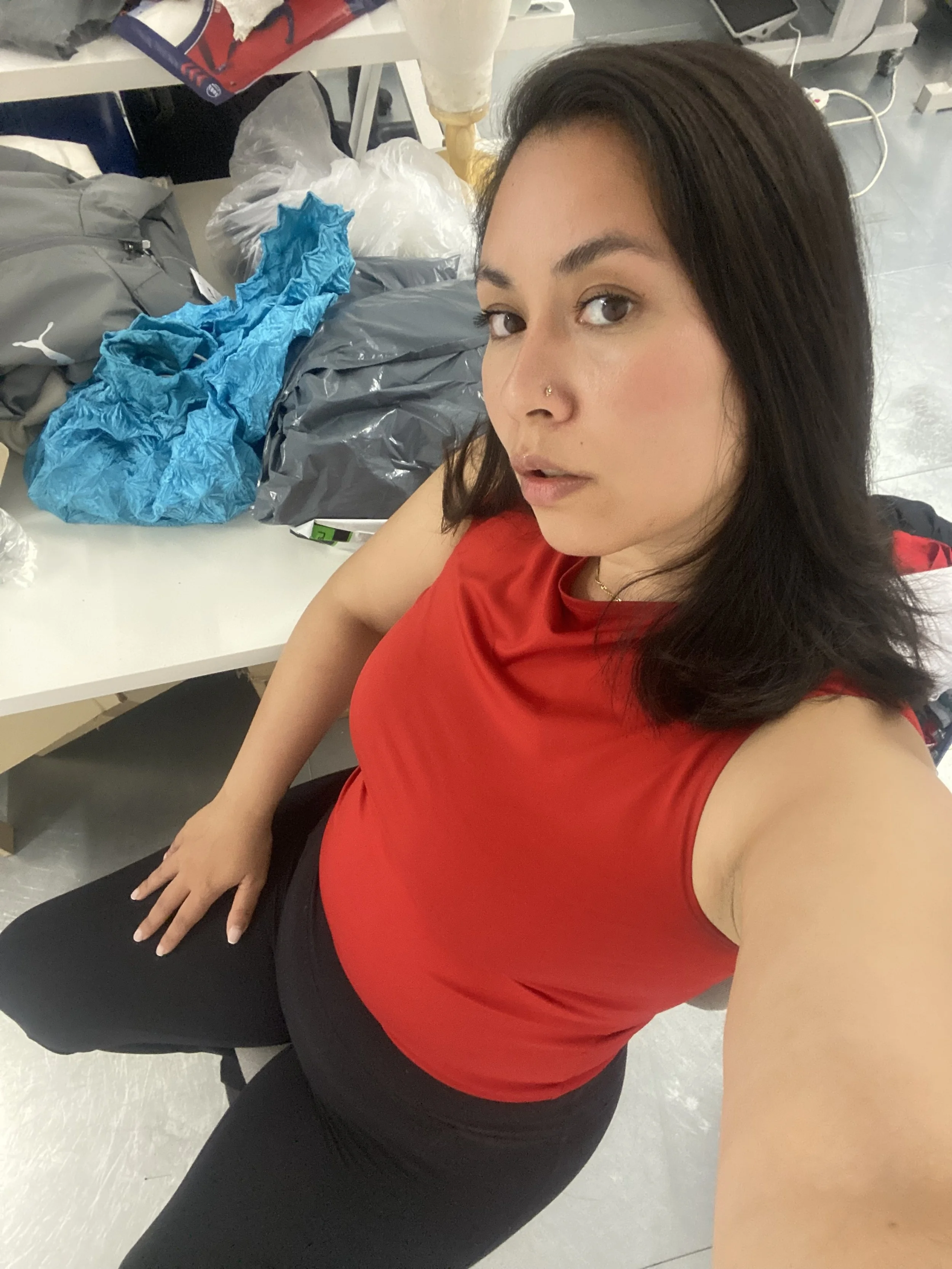
Alyssa Marie Groeneveld. Image courtesy of Alyssa Marie Groeneveld.
That belief in fashion as something emotionally and conceptually grounded also informs her teaching. Alongside running her label, Groeneveld works as an associate lecturer at London College of Fashion, where she teaches a Streetwear Fashion Design short course. From the outset, she encourages students to begin with a concept and point of view. What is the story behind the work? Some students take naturally to that process, while others find it unfamiliar or disorientating. But for Groeneveld, design without a deeper interior logic is difficult to imagine. “I really try to push them to create from that place,” she says. “I still see my work as a form of art. Otherwise, why are we making it?”
Looking ahead, Groeneveld describes herself as standing at a crossroads. She wishes to bring her work into more public and physical spaces, reconnect directly with consumers, and continue building her brand through gradual, but steady growth. She also sees Asia as an important part of that future. Though based in Europe, her work has already found resonance in Japan and Korea. She hopes to deepen those connections, while also moving closer to her Southeast Asian roots. She speaks of upcoming travel to Hong Kong, Vietnam, and the Philippines, and of a broader desire to imagine her work within Asia more fully. “I really want to see my work most in Asia,” she says. “I would love to live there one day, or do more projects there, physically, with the right timing.”

AW25 Showroom during Paris Fashion Week. Image courtesy of Alyssa Marie Groeneveld.
What makes Groeneveld’s work so compelling is that the way it carries feeling forward: through intuition, garments remade from other lives, and recurring silhouettes that take on new emotional meanings over time. Fashion, for her, becomes a way of making inner experience visible. Through draping and emotional storytelling, Alyssa Marie Groeneveld turns feeling into form.
To learn more about Alyssa Marie Groeneveld, visit her website or follow her on Instagram.
About the Writer
Faith Cooper is the creator of the Asian Fashion Archive. She holds master’s degrees from the Fashion Institute of Technology (FIT) in New York and from Fu Jen Catholic University in Taiwan, where she researched Taiwanese fashion and cultural identity as a Fulbright Student. Faith is now pursuing a PhD in history at the National University of Singapore, focusing on the cultural history of women’s sartorial developments in mid-twentieth-century Singapore.