
Fashion & Memory: Quý Cao, CAOSTU
From Coastal Memory to Contemporary Fashion
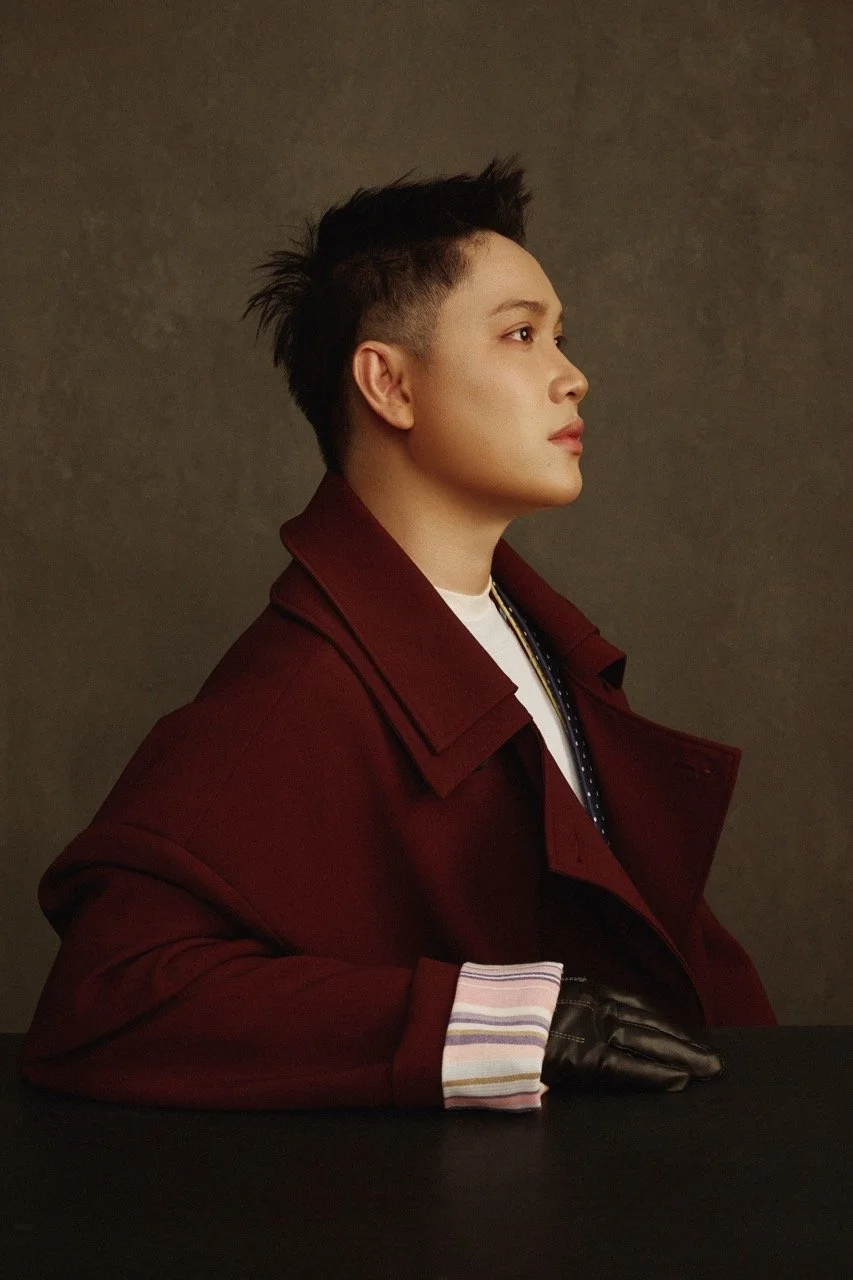
Quý Cao, founder and designer of CAOSTU, 2026. Photo by Milor Tran (@milortran). Image courtesy of Quý Cao.
For Quý Cao, founder and designer of the Saigon-based fashion brand CAOSTU, fashion is a way of remembering. Drawing from the landscapes of his childhood and the architectural forms that shape his design language, Cao transforms memories of dragon fruit orchards and fishing villages into garments defined by curves, texture and movement. Born and raised in the countryside along the coastal region of South Central Vietnam, he developed a deep appreciation for beauty from an early age. “For me, fashion is more than creating garments,” Cao explains. “It is a way of translating memory, culture, and the beauty of the natural world into stories people can wear.”
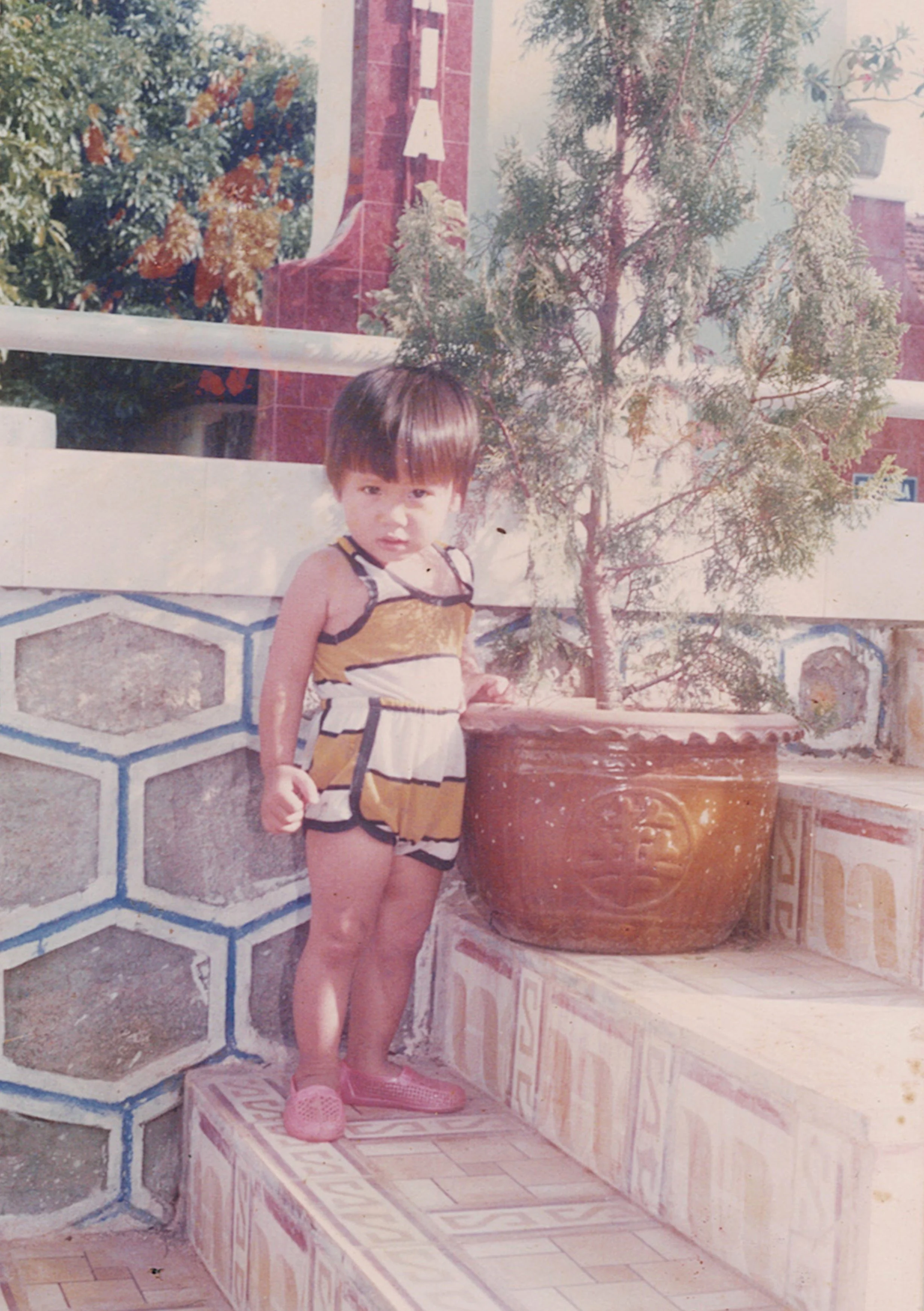
Quý Cao at age two during his younger brother’s baptism at Thọ Trang Parish, Bình Thuận, 1995. Image courtesy of Quý Cao.
Cao’s first memories of fashion began in the fourth grade, when a friend gifted him a notebook. “Instead of drawing people or landscapes, I filled its pages with fashion sketches,” he recalls. “That was the moment I realised my passion for fashion design.” At a time when internet access was limited, FashionTV became his window into the wider fashion world.

Quý Cao’s baptism at one month old, photographed at his family home, November 1993. He is pictured in his mother’s arms, surrounded by family members including his grandmother, father, older brother, godfather, uncle, and aunt. Image courtesy of Quý Cao.
Family memory is central to this origin story. Cao’s earliest encounters with clothing also came through the intimacy of domestic life: watching his uncle work as a tailor, handling fabric scraps, and making clothes for dolls as a child. Together, these early experiences shaped his understanding of fashion as a practice rooted in home, material, and everyday memory.
The landscapes around him also left a lasting impression. Cao grew up between mountains and the sea, surrounded by orchards, marine life, and shifting coastal light. The vivid blue of sky and water remains central to his aesthetic, while the rhythm of waves continues to influence the soft lines, layered silhouettes, and sense of movement in his work. “In many ways, each collection is a tribute to the place that nurtured both my imagination and who I am,” he notes.
Cao later studied fashion at Văn Lang University, graduating top of his class in 2015. His focus on menswear informed CAOSTU’s foundation, while internships with local design houses, including Công Trí, Phương My, and Lê Thanh Hòa, gave him experience across Vietnam’s fashion industry. He also worked in production and magazine styling before founding CAOSTU in late 2020, developing the brand as a contemporary ready-to-wear label known for fluid silhouettes and experimental material treatments.
Yet Cao’s path was not linear. After several years of feeling “disconnected from the industry”, he reached a turning point at the end of 2019, when a serious back injury led him into a period of reflection. “Being forced to slow down gave me the chance to ask myself a simple question: ‘What truly makes me happy?’ The answer was fashion,” he recalls. His return to fashion also meant a return to himself. Rather than trying to fit into other people’s expectations, he began to embrace his own “instincts, strengths and imperfections.”
The name CAOSTU carries this personal history. “CAO” comes from his family name, while “STU” stands for “stubborn, stupid, and studious.” For Cao, the phrase reflects a belief that growth comes through mistakes, reflection and continued learning. What began as an experimental young label has since developed into a more defined design language rooted in Vietnamese memory, culture and identity.

A model wearing a CAOSTU design outside the brand’s boutique on its opening day in Ho Chi Minh City, 2023. Image courtesy of CAOSTU.
Since launching CAOSTU, Cao has steadily built the brand’s presence within Vietnam’s fashion industry and beyond. In 2021, he won the Fashion Design Icon award at TikTok FashUP, and later participated in Vietnam International Fashion Week. He opened CAOSTU’s first physical shop in Ho Chi Minh City in 2023. The brand has also received coverage in international and regional publications including Vogue Australia, PAPER Magazine, Tatler Asia, Harper’s Bazaar Vietnam and L’Officiel Vietnam. Its visibility has extended to public figures as well, with designs worn by model and actress Nguyễn Minh Tú and actress and singer Chi Pu.
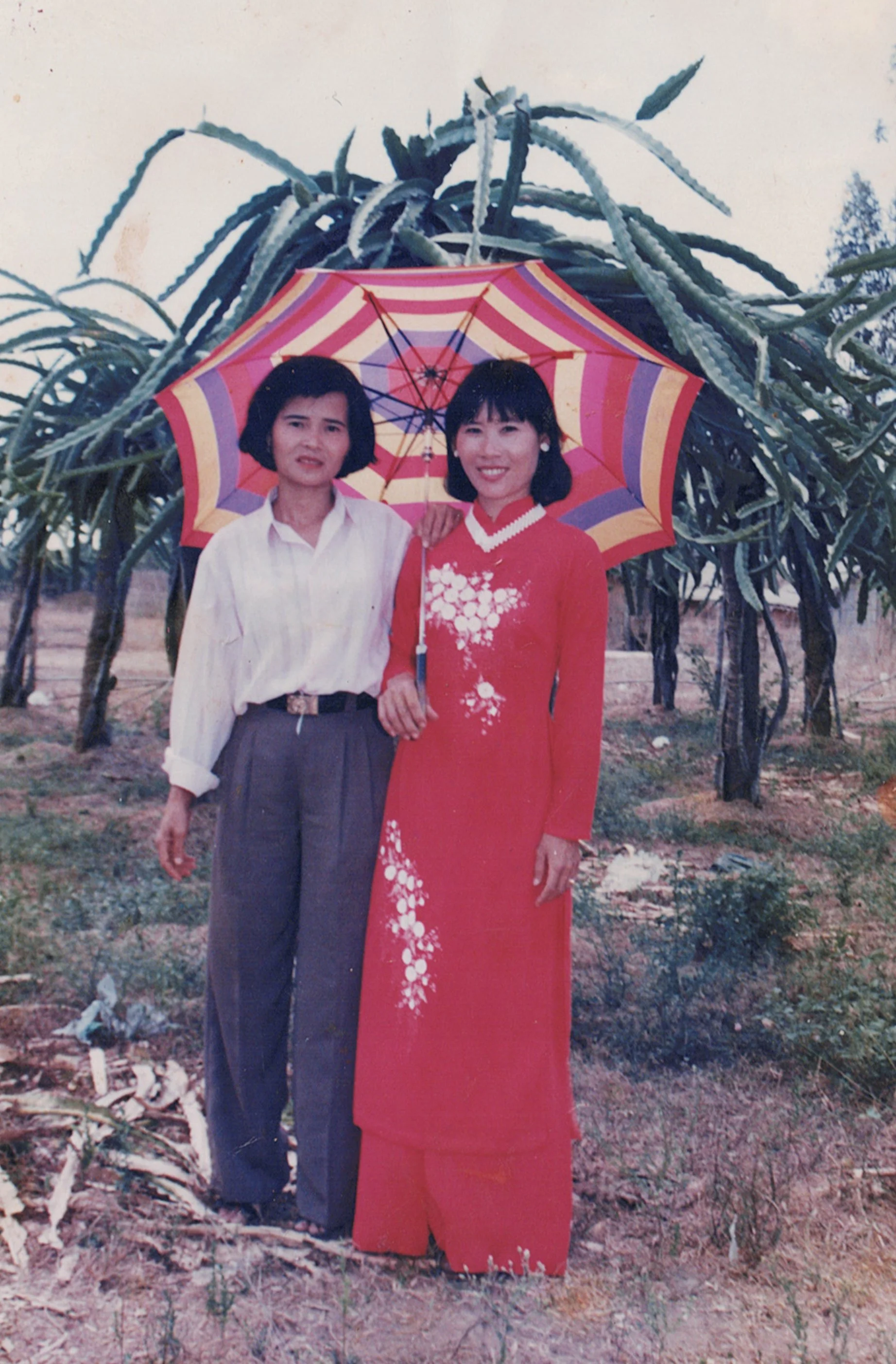
Cao’s mother wears a red áo dài with Nam, her first godchild, at his grandfather’s dragon fruit orchard on Christmas Eve, c. 1990s. Image courtesy of Quý Cao.
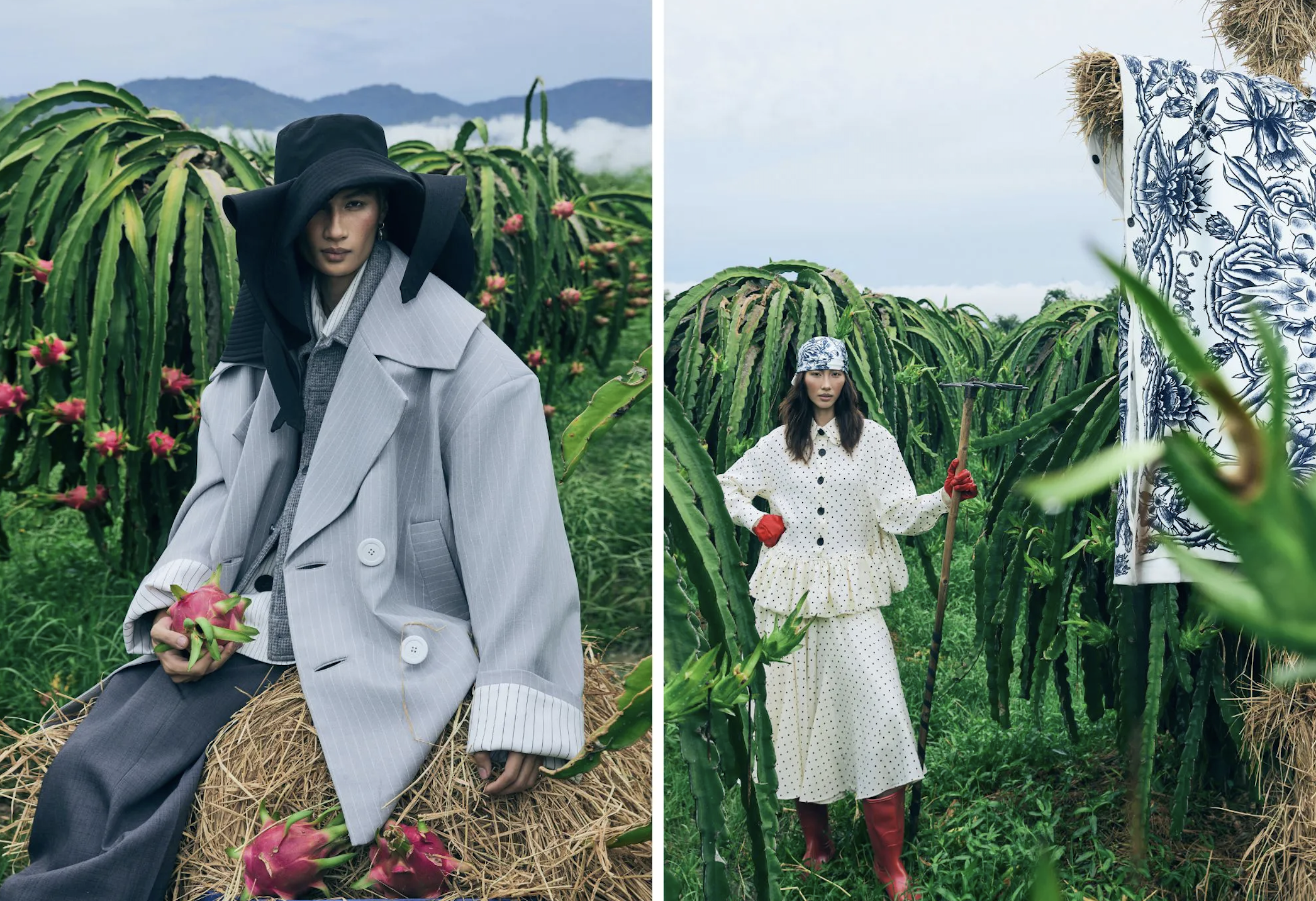
Campaign image from CAOSTU’s Fall/Winter 2025 Dragon Fruit collection. The orchards recall those surrounding Cao’s childhood home. Photo by Hoàng Phúc. Image courtesy of CAOSTU.
Beyond these public milestones, CAOSTU’s collections reveal a more intimate story of memory and place. With the Fall/Winter 2025 Dragon Fruit collection, Cao revisits one of his fondest childhood memories: the dragon-fruit fields of Phan Thiết. As a child, he remembers following his parents to the fields, watching the sun set over the orchards, and waking before dawn as they prepared for another day of work. The collection unfolds as a reimagined fashion garden, with handcrafted prints recalling the form of the fruit and a colour palette drawn from the natural landscape of the fields. In Cao’s words, the dragon fruit became “a symbol of home — of the land where I was born, my parents’ hard work, and the values that shaped who I am.”

Campaign image from CAOSTU’s Spring/Summer 2026 Fishing Village collection. Photography by Hoàng Phúc. Image courtesy of CAOSTU.
CAOSTU’s Spring/Summer 2026 collection, Fishing Village, turns from the fields to the coast. Although Cao did not grow up in a fishing family, the harbour was an inseparable part of his childhood, shaped by friends from fishing communities and the daily rhythms of life by the sea. Drawing from the familiar landscapes of Phú Quý Island, the collection translates coastal memory into garment details: mother-of-pearl buttons sourced from the seabed, striped patterns recalling fish-drying tarps, floral prints referencing clothing worn by locals, and a palette drawn from salt fields, wooden boats, sunrise light, and the surrounding sea. “Through these moments, I wanted to celebrate the enduring spirit of Vietnam’s coastal communities—their warmth, perseverance, and the quiet beauty found in everyday life,” he explains.

Quý Cao presenting The Beetle collection at the DEPA Fashion Show, 2025. Photography by Hoàng Phúc. Image courtesy of CAOSTU.
For Cao, such details are part of a larger commitment to craft as a form of storytelling. Embroidery, layering, fabric manipulation, and contrasting textiles are not simply decorative effects, but ways of carrying memory through material. “What matters is not how many traditional elements are placed on a garment, but how deeply one understands the spirit of craftsmanship itself,” he says. “Every technique carries the history, knowledge, and way of thinking of generations of artisans.” This approach shapes how CAOSTU engages with Vietnamese cultural references: not by reproducing tradition unchanged, but by reinterpreting it through contemporary design, allowing traditional craftsmanship and fashion to sustain one another.
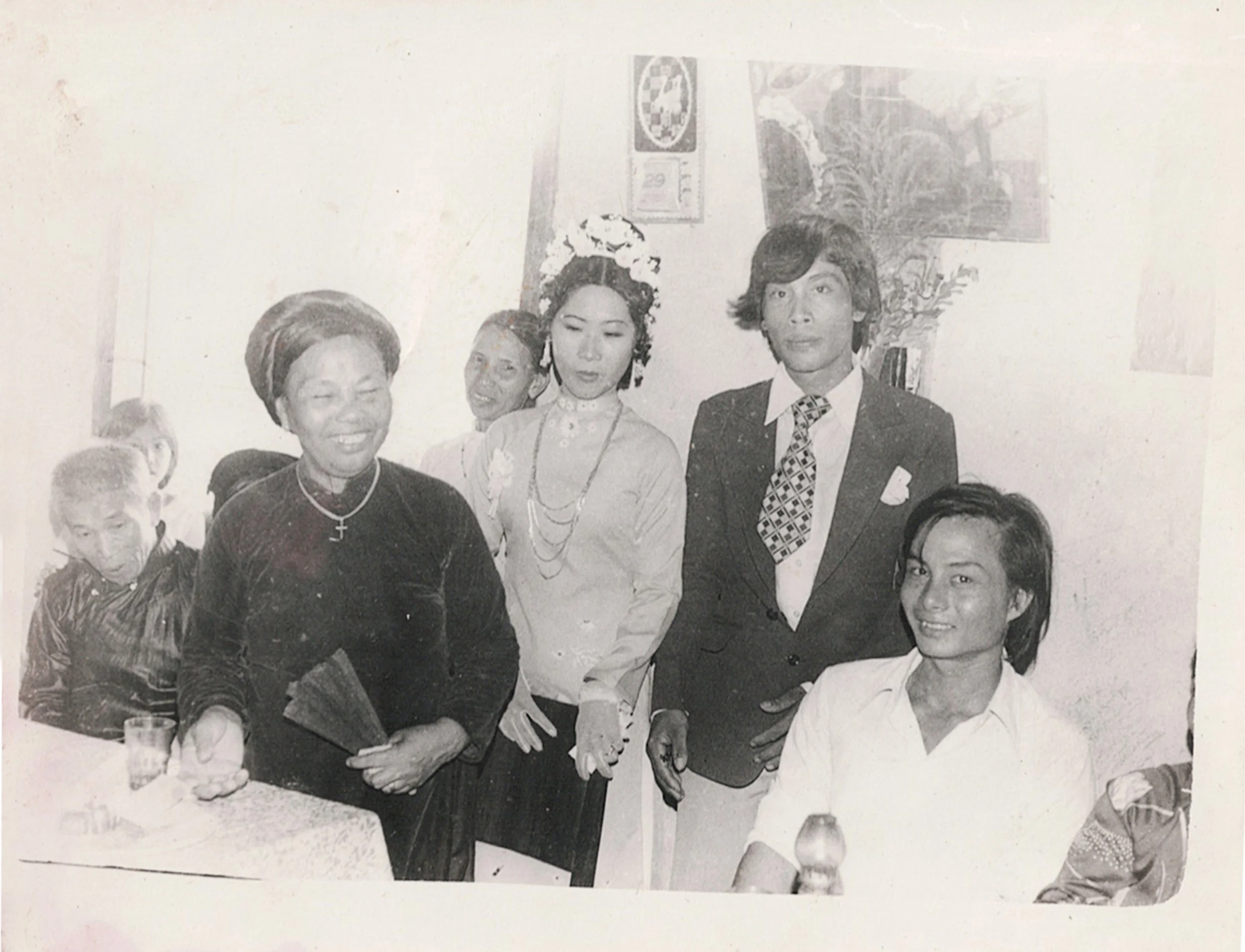
Cao’s parents on their wedding day with his grandmother and uncle in Mương Mán, Hàm Thuận Nam, Bình Thuận, 1984. Image courtesy of Quý Cao.
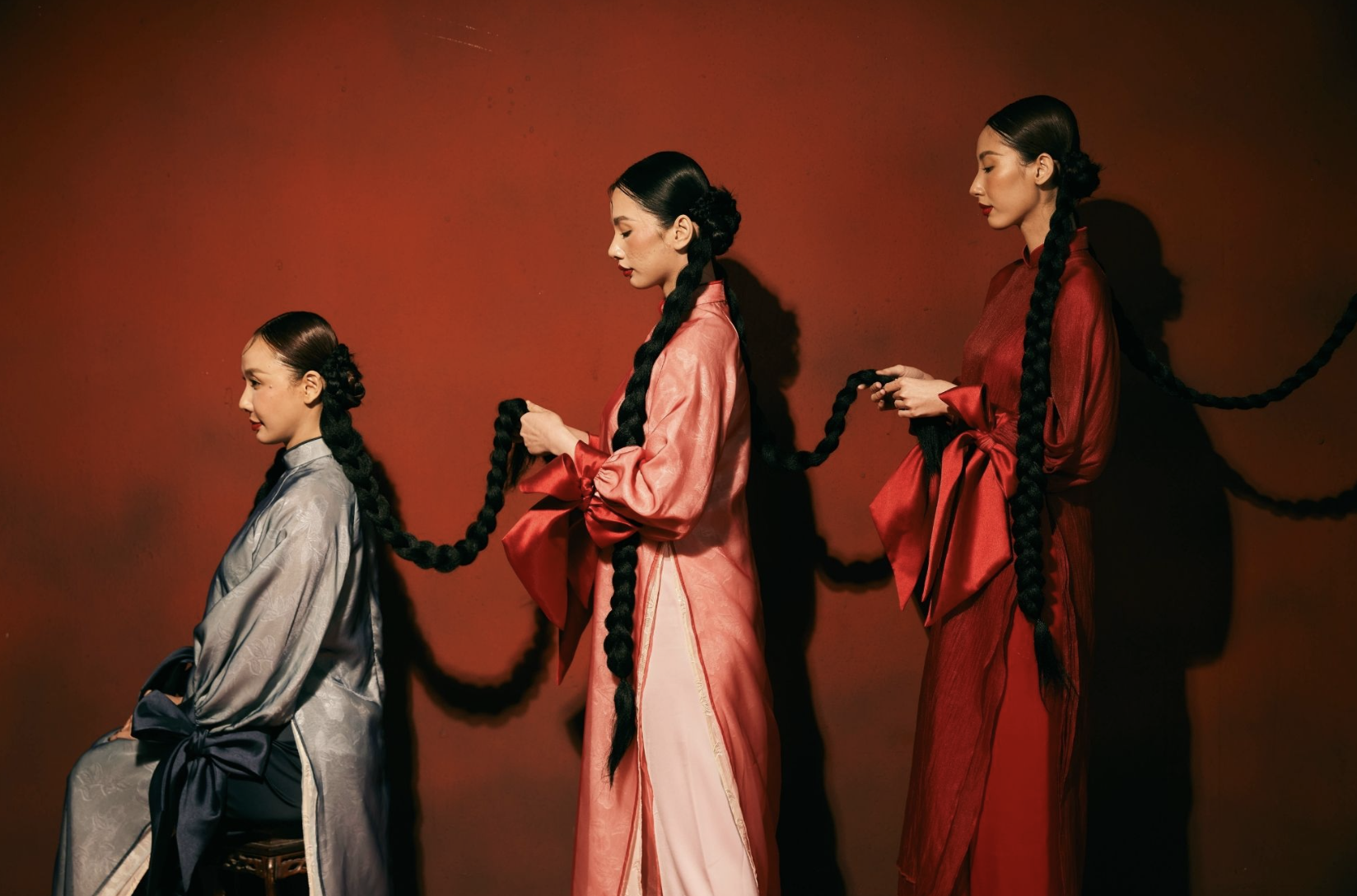
Look from CAOSTU’s Tết Holiday collection, 2025. Photography by Hoàng Phúc. Image courtesy of CAOSTU.
His approach to the áo dài follows a similar logic. As part of CAOSTU’s Tết collections, Cao preserves the garment’s essential silhouette out of respect for its cultural spirit, while experimenting with surface treatments and details to create an expression that feels closer to younger audiences. Through this process, CAOSTU seeks to foster pride in Vietnamese fashion and a deeper appreciation for the country’s cultural identity and heritage.
This desire also extends to the wearer. Cao does not want CAOSTU to be remembered only as beautiful clothing, but hopes each garment becomes part of someone’s personal memory, connected to an emotion, moment, or milestone. “Every piece is the result of time, craftsmanship, and stories embedded in materials, techniques, and Vietnamese culture,” he explains. Even if the wearer does not know every detail behind the garment, he hopes they can still feel “something honest, familiar and meaningful” within it.
This balance with memory, craft, and contemporary fashion also shapes Cao’s view of Vietnam’s fashion industry today. Over the past five years, he has observed local brands investing more seriously in design, craftsmanship, product quality, and storytelling. At the same time, Vietnamese consumers have become increasingly interested in wearing Vietnamese labels, reflecting a shift not only in buying habits, but also in how local fashion is perceived and valued. For Cao, this is a positive sign for a new generation of Vietnamese designers becoming “more confident in expressing their individuality, exploring their own aesthetics, and building distinct design languages”.
Looking ahead, Cao hopes to continue refining CAOSTU’s craft and storytelling, while bringing the brand to a wider audience, particularly within Southeast Asia. He describes his vision as one of “telling stories rooted in Vietnamese memory, culture, and identity,” a direction CAOSTU will continue later this year when the brand returns to the runway in collaboration with the Designer Emerging Partnership Association (DEPA). DEPA is a fashion platform that brings together emerging Vietnamese designers and supports a sustained creative ecosystem.
At the heart of CAOSTU is a belief that cultural identity can live quietly in colour, texture, movement and material. In Cao’s work, the everyday lives and landscapes of South Central Vietnam become garments shaped by craft and feeling. Through fashion, CAOSTU treats memory as material: shaped, layered, worn and carried forward.
To learn more about Quý Cao and CAOSTU, please visit their website and follow the brand on Instagram.
About the Writer
Faith Cooper is the creator of the Asian Fashion Archive. She holds master’s degrees from the Fashion Institute of Technology (FIT) in New York and from Fu Jen Catholic University in Taiwan, where she researched Taiwanese fashion and cultural identity as a Fulbright Student. Faith is now pursuing a PhD in history at the National University of Singapore, focusing on the cultural history of women’s sartorial developments in mid-twentieth-century Singapore.