
Fashion & Memory: Raven Ong
Costuming memory
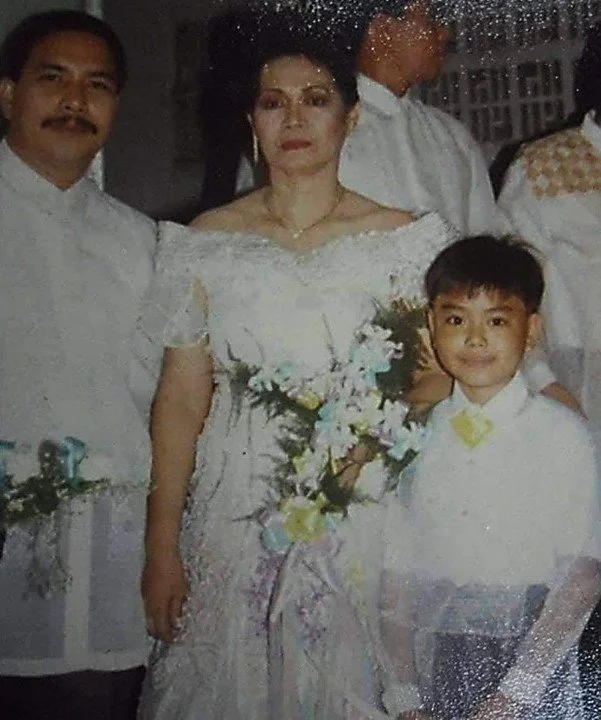
Raven Ong as a young boy wearing an organza barong tagalog during a Santacruzan celebration in the Philippines. Ong played the young Constantine alongside his grandmother, who appeared as Queen Helena (Reyna Elena). Image courtesy of Raven Ong.
For costume designer Raven Ong, some of his earliest memories of fashion begin with his grandmother. Growing up in Manila, Ong accompanied her to fittings for the ballroom gowns she wore to dance competitions and elaborate birthday parties she threw. “My grandmother, from my Chinese side, loved dancing,” he remembers. “Every year, she joined competitions, and every year during her birthday, she hosted big ballroom dancing parties. Sometimes, she even hired dance instructors for her guests.”
As a child, Ong did not understand the creative processes taking place around him, but he remembers being mesmerised by the materiality of dress. “I remember being really interested in the fabrics, the flow, the sequins, the beadwork, the glitter and how they moved,” he says. “Those fittings were my early introductions to costume and fashion.”
These encounters were accompanied by a childhood fascination with drawing and creating looks. Using his grandmother’s fashion magazines, Ong devised his own way of transforming their pages. At the age of six years old, he cut out photographs of selected fashionable outfits, pasting his mother’s passport photos over the models’ faces. Long before his established career as a costume designer, fashion had already become intertwined with play and memory.

Ong’s family, c. 1963–64. His Chinese grandfather stands at the top right, while his Filipina grandmother is pictured in the middle row, third from left, holding Ong’s aunt. His father is the young boy at the bottom left wearing a white polo shirt. Image courtesy of Raven Ong.
Textiles were also part of the physical landscape of Ong’s childhood. His parents were in the vegetable business, living near Divisoria, Manila’s historic wholesale and textile district, where designers and dressmakers source fabrics and other dressmaking materials. “I basically grew up seeing a lot of these fabrics,” he says.
Yet, Ong did not initially imagine himself as a costume designer. He first pursued fine arts at the University of Santo Tomas, where he spent two years developing his drawing skills. By his second year, however, he grew frustrated by the limitations of working primarily on paper. “I was lacking the three-dimensional aspect,” he explains. “I was starting to feel like I needed to create more.”
He transferred to De La Salle–College of Saint Benilde to study production design, a decision that brought him closer to theatre and costume. Many of his professors were themselves active designers, connecting his classroom education with professional practice. “I guess they saw the hunger in me,” Ong says of his teachers. “I really wanted to excel in my classes. I instantly said to myself and put it out in the universe that someday I want to be like them.”
One of the most influential figures was costume designer Eric Pineda, with whom Ong still works with today. For approximately eight years, he assisted with theatre productions and learned the skills needed to work within a costume shop. The geography of his childhood consequently became part of his professional education: he returned to the neighbourhood where he grew up surrounded by fabrics, this time sourcing them as a designer.

Ong at work as costume designer for a production of The Magic Flute at Carnegie Hall in New York City, autumn 2017. Image courtesy of Raven Ong.
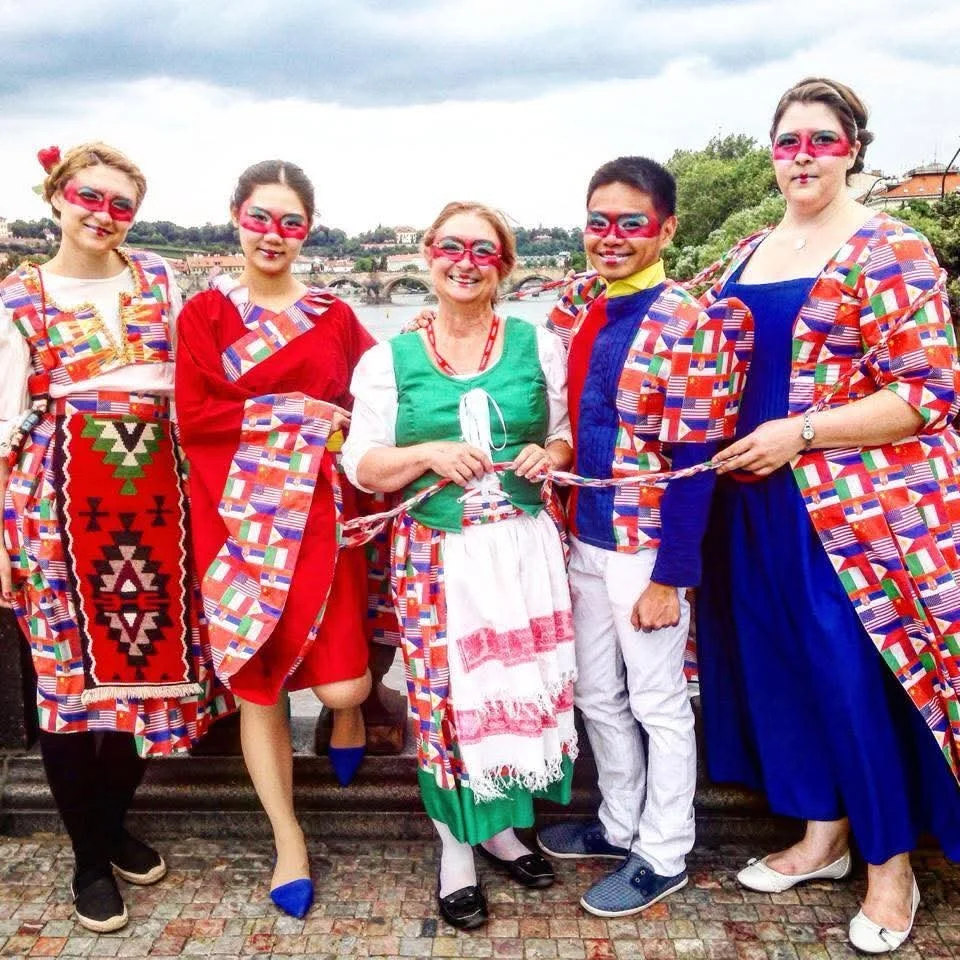
Ong and his fellow graduate students participating in a costume parade at the Prague Quadrennial in 2015. Representing China, Serbia, the United States, Italy and the Philippines, the five participants incorporated a shared cotton fabric custom-printed with their respective national flags into their costumes. Image courtesy of Raven Ong.
In 2014, Ong left the Philippines to pursue an MFA in costume design at the University of Connecticut. Moving to the United States expanded his access to costume collections and professional networks, including later training with costume-maker Eric Winterling in New York. Today, Ong is a tenured Associate Professor of Costume Design at Central Connecticut State University. However, living abroad also changed how Ong thought about the fashion histories he inherited.

Ong during a short course in costume construction at Central Saint Martins in London, summer 2019. Image courtesy of Raven Ong.
His own formal introduction to Western fashion histories had been surprisingly limited. He recalls encountering a book of Victorian fashion while still a student in the Philippines and being struck by the unfamiliarity of the clothes. “People dressed like this in the past?” he remembers thinking. At that time, access to fashion history books and museum collections was more restricted, and much of his research depended upon what could be found locally.
Years later, as a professor in the U.S., Ong encountered a different problem: although classrooms were becoming increasingly diverse, fashion-history curricula often remained overwhelmingly Eurocentric. During a 2020 academic conference for costume educators, the Western orientation of fashion-history teaching became a subject of discussion, leading Ong to realise, “I might just have something to share to the group then.”
Ong’s knowledge of Filipiniana dress that he carried with him from the Philippines led him to speak at several universities and share aspects of Philippine fashion history with students and fellow educators.

Ong during a Barong Tagalog fitting in the Philippines in 2019. The garment is made from pure piña, or pineapple fibre, and embellished with callado embroidery. Image courtesy of Raven Ong.
In recent years, Ong has watched a renewed interest in Filipino textiles and dress develop alongside his own deepening research. When he returns to the Philippines, he seeks out newly published books, visits textile communities and interviews people working in the field. In this way, distance has encouraged him to return to Philippine dress histories with new questions.

Raven Ong with costumes he designed for Theatre Group Asia’s 2025 Manila production of Into the Woods, starring Lea Salonga as the Witch. Image courtesy of Raven Ong.
These layers of personal memory and historical research into Filipino material culture came together in his costume designs for the 2025 Manila production of Into the Woods. Ong created a visual language through which Philippine textiles, histories and beliefs could become part of the characters themselves. His references ranged widely: Inabel and Inaul textiles, Cordillera weaving, abaca, sampaguita flowers, anting-anting, Manila Carnival queens and more. For Little Red Riding Hood, Ong recalled childhood trips to Baguio and incorporated a strawberry motif into her costume. Elsewhere, crochet evoked inherited domestic objects and family memory.
Research into textile motifs also shaped Ong’s interpretation of individual characters. For the Little Red character, he turned to weaving traditions from the Cordillera region. During his research, he became interested in diamond-shaped motifs that resembled eyes and were associated with protection from evil.
Such details demonstrate the possibilities of cultural references when they become embedded within storytelling. Ong’s approach asks what a textile, silhouette, or motif can communicate about a character and how cultural forms might acquire new meanings when placed in another narrative.
Working with Philippine dress history, however, also confronts Ong with the unevenness of the historical record. He observes that colonial-era forms of Philippine dress are often more visible in surviving archival sources. Certain silhouettes associated with Filipiniana, such as butterfly sleeves, have become especially visible representations of Philippine dress. He points to the importance of sources such as the late-sixteenth-century Boxer Codex, a colonial-era visual source for early Philippine dress, while also acknowledging the limitations of relying upon records often produced through European perspectives.
For a costume designer, historical absence therefore becomes a creative as well as a scholarly issue: how should one interpret a past whose material and visual evidence survives only in fragments? His own research therefore extends beyond conventional fashion-history sources to include visiting weaving communities, following contemporary textile production and engaging with people whose knowledge may not appear in institutional archives. His process suggests that researching dress history can mean moving between archival evidence and living knowledge. It also demands attention to the meanings embedded within textiles themselves. As Philippine fabrics become increasingly visible within fashion and design, Ong stresses the importance of understanding what particular patterns and materials signify before incorporating them into new work. For him, cultural material forms are inseparable from respecting the communities from which they originate.
Ong’s relationship with memory may soon take him back to where his story began. His grandmother’s ballroom dancing gowns from the 1980s remain preserved in the Philippines. In the future, he hopes to repair and perhaps eventually showcase them in an exhibition. “My grandmother also helped with my college education. For me, preserving her legacy is honouring her life,” he explains. Preserving her clothes would therefore become another form of design work: the care of something that has survived.
For Ong, costume has never existed only on the stage. It carries memories of a grandmother walking into a fitting, childhood afternoons reimagining fashion magazines, searching for fabric in Manila and the experience of looking back towards home from abroad. His work demonstrates that cultural memory can be cut apart, researched, stitched together and placed into motion again.
To learn more about Raven Ong, please visit his website or follow him on Instagram.
About the Writer
Faith Cooper is the creator of the Asian Fashion Archive. She holds master’s degrees from the Fashion Institute of Technology (FIT) in New York and from Fu Jen Catholic University in Taiwan, where she researched Taiwanese fashion and cultural identity as a Fulbright Student. Faith is now pursuing a PhD in history at the National University of Singapore, focusing on the cultural history of women’s sartorial developments in mid-twentieth-century Singapore.