
Idyllic Summers, Earthbound and more

Installation view of Earthbound exhibition by Marionne Contreras, Steffi Cua, Geraldine Javier at Mo_Space, which ran from 15 February to 16 March 2025.
In a small workshop in Bacoor, Cavite, there is a pattern-cutting table, six feet by sixteen, that I share with Ate Marita, our manufacturer’s head cutter. She cuts fabric at one end. At the other, I drape on the stand or work from my laptop. For the last few years, this is where Idyllic Summers has been made.
Most founders don’t work from their manufacturer’s; the expected path is a studio of your own, then a bigger one. In today’s neoliberal economy, the push to say yes is everywhere: to scale, to another stockist, to every feature and every chance at visibility. I’ve said my share of yeses. But the times I said no, or hesitated, or waited, turned out to be the decisions that made the work true.
That table is the result of a series of refusals. But I can only refuse well if I can see what’s true.
“I’ve said my share of yeses. But the times I said no, or hesitated, or waited, turned out to be the decisions that made the work true.”

The pattern-cutting table shared by the author and Ate Marita.

Ate Marita measuring the yardage required for the 12-circle dress for Idyllic Summers.
Learning to Look
I grew up in a Filipino-Chinese community where value was measured almost entirely in hard numbers, a habit of mind passed down by generations who survived scarcity and war. Art and beauty were secondary luxuries. Yet my family’s home was full of raw material. My mother, whose father supplied rattan, went into interior design and bought pieces in the 1990s from Patis Tesoro, now a National Artist. My father exported Philippine craft and exotic leathers to European agents of luxury brands.
I grew up watching my parents appreciate and evaluate objects up close: the drape of a curtain, the finish on a piece of shagreen, whether something was made well. Before I had any formal design language, I already knew what felt right.
Two Ways of Looking
London gave me another language. Buying at Harrods and working in wholesale taught me to read a business through its numbers, and when I moved back to Manila, I brought both ways of looking home with me.
I must admit my buyer’s brain has never fully switched off, even as my role has expanded to creative direction. I watch sell-through rates, range architecture, merchandise mix and how our numbers track year on year. Small as our business is, I can tell our year-on-year growth per channel since 2022, down to units sold against units delivered. I keep track, like a hawk.
For a time, I tried to convince myself that metrics were the only reliable guide. After all, isn’t this what a modern, capitalist society teaches us?
But data is an inventory tool; it can’t direct a practice. Data, in my opinion, is also always late. By the time information is formalised as data, the zeitgeist has already moved on. You can’t chart instinct or vision in a spreadsheet, yet you feel it immediately when a proportion works, when a cloth has integrity, or when a collaboration makes sense.
Numbers keep the practice viable, but numbers don’t get to decide what we do. Over the years we’ve been invited into more than a dozen retail stores and pop-ups, and we’ve kept only the partners where the values, space, and customer genuinely fit.
“Data, in my opinion, is also always late. By the time information is formalised as data, the zeitgeist has already moved on.”

Research and development taking place at the opposite end of Ate Marita’s table.
Starting Slowly
When I started Idyllic Summers in 2021, I decided the business would run the other way round from most. For conglomerates and most brands, creative work is fuel to build a bigger business. For us, the business exists to protect the practice.
What makes that possible is the table. Working inside our manufacturer’s workshop, beside a small team of five to eight women, rather than in a studio of my own, keeps our overheads low and the team in steady work. It also means the real design decisions happen at that table, where the way a print flows across cloth shapes a garment as much as any drawing. What we save goes into product development and into projects that will never show a traditional return. With multimedia artist Sara Erasmo, we made an accordion-fold zine, something more tactile than a lookbook. And there is the Grid Room, a modular timber frame that travels with us to trade shows.
The Space I Kept
Hesitation, or the feeling that it isn’t the right time or project, gets labelled as procrastination or indecision. Sometimes, that’s fair. But sometimes, hesitation is what protects us, our work and our practice.

Marionne Contreras, Geraldine Javier and Steffi Cua. Photo by Patrick de Veyra for Lifestyle Inquirer. Image courtesy of Steffi Cua.
In 2024, I had left room in the practice for something I couldn’t name. I still can’t tell you exactly what I was waiting for. Maybe the right project. Maybe the right people. That was the year visual artists Geraldine Javier and Marionne Contreras asked me to collaborate.
If I hadn’t kept that space open, Earthbound couldn’t have existed. We set a clean structure from the start. Geraldine and Marionne invest in the raw textiles and own the surface through botanical eco-printing; I handle silhouette, pattern-cutting, sample-making and selling, building each garment in large, minimally seamed panels so their artwork stays intact. Production sometimes doubles as research for their eco-prints, and their test pieces return to us as rare material, cut into garments and priced fairly.
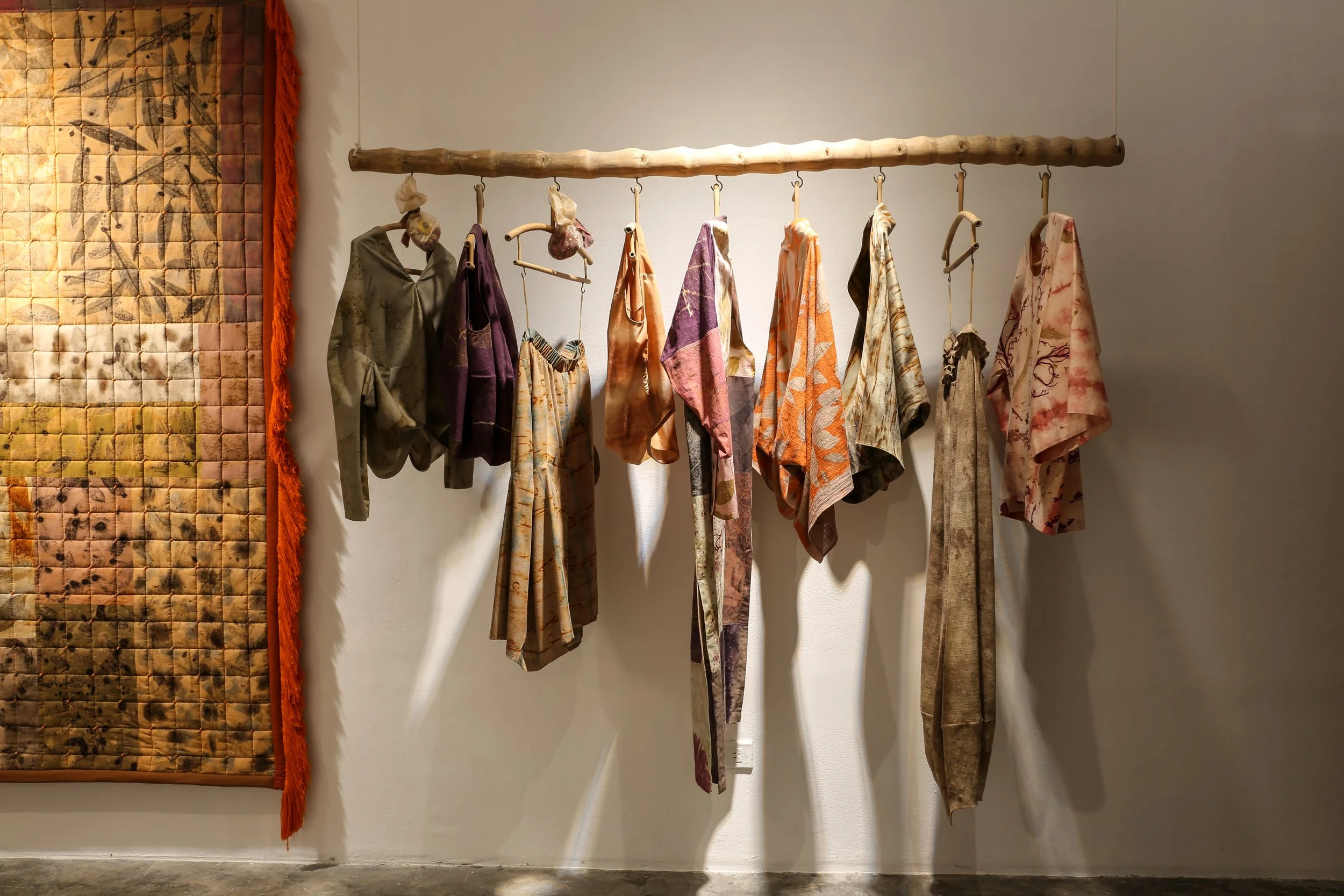
Installation view of Earthbound exhibition by Marionne Contreras, Steffi Cua, Geraldine Javier at Mo_Space, which ran from 15 February to 16 March 2025.
Earthbound launched as a fashion and art exhibition at MO_Space in 2025. It still exists today, taking a new form for each public it serves: a retail pop-up at ArteFino, an installation at WHYNoT, an exhibition at Fondazione Sozzani.

Idyllic Summers and Earthbound at Fondazione Sozzani in September 2026. Image courtesy of Steffi Cua.

Outside Fondazione Sozzani. Photo by designer Christian Edward Dalogaog. Image courtesy of Steffi Cua.
When our Earthbound eco-printed jerseys sold out rapidly this year, standard retail logic would dictate buying more yardage and finding a subcontractor to double the run. Buying fabric and hiring sewers for T-shirts is easy. But each piece is botanically printed by hand, one by one, by two artists, and that works on a human scale that industrial speed simply cannot force.

Textile as Skin on Bones, an installation for Skin: A Sensory Perception, an exhibition at WHYNoT, a creative workspace, reading room, and transdisciplinary arts hub, which ran from 27 June to 6 July 2026. Image courtesy of Steffi Cua.

The modular Grid Room, in the workshop, modelled after Daniel Buren’s Cabane éclatée No. 6. Image courtesy of Steffi Cua.
So we move deliberately. In some ways, choices like this have held back our growth. The numbers told us to make more, and we did, but only as much as two artists can print by hand. Even so, this year alone, we grew by 30 per cent. If we have the privilege of time, why not take it?
“If we have the privilege of time, why not take it?”

S/S 27 12-circle dress ecoprinted by Geraldine Javier for Earthbound, in handloomed pineapple silk. Image courtesy of Steffi Cua.
The Room
My mother and I conceived and built the Grid Room together, after Daniel Buren’s Cabane éclatée No. 6. Decades after she taught me to look at material, we were measuring timber side by side. The frame travels between trade shows and stays the same; the fabric inside it changes with each collection, holding weaves, photographs, or whatever the work needs. Today, each square frames Geraldine and Marionne’s eco-prints.
Only now, five years in, do I feel the need for a studio or a showroom of our own. Not because demand requires it, but because a space will let us shape a physical world for our ideas.
Geraldine once told Marionne to trust her instincts. It sounds simple, but we often forget it. In a market pushing for speed and data validation, following your gut is its own stand. Saying no, and sometimes simply waiting, is how you hold that ground.
Refusals protect the room, and inside my room are the artists, the makers, and the practice itself.
About the writer
Steffi Cua is the founder and creative director of Idyllic Summers, a craft-centred womenswear practice launched in Manila in 2021. Working with Philippine handloom textiles and artisan collaborators, the practice has presented twice at Fondazione Sozzani in Milan. With artists Geraldine Javier and Marionne Contreras, she co-created Earthbound, an ongoing collaborative project bridging contemporary art and garment construction. She contributes fashion criticism to the Philippine Daily Inquirer and teaches Fashion Buying & Merchandising at FAB Creatives Manila.