
Time as Material: The 45 Bayani Residency Programme, Edition 1
Carl Jan Cruz, Prior Matter, Ancán, JOS mundo, Nooke, bodyspaceobject, artbooks.ph

The Carl Jan Cruz working studio where the intimate roundtable discussion was conducted by the 45 Bayani residents.
Carl Jan Cruz, the Filipino fashion designer behind the eponymous label at 45 Bayani Road in Taguig City, launched the 45 Bayani Residency Programme in March 2026, a gathering of local independent practices with a shared investment in craft, process, and the Filipino contemporary. The first edition, themed Time as Material, has brought together six resident brands: Ancán, bodyspaceobject, JOS mundo, Prior Matter, Nooke and artbooks.ph.
Time is intrinsic to their process. Some, like Ancán and JOS mundo, measure time in production cycles. Ancán works with natural materials and local artisans, where a single product can take more than a year to develop. JOS mundo produces in small batches with Filipino artisans in Marikina, the footwear capital of the Philippines, each piece shaped by both current thinking and long-held craft traditions. Others work with time that has already passed: Prior Matter selects vintage garments for what they reveal about how people dressed and thought in a given period, while artbooks.ph keeps a running archive of printed matter produced by Philippine local and diasporic communities. Nooke and bodyspaceobject sit somewhere in between. Nooke works primarily in wood where the grain and patina make time visible in every piece. bodyspaceobject moves across modes and materials to examine the relationship among body, space and object.
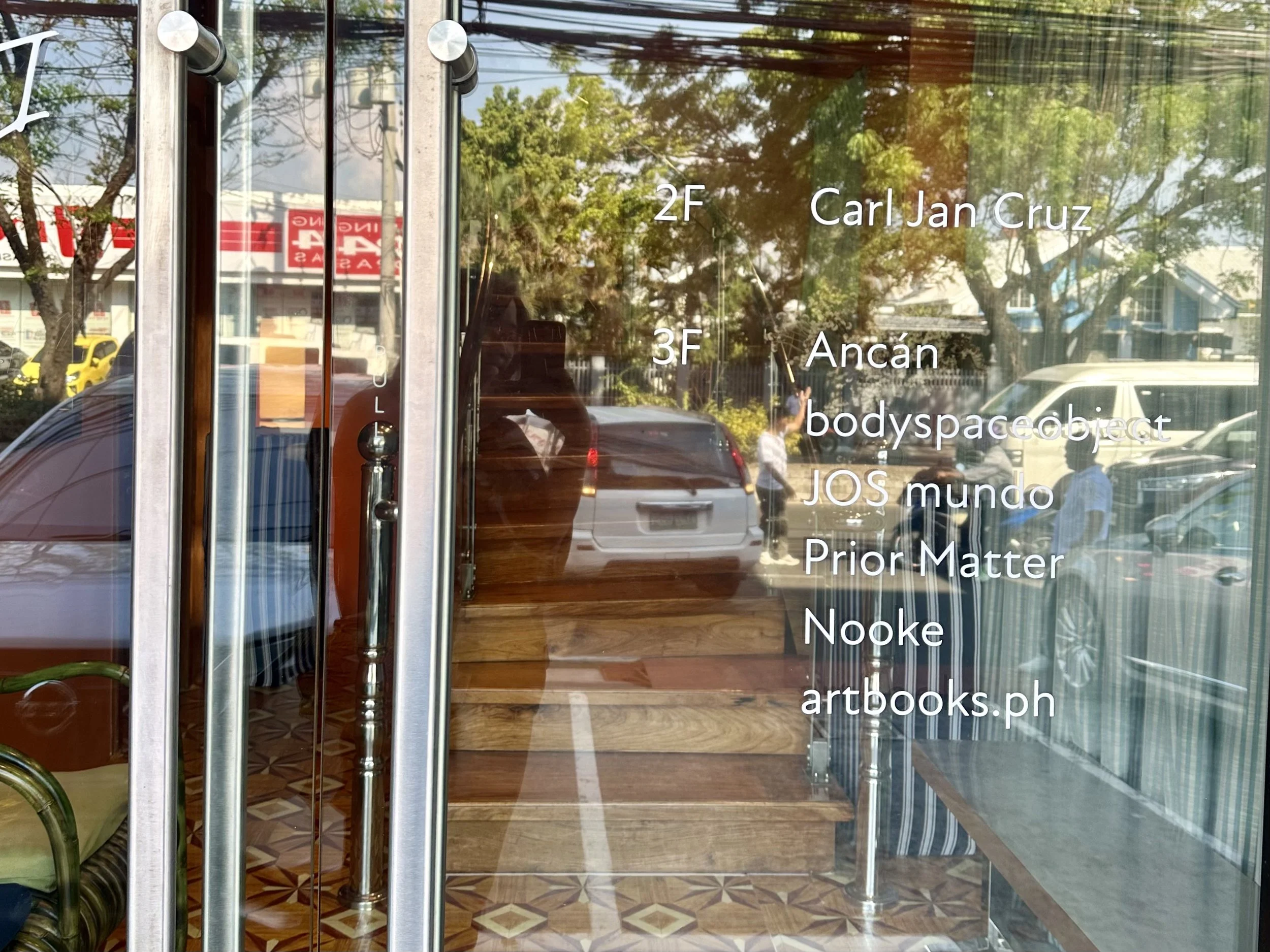
Entrance to the 45 Bayani Residency in Taguig.
On 17 April, the residents convened for a roundtable at the Carl Jan Cruz atelier. In the working studio, there are long cutting tables, a corkboard dense with sketches and fabric references pinned over one another and sewing machines running along one wall. I was invited to sit in. The conversation, led by Carl Jan Cruz, covered three broad areas: what time as a material means in practice, the relationship between creativity and capitalism and what success looks like when scale is not the primary measure.
The residents started the discussion by working through what time as material means for each of them. Cruz set the tone early, observing that time is an inconsistent component, and that the only thing that keeps it consistent is the maker’s own idea or intention. The conversation moved through how an object’s meaning shifts when it feels out of place in its era, or when it ages in ways that were not anticipated, until the group arrived at a question Cruz had posed to himself: once you identify something as a product of time, does it then begin to define time in return? Bea Cruz of Ancán brought it back to her own process, saying, “I often have to wait it out a while until an idea or a direction comes, and for it to settle until it feels right. I cannot really force that.”
The conversation turned to creating against the background of capitalism. Most of them hold the belief that creativity and capitalism are inseparable. The more honest question, the group agreed, is what is possible within that condition. Redistribution came up as a concrete approach: using capital, when it arrives, to give other people time and room rather than to simply grow and keep scaling. The question of pricing was also raised as one of the places where this plays out most directly. Lk Rigor, the Operations Lead at artbooks.ph, shared that the decision around increasing prices is also a decision about who the work is for. At a specialty shop dealing in niche, often limited-run printed matter, the pricing of a book makes a difference.
In terms of support, artist Jao San Pedro of bodyspaceobject pushed the frame further. She drew a distinction between strategies that involve institutional support, large organisations, and capital at scale, as well as the tactics and smaller decisions made by individuals, project to project, day to day. The freedom, she argued, is in knowing that they are not locked into one or the other. “We are not playing just one game board of capitalists,” she said. “We have the freedom to create a section within that board, or to create our own board entirely, and go back and forth between different games.” The solutions to the problem, she added, are not just within the board. They are also within oneself, and in knowing when each is serving one’s purposes.

Nooke X Carl Jan Cruz collaboration. A loveseat reminiscent of the designer’s childhood sofa in Bicol with the signature pique in Bruce. Image taken from the 45 Bayani’s Instagram.

Prior Matter pieces on display at the 45 Bayani Residency. Image taken from the 45 Bayani’s Instagram.
The final thread of the discussion turned to success. Carl Jan Cruz was frank about what it looks like at the moment. He sat down with his team to put a number to their growth, to know what it takes to keep their way of working going in the next five to ten years. He emphasised that those numbers are a living wage to keep the creativity running and to fall back on. It was not an obsession with growing bigger and bigger. Better, he said, does not necessarily mean more.
When asked about their experience in the programme so far, some of the residents shared how it carried value beyond the shared theme. Bea describes the invitation as a reframing: in a market that rewards speed, being positioned within a programme explicitly about slowness and process shifted the perspective on her own model. “When everyone seems to be moving much faster,” Bea notes, “reminding myself that that is an edge and not a liability is so important, especially for me, to be able to continue.”
Further, Carlos Erquiaga, co-founder of Prior Matter, emphasises how the residency has given his online-only store its first sustained engagement with a local audience. That contact changed how he thought about his work, steering him towards lighter fabrics and more straightforward silhouettes suited to the climate and to how people here actually dress. He shares, “It has enabled us to contribute to the growing local interest in vintage, particularly among younger audiences, while positioning our work more clearly by carving out a space for vintage that is informed by irreverent and thoughtful design.” It helped them find a context where the pace and intention of their work made sense alongside others.

artbooks.ph selection at the 45 Bayani Residency. Image taken from the 45 Bayani’s Instagram.
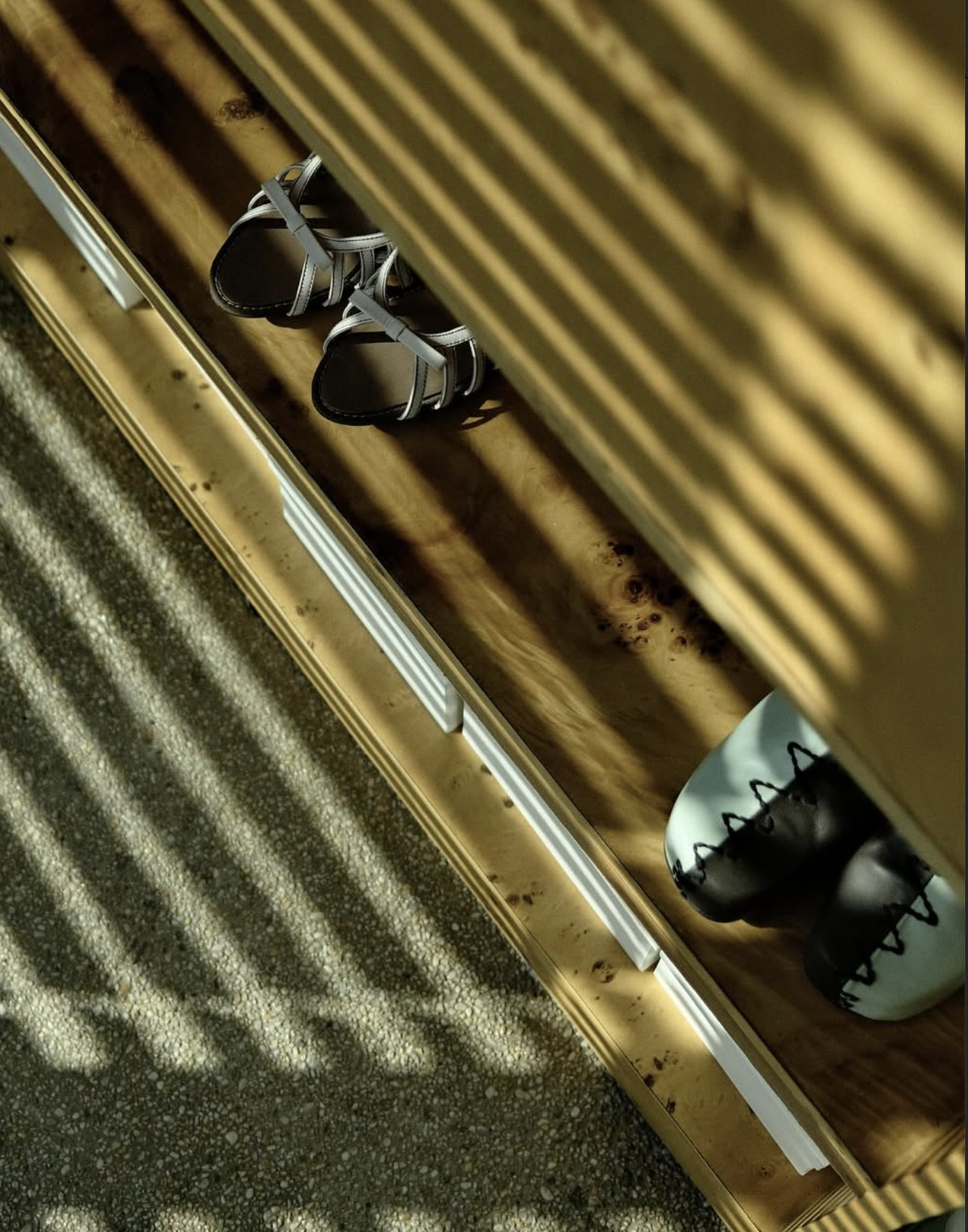
JOS mundo pieces on display. Image taken from the 45 Bayani’s Instagram.
For Nooke and JOS mundo, the residency opened up a sense of shared purpose. Ada Laud, co-founder of Nooke, noted that the residency reduced the sense of working in isolation. She says, “It has allowed us to feel less siloed about our work, fostering a shared vision for championing creativity and building a sense of community through conversation.” For Karen Bolilia, along with Sabine Monfort, Serena San Jose, Trinity Yeung, and Tasha Soriano of JOS mundo, the residency was an occasion to take stock. The team reflects, “Being a part of a collective that holds space for craft and curation allows us to further probe what it means for us to keep creating as JOS mundo, what else we can be moving forward. Because time goes on and so do we.”
For all seven brands, time moves differently. None of them treat it as something to be optimised. Sometimes it is a years-long production cycle, other times it is a garment that has already lived through decades. For all of them, the time it takes is not incidental to the work; it is simply how things get made.
The 45 Bayani Residency Programme, Edition 1, remains on view at 45 Bayani Road, Taguig City, Tuesday to Sunday, 9:30am to 5:30pm. Follow here for more.