
Conversation with Joni Zhu
Curator, cultural institution leader and director of CHERUBY
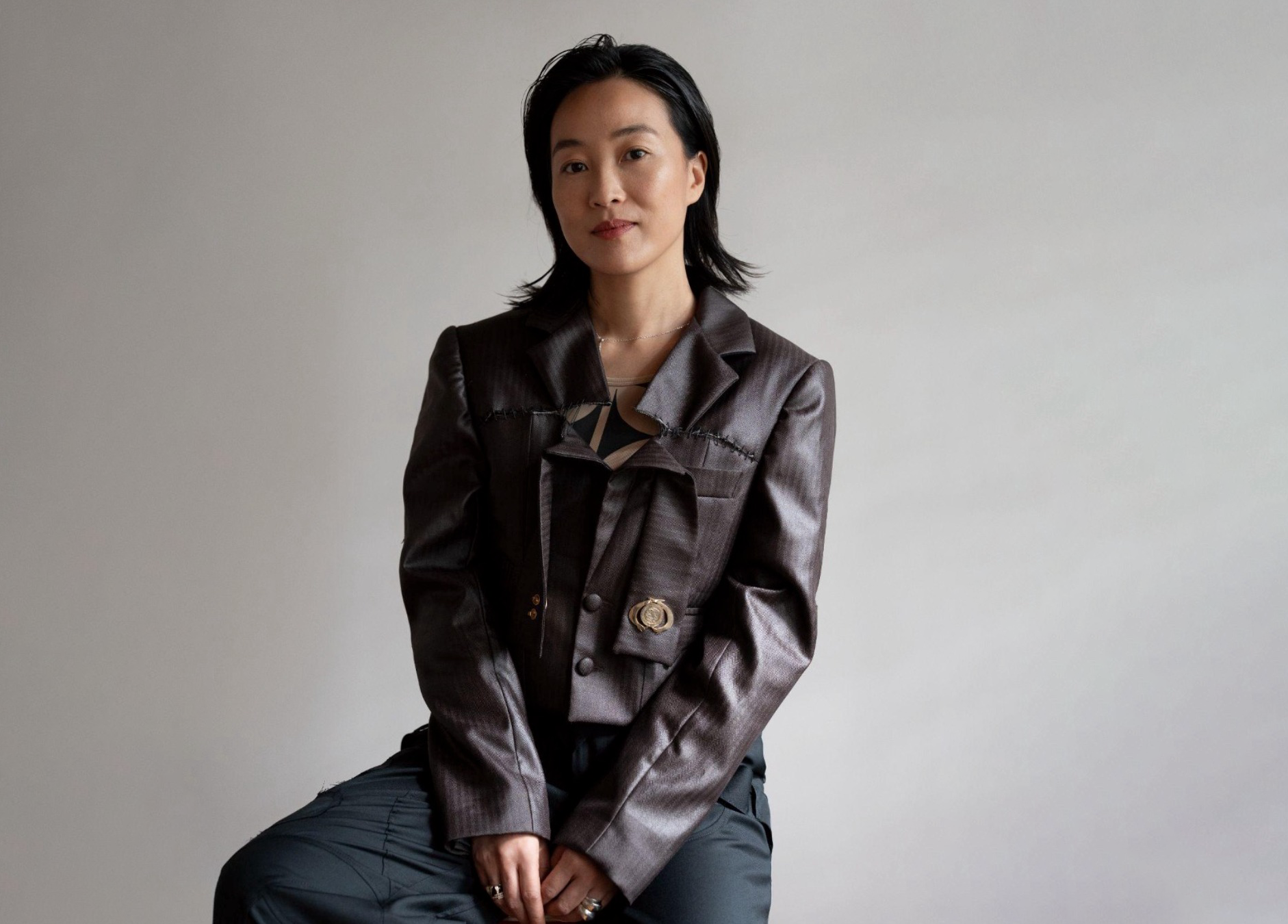
Portrait of Joni Zhu, at CHERUBY, 2025. Photo by Lanxin Zhao. Image courtesy of CHERUBY.
Joni Zhu is a curator and cultural institution leader based in Shanghai. She is currently the director of CHERUBY, which operates at the intersection of art and fashion, with programming including a residency, exhibitions and public programmes. In this conversation, she speaks about her multifaceted practice and research interests, the many hats she has worn in the cultural space, and what she is building with the team at CHERUBY to introduce fashion to a wider audience.
Hello, Joni! Could you introduce yourself, please? How would you describe your multifaceted practice and your research interests?
Hello Nadya! I am a curator and a cultural institution leader based in Shanghai. Currently, I am the director of CHERUBY that operates at the intersection of art and fashion with programming including a residency, exhibitions, public programmes. I work interdisciplinarily, that is not surrounding an object such as a garment or a sculpture, but with multiple modes of scientific inquiry, like technology and archaeology. I am interested in constituting new objects of knowledge that are in the field of Visual Cultures, where the object of study can be evacuated from disciplines and forms of knowledge territorialisation.

Exterior of CHERUBY House. Photo by Burn Li. Image courtesy of CHERUBY.

Director Joni Zhu at the opening of Coro de Soles Menores, at CHERUBY, 2025. Photo by Lucy. Image courtesy of CHERUBY.
Could you introduce us to CHERUBY as well? What makes this space one-of-a-kind?
CHERUBY is committed to transforming cultural and disciplinary hierarchies by working with practitioners in the fields of art and fashion design. The focus on the intersection of art and fashion is niche and also not. In a world where meanings circulate predominately visually, information is conveyed through images that influence style, determine consumption and mediate power relations. We are asking questions differently. We just hosted a talk by asking how Ita culture and the “pain bag” phenomena influenced her invasive sculptural practice.
There are not many residencies in Shanghai, and our programme nurtures boundary-pushing practices and fosters dialogue that embraces both local and global perspectives.
“The focus on the intersection of art and fashion is niche and also not. In a world where meanings circulate predominately visually, information is conveyed through images that influence style, determine consumption and mediate power relations. We are asking questions differently.”
You were previously Head of Programmes and Initiatives, Rockbund Museum. What made you say yes to your role at CHERUBY, to work with founder Cherry Xu?
After being abroad for 18 years, Rockbund with its idiosyncrasies and experimental programming was a perfect soft landing for me. The last project I worked on there before leaving was programming for the architectural biennial, which is interesting for thinking about the question of scale. With the rise and fall of private museums in China, it is encouraging to see that Cherry wants to work with a more sustainable scale and model. There are only a small number of artist-focused programmes in Shanghai and Cherry has a vision for one that affords a bespoke residency programme, which is rare in our region.
How does your educational and work experience inform your approach to work at CHERUBY?
I have worked in many different art spaces: a university gallery with a collection, a commercial gallery, private institutions, as well as teaching at universities. All these experiences shaped my way of working with practitioners and researchers in different contexts. There were definitely attempts to move out of a traditional model of what it means to be curatorial. I completed my PhD in Curatorial/Knowledge at Goldsmiths, where I learnt to actively seek to produce knowledge through many different practices and not just simply analyse and interpret the already “known”, as the boundaries between theory and practice erode.

Installation views, Bárbara Sánchez-Kane, Coro de Soles Menores, 2025, CHERUBY, Shanghai. Commissioned by CHERUBY. Photo by Ling. Image courtesy of CHERUBY.
How do you work with Cherry, and the rest of the team, to make CHERUBY work
The core team has four members and everyone is very involved in the programming. Our local associate this year was selected by our communications and community coordinator Tone Wong. Anqi Zhang looks after all the residents and the production of the exhibitions. Cherry has the vision, and the commitment to build things closely and materially. She is trained in both fine art and fashion and has invited Barbara Sanchez-Kane, Tanat Teeradakorn, Precious Okoyamon to our residency. And I direct executively and programmatically.

Bruno Zhu, License to Live, 2024. Installation view, Chisenhale Gallery, London, 2024. Commissioned and produced by Chisenhale Gallery, London. Photo: Andy Keate. Image courtesy of CHERUBY.

Open Studio of Tanat Teeradakorn, CHERUBY, 2026. Photo by Zhang Hong. Image courtesy of CHERUBY.
Could you speak about the highlight projects at CHERUBY since its launch in 2024?
Bruno Zhu’s 2024 commission at Chisenhale Gallery in London has just travelled to Gulbenkian in Lisbon. Barbara is our inaugural resident in 2026. She has neither done a residency nor been to China before, and we are so honoured for her trust.
How have these projects been received by CHERUBY audiences, and what have been your own takeaways from them as their organiser, and also against the landscape of art and fashion in Shanghai?
CHERUBY is located in an old house built in 1939, so a lot of the visitors are drawn to us through the architecture. Through our talks about the history of the road we inhabit and the upcoming exhibition with Tanat Teeradakorn, we will give more contextualisation of the history of the building itself. We are working with younger fashion designers through the retail platform that we are building at the CHERITY Shop. It will have exclusive capsules, designer collaborations and editions, which would introduce designers to our Shanghai audience.
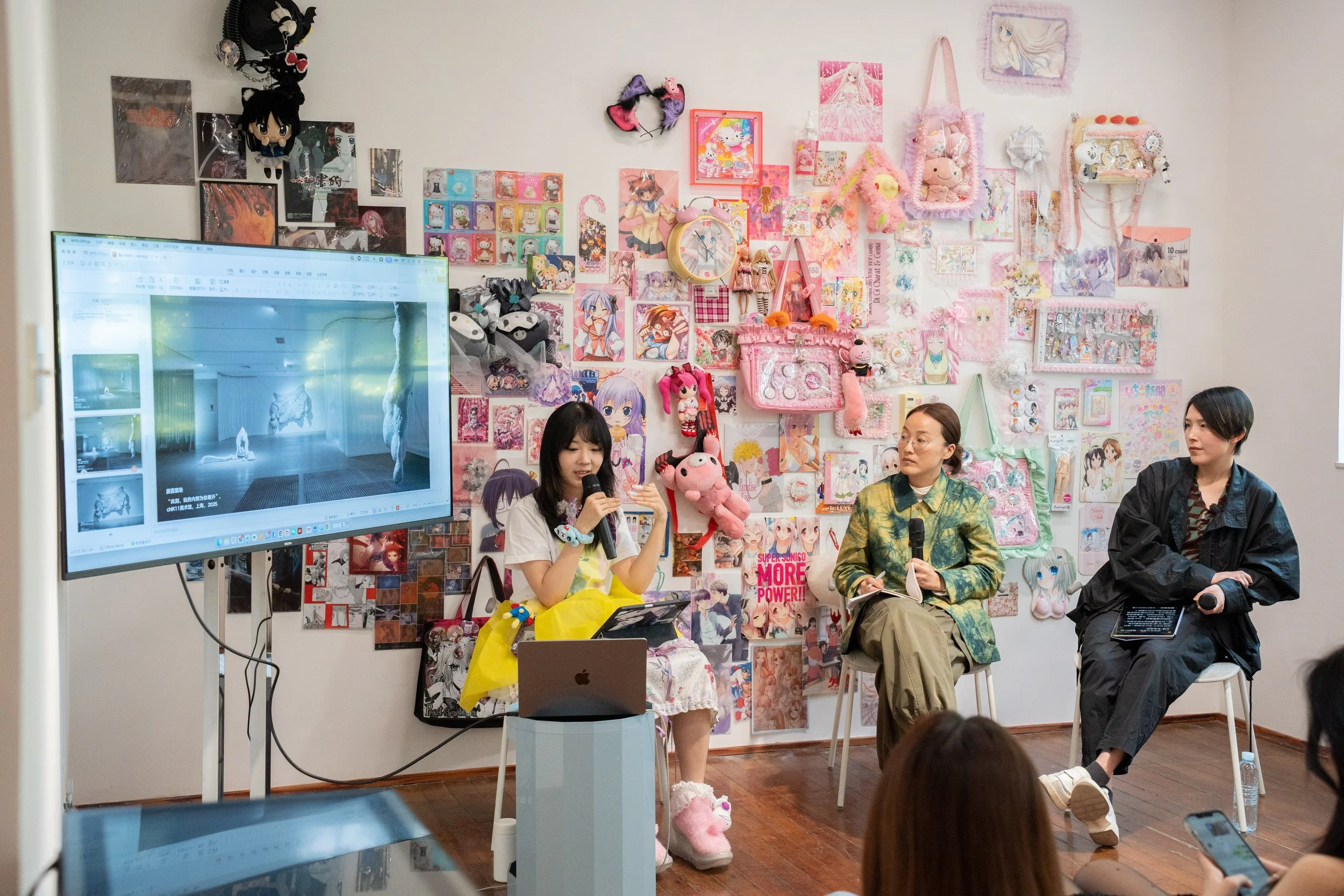
…Ita, pain, acute!, Shanliang artist talk at CHERUBY, 2026. Photo by Tianlong. Image courtesy of CHERUBY.
What projects are coming up for CHERUBY in 2026? What are you most excited about?
The launch of CHERITY Shop. All income generated from it goes back to CHERUBY’s programmes. Marie Hazard and Constança Entrudo’s joint residency in the summer where they just opened their exhibition at studio2m in New York, dissolving distinctions between artist and designer to co-create each work while questioning art and fashion’s positions in the contemporary moment. Tanat Teeradakorn’s exhibition investigating revolutionary history and “red tourism” in Shanghai, and Precious Okoyomon’s residency in the fall.
How can interested individuals apply to participate in initiatives at CHERUBY, or otherwise be considered for them i.e. getting on CHERUBY’s radar?
Hopefully soon, we will have some residency slots open for open calls. We have some international partnerships in the making with co-commissions. And please visit us in the space to have a chat!
What about for the general public? How can they find out about exhibitions to visit and programmes to attend? Who would you like to see come through CHERUBY, or who do you see CHERUBY catering to?
You can find out about our programme on www.cheruby.com, follow us on instagram @c.h.e.r.u.b.y, and CHERUBY on WeChat.
We are in the process of remodeling our facade, so hopefully more people would wander in. More neighbours, more curious minds.