
Fashion & Food: Bianca Carague
On speculative design, localised futures and Technospoonism

Portrait of Bianca Carague. Photo by Colin Dancel. Image courtesy of Bianca Carague.
Bianca Carague is a Filipino artist and social designer based in Manila. She holds a Master’s in Social Design from the Design Academy Eindhoven. Her work runs across speculative design, worldbuilding and design for wellbeing, taking cues from the rituals and ecologies of Southeast Asia.
To build a world, Bianca visualises every detail: environments, sustenance, attire and rituals. Her designs begin as inquiries, culminating in forms meant to be seen, held or worn. In Technospoonism (2026), she imagines a future reshaped by climate and technology. She lets the kamayan ritual — the Filipino tradition of eating communally by hand — mutate through a suite of silver jewellery-cutlery, paying homage to batok, the indigenous tattoo art of the Philippine Cordilleras. To complete this world, she and Chef Kevin Pundavela envision a culinary repertoire of cured and preserved foods, made to withstand austere climates.
This year alone, her work has travelled from Manila to Milan, with presentations at Art Fair Philippines, 125 Projects, the De La Salle - College of Saint Benilde, BASE Manila for Milan Design Week, and Jia Curated in Bali.
For this instalment of Fashion &..., she walks us through the making of Technospoonism, her collaborators and what she hopes to build next.
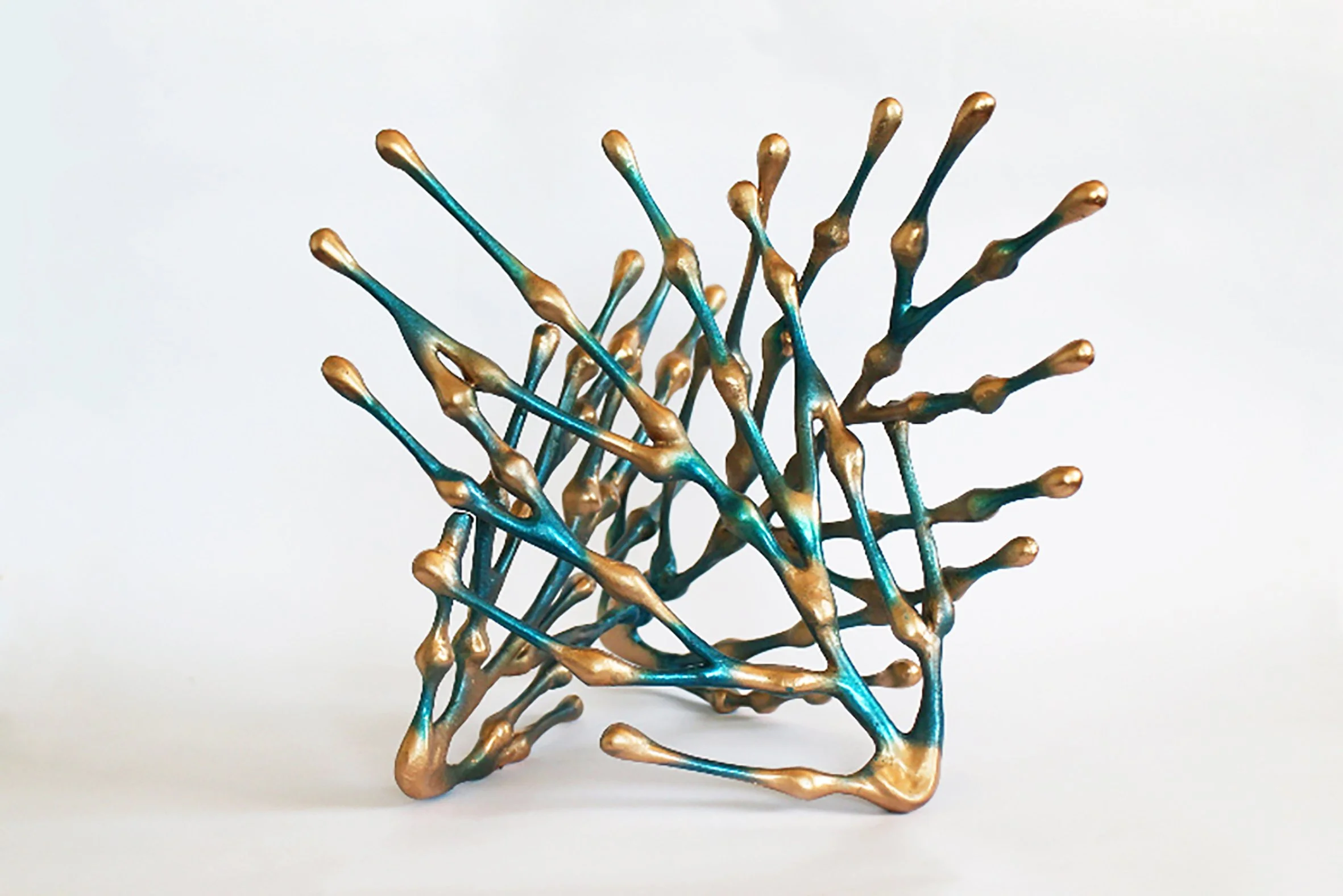
Bianca Carague, Future Artefact, Metal. Image courtesy of Bianca Carague.
Hello, Bianca! Could you please introduce yourself and your creative practice as a whole?
Hi! I am Bianca Carague. I am an artist and designer. I create objects, sculptures and digital landscapes that are part of worlds or futures that I imagine.
What drew you to imagined and future worlds as the focus of your practice?
When I studied industrial design in college, it was mainly about combining engineering and aesthetics to solve problems. However, I was also interested in conceptual design. I believe that design can be used to ask “what if?” and imagine what could be.

Bianca Carague, Somnium Treehouses, 2021. Render by Jau Timbol. Image courtesy of Bianca Carague.

Bianca Carague, Ripple Oval Dish, 2025, Porcelain, 290×223×78mm. Photo by Miles Wency. Image courtesy of Bianca Carague.
Much of your earlier work lived on-screen, from Bump Galaxy (2020) to the virtual realms you built for mental wellbeing, whereas Technospoonism and the Ripple Dishes are physical objects. What has that shift been like, and how do you decide whether an idea should be digital or physical?
I started my artistic practice during the COVID-19 pandemic and after that, a shift towards creating physical objects felt as natural as returning to museums and galleries in person. When it comes to deciding what gets made digitally or physically, my process usually starts with a big idea or a scenario. Deciding whether something gets made digitally or physically depends on which medium I believe would best help people imagine the scenario I envision. It might be a digital landscape, a sculpture, wearable artifact or even a scent.

Bianca Carague, Technospoonism, 2026. Photo by Renzo Navarro. Image courtesy of Bianca Carague.
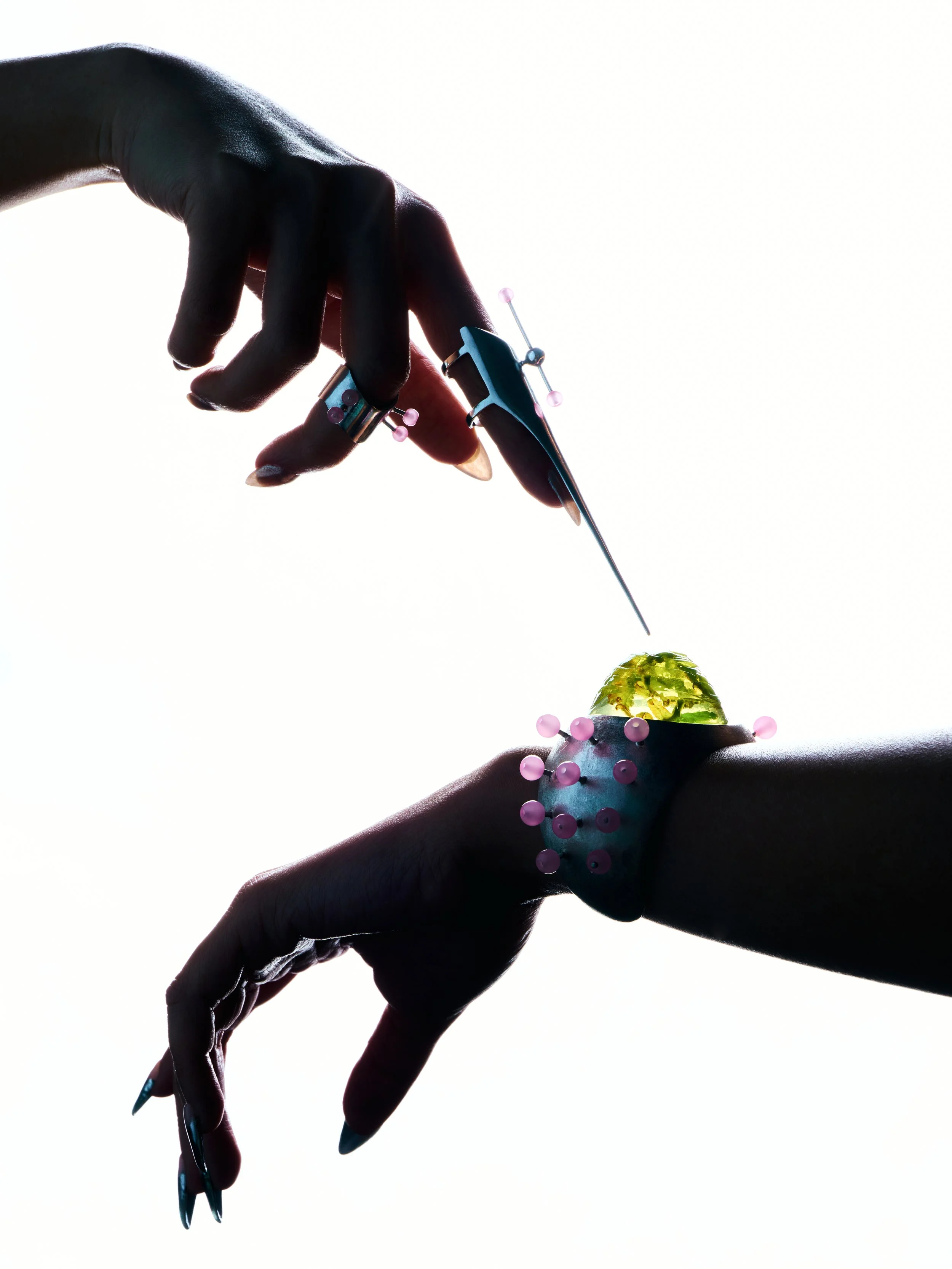
Bianca Carague, Technospoonism, 2026, 925 sterling silver and glass, varied dimensions. Photo by Renzo Navarro. Image courtesy of Bianca Carague.
Technospoonism was on show at BASE Milano’s We Will Design 2026, under the theme “Hello Darkness.” How did the idea first come together, and how did you bring it to life for the show?
Around the time I came up with the idea, I had a desire to do something with food, jewellery or set design. Maybe I was unconsciously looking for a way to bring all these interests together in one project. After a trip to the beach where I shared a boodlefight lunch with my friends, I started to have this vague idea of creating wearable eating tools. The research followed my initial intuition, and that became the basis of Technospoonism. I made small wearable clay objects and tested them as eating devices. I then digitally modelled a handful of those designs and 3D printed prototypes before producing them in silver.

Bianca Carague, “The Offering”, from Technospoonism, 2026, 925 sterling silver and glass, 85 x53x60mm. Photo by Renzo Navarro. Image courtesy of Bianca Carague.
Please walk us through your process from world to object, from conceptualisation to execution. Where does a project usually begin for you?
For me, every project begins with a blurry image in my mind, or a general feeling that I want to explore. I rarely begin with a fully formed idea. Making and prototyping, whether through digital tools or simply playing with clay, helps me give that initial instinct some form and gradually makes the idea clearer.
All of my projects begin with play and experimentation. I start with a big idea, question, or scenario, and then imagine: if this scenario were true, what would the world around it look like? What would the natural and built environments be like? What kinds of cultures, behaviours or rituals might emerge from it?
Imagining all these different pieces of a world helps me understand the project itself. I am building the world as a way of figuring out what the work wants to be. My process starts intuitively, and research gives it depth. I follow a vague instinct or feeling and use the process of making to get closer to it.
“I am building the world as a way of figuring out what the work wants to be. My process starts intuitively, and research gives it depth. I follow a vague instinct or feeling and use the process of making to get closer to it.”
I know the work is finished when that initial feeling has been resolved and when the final piece captures what I was trying to reach, even if I could not have articulated it clearly at the beginning.
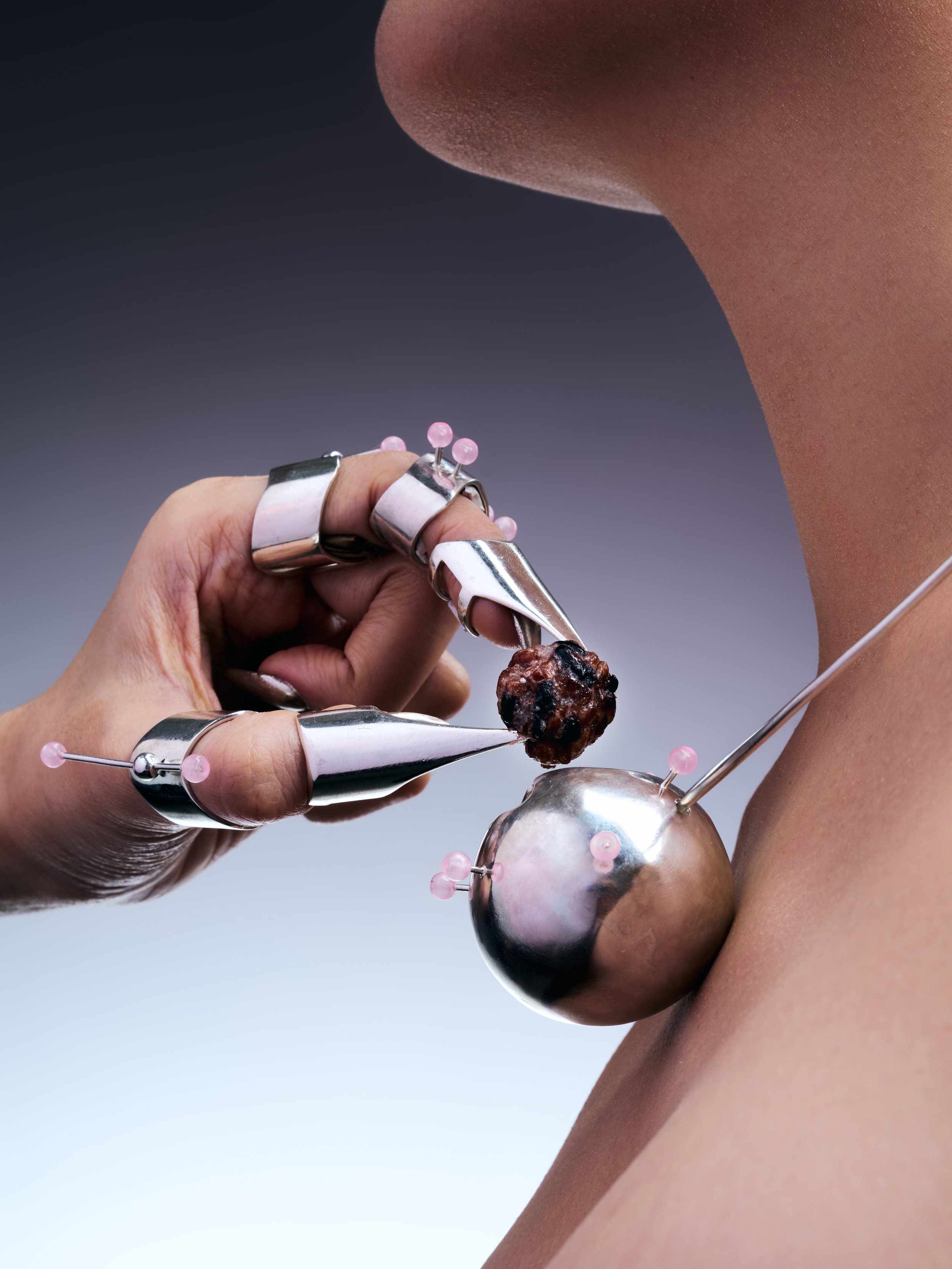
Bianca Carague, Technospoonism, 2026. Photo by Renzo Navarro. Image courtesy of Bianca Carague.
Collaboration runs through your projects, whether with chefs or visual directors. What do you look for in a collaborator, and what does working with others bring to a world you first imagined on your own?
When I collaborate, I like working with people who do not only see the future I am describing, but imagine for themselves how it could be different. I like working with people who have their own sense of how it might be brought to life, or be steered somewhere I had not considered. A project is more interesting to me when it is big enough to hold more than one perspective. My vision might be the seed, but I like that it can grow in directions I did not plan.
When imagining the food for Technospoonism, I worked with chef Kelvin Pundavela of Astro and formerly NowNow Canteen. At the beginning, I told him that we probably should not use rice, since I had imagined it as a scarce ingredient in this future. But he wanted to create a preserved rice ball using rice from the Kalinga province. That challenged my initial assumption and made me imagine a future scenario shaped by abundance and reverence rather than scarcity.

Bianca Carague, Technospoonism, 2026. Photo by Renzo Navarro. Image courtesy of Bianca Carague.
How do fashion and objects help you build a world or imagine a future?
A world is made up of many things: terrain, architecture, food, fashion, culture, technology, flora, fauna, even physics. Making objects is like bringing a world together bit by bit. An object is just a piece of a bigger story or idea. Fashion and objects become a way of giving that idea a physical language.
“Making objects is like bringing a world together bit by bit. An object is just a piece of a bigger story or idea. Fashion and objects become a way of giving that idea a physical language.”
What shifts do you notice in speculative design and futures thinking across Southeast Asia at the moment? What feels most exciting to you right now?
I am excited about a shift in the imagination of more localised or region-specific futures, rather than universal ones. It resists simply borrowing ideas of the future from elsewhere, and instead asks what the future might look like if it evolved from specific histories or contexts.

Bianca Carague, Flutter, 2026, wood veneer, varied dimensions. Collaboration with South Sea. Image courtesy of Bianca Carague.
Lastly, how do you plan for your practice to grow? You have mentioned wanting the next iteration of Technospoonism to let the cuisine lead the objects. Are there other worlds or formats you are eager to build next?
I think the growth of my practice is really about moving between different scales and forms of world-building. I started by creating interactive digital worlds. Recently, I started bringing those imagined worlds into physical life through objects.
I want to continue making connections between objects, environments and rituals, and exploring how they can inform and generate one another. I think this could allow my practice to become more expansive, rather than being confined to a particular category or medium.