
My Own Words: Alifah Malik
Tracing fashion’s credit gap from colonial batik to heritage branding
This is a winning entry from the inaugural Fresh Take 2026 writing contest. For the full list of winners and prizes, click here.
A piece of cloth is never simply cloth. Before reaching a fashion studio, it has already gathered knowledge through the hands of those who made it. Fibres are cultivated and extracted before being woven, dyed, stamped and finished. Techniques are learned through practice, adapted over time and passed between households, workshops and generations.
In Central Java, batik artisans choose motifs, control wax temperature, align stamps and build colour through repeated dyeing. Tailors study how the fabric falls, translate it into a garment and finish its details by hand. These are not merely technical tasks, yet fashion rarely describes such choices as design.
Developing a batik and tenun collection through Studio Alifah Malik brought this contradiction into my own practice. I once believed that naming and photographing makers offered meaningful recognition. Listening to artisans explain their decisions about colour, pattern, tension and construction changed my understanding. They were not simply carrying out a completed design. They were continuing to shape it. This unsettled the familiar division in which the artisan preserves while the designer invents.
“Listening to artisans explain their decisions about colour, pattern, tension and construction changed my understanding. They were not simply carrying out a completed design. They were continuing to shape it.”
But who receives credit when the garment is sold? Usually, the designer and brand are named, while the people who shaped the cloth are compressed into a single phrase: “Made in Indonesia.” I describe the distance between contributing creative knowledge and being recognised as its author as the “credit gap”. It raises two questions: where does making end and design begin, and why does one form of knowledge become authorship while another remains labour?

A batik artisan carrying out pelorodan, the process of boiling the cloth to remove the resist wax, in Semarang, Central Java, Indonesia in February 2026. Documented during the production of Studio Alifah Malik’s signature collection. Photo by Alifah Malik. Image courtesy of Studio Alifah Malik.
This distinction has deep historical roots. In the early twentieth century, imprisoned women in Semarang and Yogyakarta produced batik under Dutch colonial rule. For instance, Jessica Hemmings in her 2025 article “Made for European Trade by Prisoners in Java: Batik Production in the Women’s Prisons of Semarang and Yogyakarta in the Early Twentieth Century”, shows that some women entered prison with textile knowledge acquired before incarceration. Prison authorities incorporated their expertise into systems of production, while the finished objects travelled through European trade and later entered museum collections. The cloth travelled farther than the women who made it, carrying their knowledge into institutions that rarely acknowledged them as authors.
“The cloth travelled farther than the women who made it, carrying their knowledge into institutions that rarely acknowledged them as authors.”
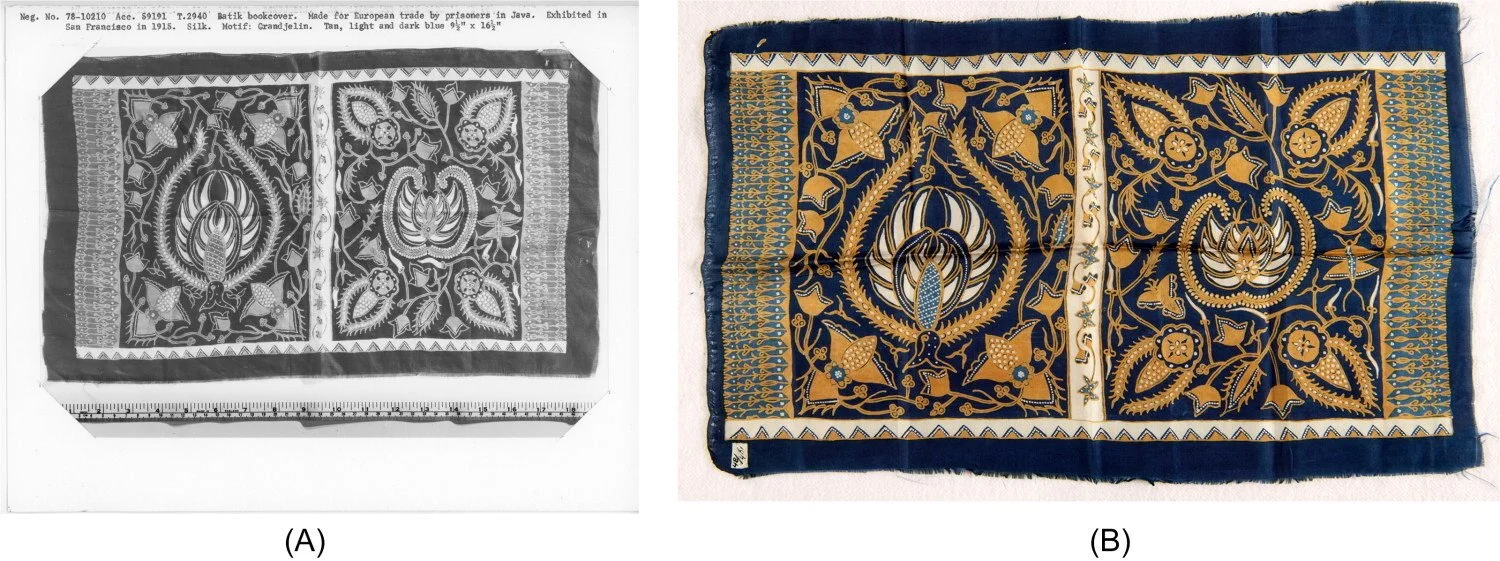
Batik book covers produced in Java for the Western market in 1914–1915. Javanese batik book cover, dated 1914–1915. Collection of the National Museum of American History. Image reproduced under a Creative Commons Zero designation (CC0). (B) Silk batik book cover. Collectie Wereldmuseum, collection no. TM-48-461. Image reproduced under a Creative Commons Attribution ShareAlike 4.0 International licence (CC BY-SA 4.0). Image discussed in Hemmings (2025).
Piña followed a similar journey through colonial history. Spanish settlers introduced pineapples to the Philippines in the sixteenth century, but local weavers adapted existing plant fibre knowledge to produce piña by the 1570s. During the eighteenth and nineteenth centuries, the labour intensive textile became associated with ilustrado wealth. Following the Philippine Revolution of 1896 and the beginning of American rule in 1898, piña was collected as an exotic souvenir while Filipino elites used it to negotiate modernity and national identity. In both markets, the textile became identifiable, but the individual weavers behind it rarely did.
These histories show that the credit gap is not new. Colonial systems shaped who controlled movement, commerce and documentation, allowing textiles to accumulate cultural and commercial value while separating makers’ knowledge from their names.
Today, the same gap can remain hidden in decisions made long before a campaign reaches the public. A batik maker may develop a motif and refine its composition. Their name might later appear on a brand’s website, but recognition does not necessarily give them a voice in setting the fee, approving how the pattern is used or deciding whether it can be reproduced. When the resulting garment is marketed as “heritage craft”, its cultural value may increase without improving what the maker receives. Credit acknowledges participation but stops short of recognising creative authority.
Furthermore, Serkan Delice, in his 2022 article “Critiques of Appropriation and Transnational Labor Ethics”, argues that appropriation must be examined through labour, capital and creative control. Makers should be able to negotiate payment, influence interpretation, retain ownership and refuse harmful uses. A fashion passport could support this shift by recording fibre origins, weaving, dyeing, motif development, construction and the designer’s point of entry.
Authorship in fashion may be conceptual, material, technical or cultural. Recognising these forms does not diminish the designer or require every maker to claim that title. It places design within a wider geography of knowledge.
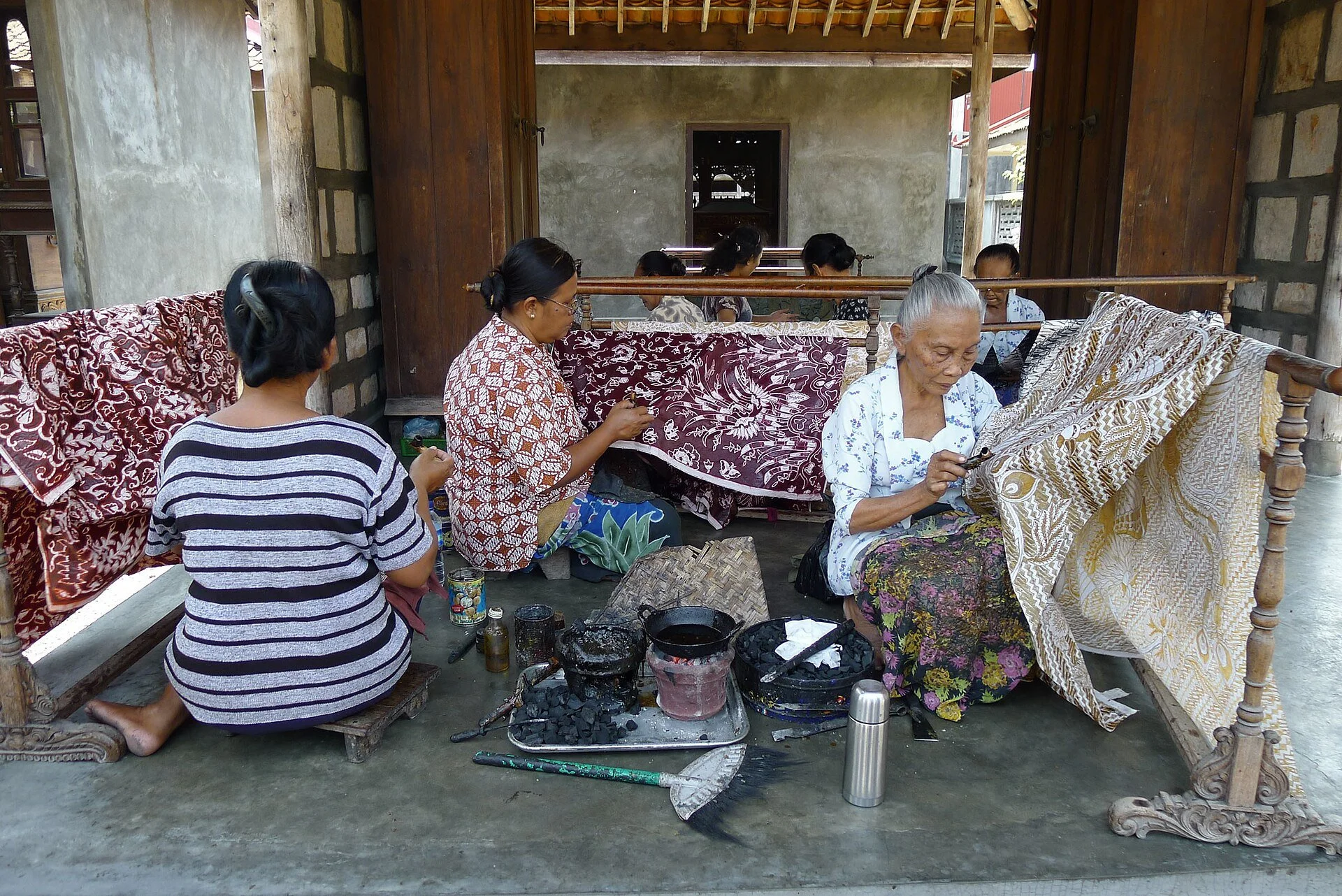
Three women making batik in Ketelan, Central Java, Indonesia, on 27th July 2011. Although the photographer is identified, the makers’ names are not recorded in the catalogue entry. Photo by Stephen Kennedy. Licensed under CC BY 2.0, via Wikimedia Commons.
This research has changed how I understand my own responsibilities. Naming and photographing makers can open a door, but shared authorship requires shared decisions and economic benefit. Perhaps the question of who made fashion asks only part of what we need to know. When fashion is shaped by many hands, places, histories and forms of intelligence, why does its story continue to centre on a single author?
Sources
Delice, Serkan. “Critiques of Appropriation and Transnational Labor Ethics”. Fashion Theory 26:4 (2022): 475–491. https://doi.org/10.1080/1362704X.2022.2046869.
Hemmings, Jessica. “Made for European Trade by Prisoners in Java: Batik Production in the Women’s Prisons of Semarang and Yogyakarta in the Early Twentieth Century”. The Journal of Modern Craft 18:2 (2025): 187–203. https://doi.org/10.1080/17496772.2025.2580828.
Roces, Mina. “Dress, Status, and Identity in the Philippines: Pineapple Fiber Cloth and Ilustrado Fashion”. Fashion Theory 17:3 (2013): 341–372. https://doi.org/10.2752/175174113X13597248661828.
Roces, Mina. “Reviving, Reinventing and Rethinking an Indigenous Luxury Textile: Piña Cloth, and Fashion in the Philippines”. Fashion Theory 28:5–6 (2024): 649–681. https://doi.org/10.1080/1362704X.2024.2380079.
About the writer
Alifah Malik is Singaporean-Indonesian, and the Founder and Creative Director of Studio Alifah Malik, a regenerative lifestyle house connecting Southeast Asian heritage, craftsmanship, Indigenous and environmental practices.
Born and raised in Jakarta, she explores Indigenous cultures, landscapes and living traditions. Through the studio, she works directly with artisans and Indigenous communities across Southeast Asian craftsmanship and textiles, approaching each object as part of a living cultural and ecological system.
Her work seeks to make the people, knowledge and environments behind production more visible while fostering responsible relationships between contemporary practice, scientific inquiry, cultural continuity, community wellbeing and the evolving future of Southeast Asian craft.