
After Escapism: Vietnamese Graduate Fashion Is Coming Home
The shift toward material localism in The Next Edition at Rue Miche
This is a winning entry from the inaugural Fresh Take 2026 writing contest. For the full list of winners and prizes, click here.
Domestic rituals, reimagined in new forms
At Rue Miche in Ho Chi Minh City, The Next Edition presented eight graduation collections by Van Lang University’s Fashion Design Class K28 not simply as final assessments, but as propositions about the future of Vietnamese fashion. The projects drew on a family woodworking practice in Huế, childhood memories of watching cải lương with a grandmother, the seasonal movement of buffalo herds, and the visual disorder of Saigon streets.
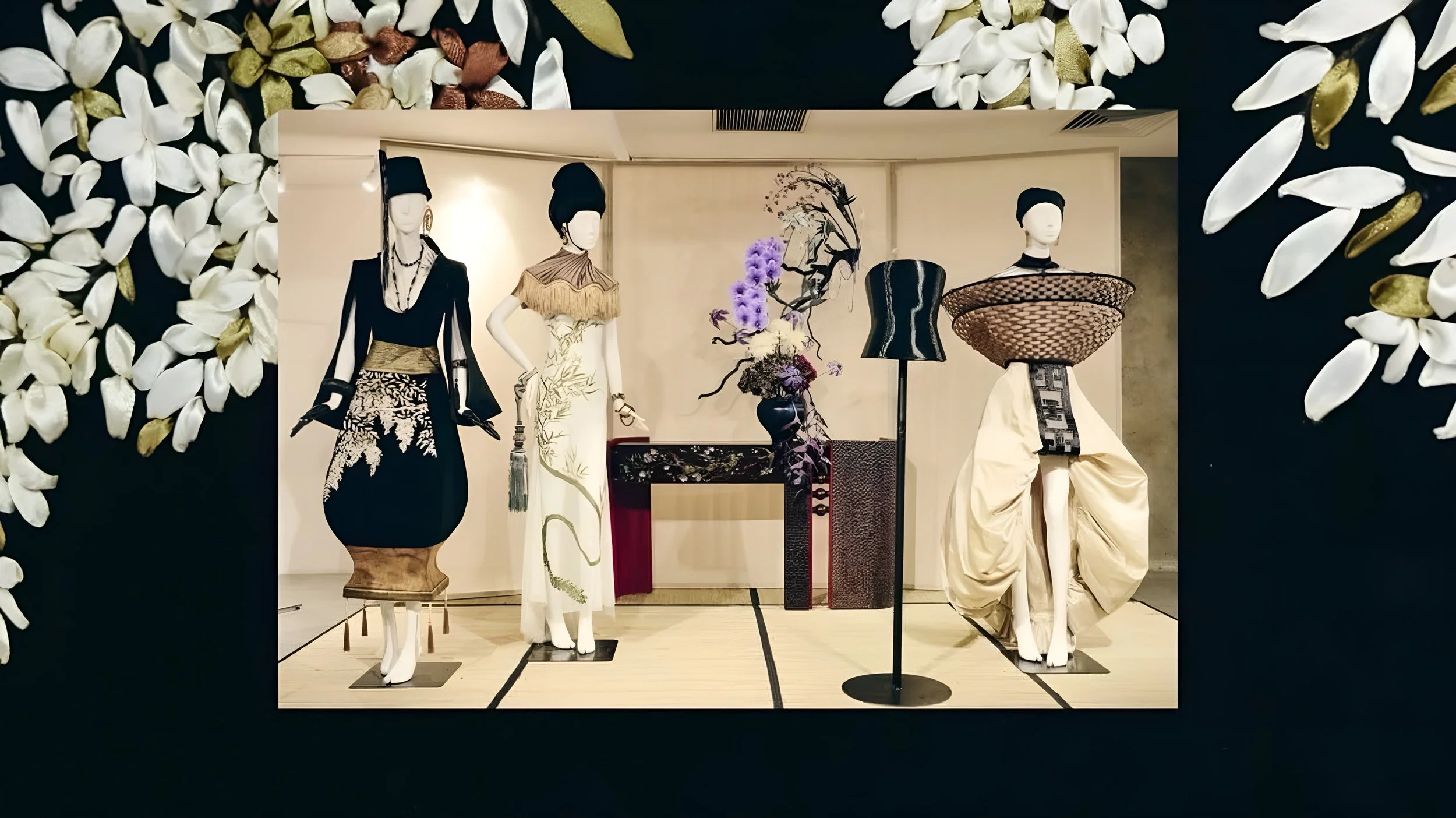
Nguyễn Bảo Ánh, MuYin, Graduation Project 2026 displayed at The Next Edition, Rue Miche. Image courtesy of Nguyễn Bảo Ánh.
Between roughly 2018 and 2022, many student collections looked outward. European dress history, mythology, cinema, fantasy and international subcultures supplied the main conceptual vocabulary. From 2022 onward, nearby environments began to carry greater authority. Family trades, urban infrastructure, agricultural life, vernacular performance and local materials were no longer treated as too ordinary to sustain ambitious fashion. The shift is not simply from “foreign” to “Vietnamese” imagery. It is a deeper change in how students understand research, materials and authorship.
2018–2022: The Runway as Elsewhere
Graduation fashion in the late 2010s often used the runway as a form of narrative escape. Designers entered another century, country or fictional universe, then translated that world into silhouette, colour and surface.
The 2018 and 2019 editions of Fashion Creation – Hoa Sen University’s annual graduation fashion show, illustrated this tendency. Collections referred to 1930s Western gangsters, an imagined Victorian dress, Japanese yōkai, Egyptian goddesses, Aphrodite, Marie Antoinette and Slavic mythology. Fashion Creation 2020 continued this outward-facing approach. Among its nine graduation collections, The Gilded Cage by Phạm Hồng Ngọc and Perfect Conflict by Nguyễn Ngọc Đan Thanh, engaged with 18th- and 19th-century European royal dress, while other projects drew on Chinese opera and Tim Walker’s photography. Corsetry, petticoats, organza, taffeta and elaborate support structures helped transform those references into dramatic runway forms.


Thùy Linh, Fascination, Graduation Project 2019. Photo by Hoa Sen University.
These projects should not be reduced to imitation. They allowed students to demonstrate technical ambition, theatrical construction and fluency in internationally recognised fashion codes. This outward orientation also reflected an educational system connected to global references and institutions. For emerging designers, historical and international vocabularies offered a clear way to prove that they could participate in contemporary fashion culture.
Yet the relationship between concept and garment was often illustrative. A mythological figure, historical period or artistic movement came first; fabric and technique were then selected to make that story visible. Taffeta produced courtly volume, organza suggested transparency, embroidery reproduced motifs, and synthetic fur created an imagined landscape. The dominant question was: how can clothing make an external narrative spectacular?
Vietnamese references, of course, did appear before 2022, including collections inspired by Hàng Trống folk painting – a Hanoi tradition combining woodblock printing with hand-applied colour, as well as the Mekong Delta and the Perfume River. The distinction, therefore, is not that local culture was absent and then suddenly discovered. Rather, it often appeared as a symbol or decorative language placed onto established fashion forms. The more recent shift lies in depth: designers increasingly begin with how a place functions, how a material behaves, who performs a form of labour, and how that knowledge might alter construction.
“The more recent shift lies in depth: designers increasingly begin with how a place functions, how a material behaves, who performs a form of labour, and how that knowledge might alter construction.”
2022–2026: Home as Subject, Material and Method
The year 2022 is best understood as a hinge rather than a clean break. Fashion Creation 2022 still included fantasy fiction and everyday life. In the following years, however, several tendencies became clearer: more fieldwork in nearby environments, greater attention to material experimentation, engagement with social subjects, and closer links between graduation projects, markets and future brand development.
This emerging approach can be described as material localism. It does not aim to produce one recognisable national style. Instead, nearby materials, memories, labour systems and environments shape both the meaning and construction of garments.
Phạm Trọng Hiếu’s Sài Gòn Shock, which won Fashion Creation 2025, demonstrates the difference. The collection did not romanticise Saigon through landmarks or nostalgia. It studied tangled electrical cables, damaged signs, warning colours and layers of pasted flyers, translating urban disorder into strong structures and accumulated surfaces. The city became not a backdrop but a critical system through which the clothes were designed.

Phạm Trọng Hiếu, Sài Gòn Shock, Graduation Project 2025. Photo by Harper’s Bazaar.
Other recent collections locate “home” in intimate relationships. Trương Kim Thùy’s Mộc xứ Huế (Woodcraft of Hue) begins with the woodworking profession practised by the designer’s family. Huỳnh Lý Thiên Nhi’s Cải Lương (Vietnamese Reformed Opera) develops from memories of watching televised performances with her grandmother, combining cải lương with pastel colour and Y2K styling. In both cases, heritage is encountered through family labour, media, memory and generational experience.


Huỳnh Lý Thiên Nhi, Cải Lương (Vietnamese Reformed Opera), Development Board of Graduation Project 2026. Image courtesy of Huỳnh Lý Thiên Nhi.
The strongest distinction appears when the subject changes the garment’s material logic. In Huỳnh Hải Dương’s Mùa Len Trâu (Buffalo Migration Season), buffalo migration through the Mekong Delta informs attention to bodies, boats, weight and rhythm, while buffalo leather becomes a principal material rather than a printed image. Nhân Thị Lan’s Lụa Họa (Painting Silk) combines Vạn Phúc silk, embroidery and heat-forming with CLO 3D. Nguyễn Duy Long’s Vàng Son Đất Mộc (Gilded Earth) uses bamboo-and-rattan weaving with banana fibre, allowing stiffness and handwoven structure to generate the form.


Huỳnh Hải Dương, Mùa Len Trâu (Buffalo Migration Season), Graduation Project 2026. Image courtesy of Huỳnh Hải Dương.
This marks a movement from cultural decoration to design methodology. At one level, a designer borrows a recognisable motif. Digging deeper, they analyse a process such as carving, herding, performing or repairing. Ultimately, knowledge from that process redefines the seams, volume, movement or surface. Culture no longer functions only as a passive image catalog. It becomes a way of interpreting material, labour, time and silhouette.
Why Has the Shift Occurred?
No single cause explains the change – it results from several pressures converging. First, international competence is no longer sufficiently, from itself, distinctive. Earlier cohorts had to show that Vietnamese students could work confidently with global fashion history, avant-garde imagery and professional runway standards. Today, those references are widely accessible through education and digital platforms. A collection based on Marie Antoinette or a famous fashion photograph may still be accomplished, but its visual language is easily repeated. Research grounded in local networks or specific urban problems is harder to duplicate and gives the designer a stronger claim to authorship.
Second, Vietnamese fashion now faces the problem of differentiation rather than permission. Designers no longer need to prove modernity only by reproducing the authority of Paris, London or Tokyo. The more urgent question is why an audience should remember one designer among thousands of globally connected image-makers. A practice rooted in a particular craft, material ecology, family history or urban condition can support an identity that extends beyond a single collection.
Finally, fashion education is becoming more industry-facing. Graduation projects increasingly include technical portfolios, brand identity, marketing strategy and customer direction. A recent example is The Next Edition, launched by Rue Miche in collaboration with Van Lang University. Its first edition brought eight K28 graduation collections into Rue Miche L’Édition from 20 July to 13 August, placing student work in a public retail environment rather than only within an academic setting. Here, the collections evolve beyond academic exercises to become foundations for products, collaborations and future brands. A fictional narrative may produce one memorable show; an enduring relationship with a material source or community can generate a lasting design practice.
“A fictional narrative may produce one memorable show; an enduring relationship with a material source or community can generate a lasting design practice.”

Cao Khả Duy, Mộc Dao Bích (The Jade River’s Trace), Graduation Project 2026 displayed at The Next Edition. Photo by Rue Miche.
What the Trend Reveals
The shift toward material localism shows that young Vietnamese designers are becoming more confident about where fashion knowledge can come from. Innovation no longer needs to arrive from elsewhere and then be adapted locally. A family workshop can operate as an archive. Street infrastructure can become a construction system. Agricultural movement can teach rhythm and weight.
“A family workshop can operate as an archive. Street infrastructure can become a construction system. Agricultural movement can teach rhythm and weight.”
This does not mean graduate fashion is moving toward one national silhouette or a uniform revival of craft. Nor will international references disappear. Recent projects remain theatrical, technologically hybrid and globally legible. The difference is that spectacle is increasingly generated from close research into nearby conditions rather than imported as a complete aesthetic code.


Phạm Thị Hà Giang, Nội (Paternal Grandmother), Development Board of Graduation Project 2026. Image courtesy of Phạm Thị Hà Giang.
The trend also introduces new responsibilities. “Returning home” can become another formula: choose a tradition, extract a palette and motif, then describe the result as a bridge between past and present. Designers must ask who produced the original material, whether communities were consulted or credited, whether sustainability claims are measurable, and whether a difficult social reality is being examined or merely converted into texture.
At its core, this turn inward is not nostalgic but critical. From 2018 to 2022, students often spoke the language of external narratives and international codes. From 2022 to 2026, more of them redefine it from within. Vietnamese graduate fashion is not simply coming home; it is interrogating “home” and reshaping that knowledge into design methodology.
About the writer
Hồng Ánh is an editor working across art and fashion publishing, alongside her involvement with a Creative Arts Fund supporting operational initiatives. She holds a BA degree in Fashion Enterprise and completed an academic exchange programme in Melbourne in 2024. During her studies, she developed a particular interest in fashion history and the evolution of visual language, examining how imagery, communication, and public reception shift across different socio-cultural contexts.