
On Chief Design Officer discusses comfort and performance
At the Business of Design Week (BODW) 2026 summit in Hong Kong, Thilo Brunner, Chief Design Officer at On outlined the design philosophy behind the Swiss performance brand, tracing its trajectory from a six-person startup to an international label with a team of a few thousand people. With Switzerland serving as BODW partner country this year, Brunner’s keynote and panel discussion examined how Swiss industrial precision intersects with creative risk-taking, collaborative partnerships, and evolving consumer habits.
Design as a Translation of Feeling

Thilo Brunner, Chief Design Officer, On, speaking at BODW 2026. Image courtesy of BODW 2026.
Brunner emphasised that On’s design ethos is rooted in translating physical sensation rather than adhering strictly to aesthetic minimalism. Reflecting on the brand’s genesis—when co-founder Olivier Bernhard glued a cut-up garden hose to the sole of a running shoe to soften vertical landings and create a firm push-off—Brunner defined the team’s core mandate: "The task of design is to show how innovation feels."
“The task of design is to show how innovation feels.”
As On scaled over the past 17 years, maintaining a unified design language while speaking to diverse global communities became central to Brunner’s role. Comparing this approach to Switzerland’s regional dialects, he noted that while On anchors itself in performance engineering, it adapts its visual and material vocabulary through collaborations, from New York running collectives and Sky High Farm to South Korean label Post Archive Faction (PAF) and Spanish luxury house Loewe.

On and Post Archive Faction introduce Current Form 4.0: A Journey of Metamorphosis. Image courtesy of On and Post Archive Faction.


On and Post Archive Faction introduce Current Form 4.0: A Journey of Metamorphosis. Image courtesy of On and Post Archive Faction.
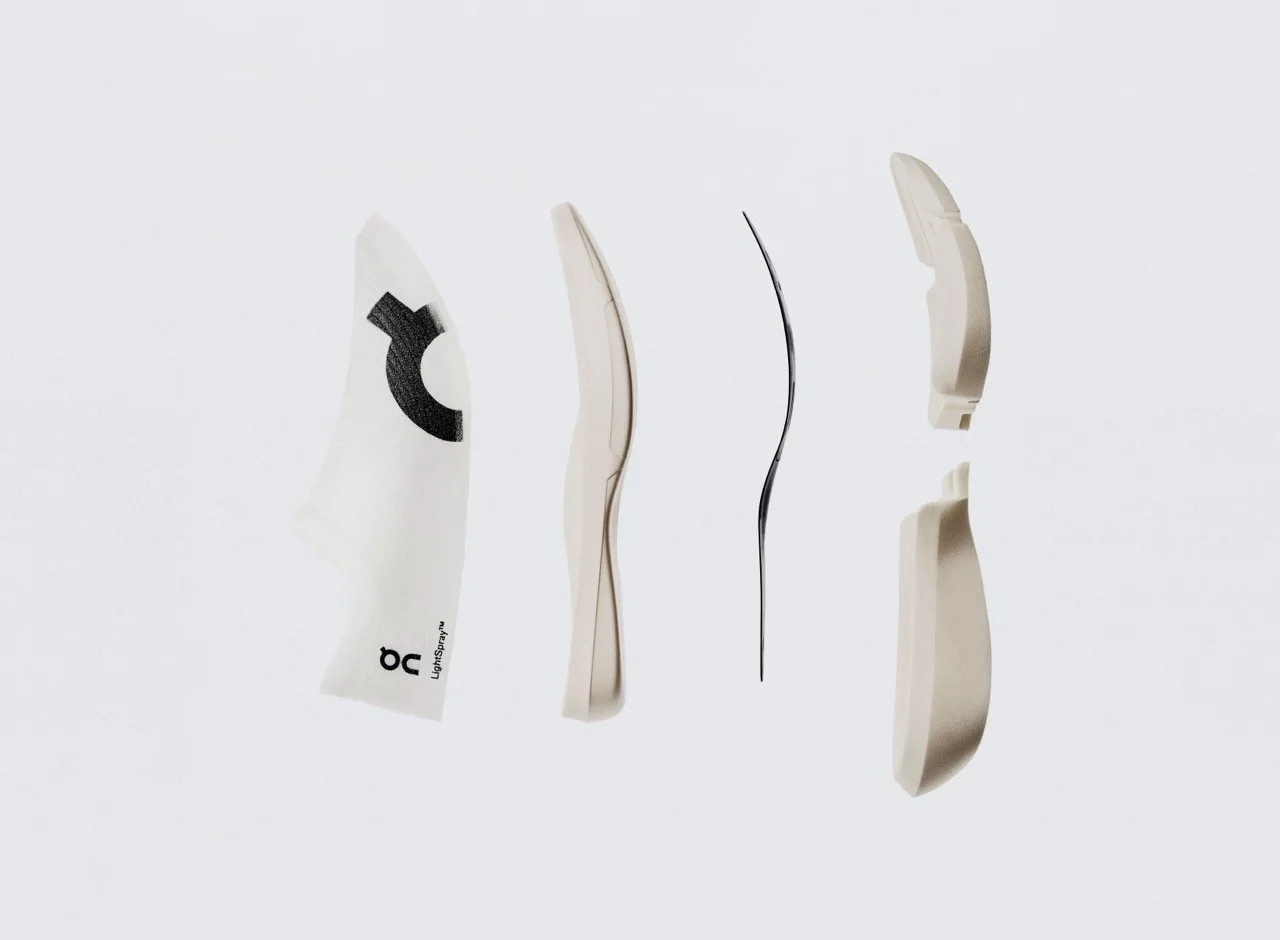
Deconstructed LightSpray Cloudboom Strike 2. Image courtesy of On.

Campaign for next generation of Cloudboom Marathon Racing Shoes, powered by New CloudTec Sphere™ Technology. Image courtesy of On.
Brunner also highlighted LightSpray™, On’s trademarked manufacturing process. Instead of assembling up to 50 cut, glued, and stitched components, a five-axis robot sprays a continuous thermoplastic filament onto a shoe in three minutes, fusing the upper directly to the outsole without adhesives. Operating out of Zurich and a new South Korean facility with 30 times the capacity, the technology has generated more patents for On than all its previous footwear combined.
Rethinking Collaboration and the Role of AI
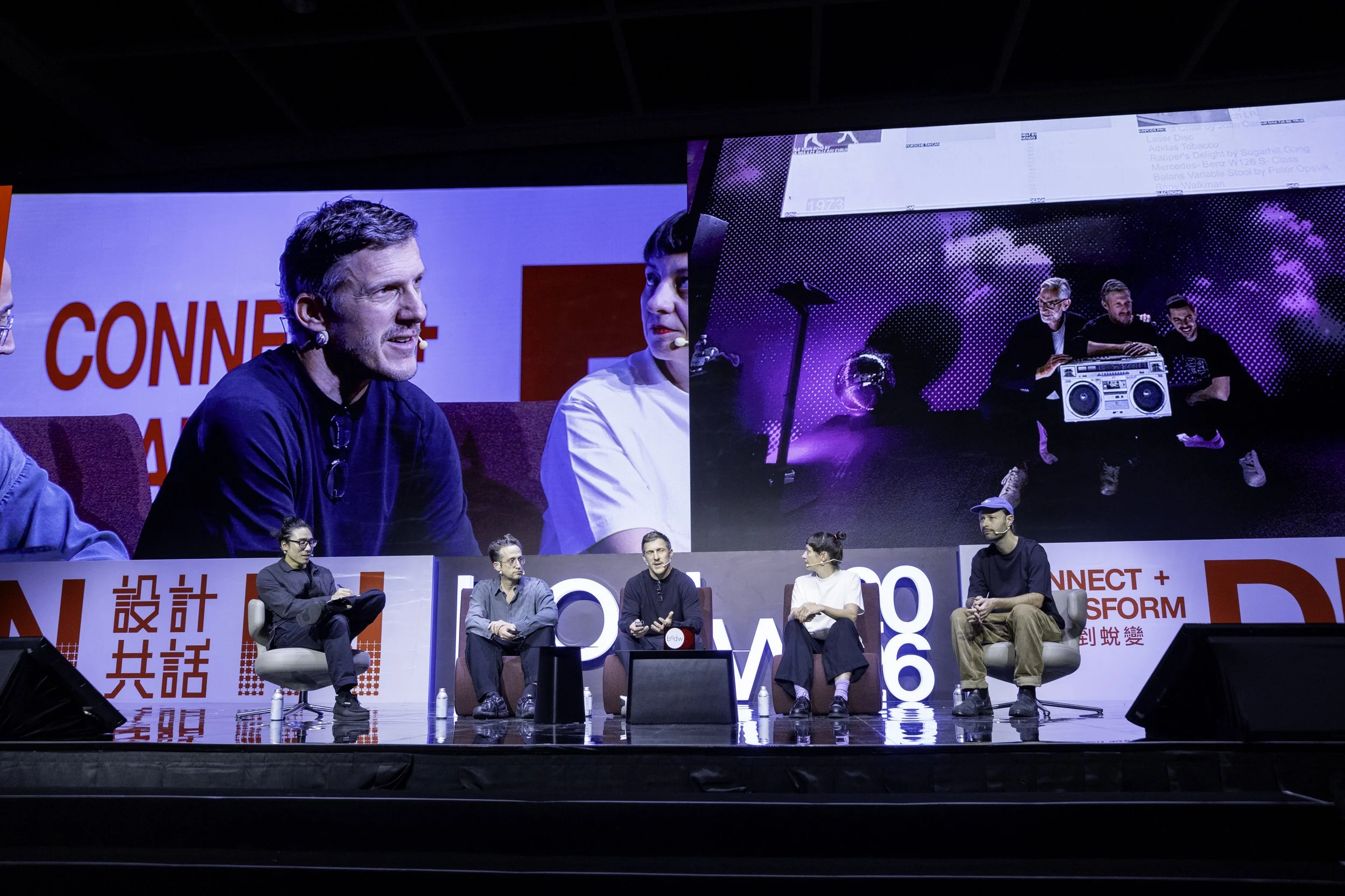
Thilo Brunner, Chief Design Officer, On, in conversation with Christian Haas and AATB at BODW 2026. Image courtesy of BODW 2026.
In a follow-up panel, Brunner joined long-term collaborators, branding specialist Christian Haas and Andrea Anner and Thibault Brevet, the founders of kinetic robotics studio AATB, to discuss how early, open-ended briefs shaped On’s visual identity, from its two-letter typography and switch-inspired logo to its in-store robotic installations.
The panelists noted that trust, interpersonal chemistry, and stepping outside comfort zones are essential when working without rigid templates. Addressing artificial intelligence in creative workflows, they agreed that while automation can absorb repetitive administrative and technical tasks–such as drafting bills of materials–human intuition, dialogue and unscripted experimentation remain irreplaceable for generating original ideas.
In Conversation with Thilo Brunner
Following the summit, we spoke with Brunner about leadership, consumer shifts and the future of technical apparel.
In your keynote, you mentioned holding various roles across your 17 years at On. What do you naturally gravitate towards—the tasks you love doing and reach for immediately—and what do you find more challenging?
Thilo Brunner: What comes easy is looking a few years out, envisioning things, and connecting and aligning people to make that dream a reality. What does not come easy is the design administration part of it—the follow-ups and being very rational about things.
It is no secret that when we really grew, I had to have a person next to me responsible for making everything work in my business life. That is just how growth goes. At some point, the administrative, alignment, and structural part is as big as the creative part, so it needs to be clear who owns what role. Every efficient business owner has to be honest and hand over what they are not good at, and I am glad I have the privilege to have someone who does what I am definitely not good at.
Is comfort a passing trend, or a permanent shift in what people find aesthetically valuable?
Let’s first answer the comfort question. I do not think this is a trend. We have seen over a long time what has happened to so-called formal wear: people still appreciate it in the moments they want to wear it, but most appreciate not having to wear it all the time anymore.
The marriage in the last few years between fashion brands and sports brands happened because of comfort and performance—people want to move freely in their everyday lives. They want to wear the same clothes for sports, and for a normal day when they do not have representative obligations. So comfort is definitely here to stay.
About the aesthetics: fundamentally, it took us a few years to establish shoes with mechanical cushioning, as we call it. It is an architectural outsole that did not really exist before On did it. I think this is here to stay. As a bigger brand now, we have to mitigate the risk of trends and build broadly enough so that if an aesthetic trend goes up or down, we are safe. From what I see on the streets with the wide dispersion we have managed with our shoes, alongside a lot of copies—and let’s take those as a compliment—people have gotten used to it.
“The marriage in the last few years between fashion brands and sports brands happened because of comfort and performance—people want to move freely in their everyday lives.”

Thilo Brunner, Chief Design Officer, On, speaking at BODW 2026. Image courtesy of BODW 2026.
Do you find On’s reception fairly homogenised across global markets, or are there stark differences in how consumers in Southeast Asia and Europe engage with the brand?
There are differences, because On is not at the same stage in every market. And in Switzerland and other European countries, we were born as a footwear brand. When we went to the US, we started with a big footwear selection and a smaller apparel one. By the time we came to Asia, we were already a sportswear brand, split fairly evenly between shoes and apparel.
Bestsellers and popular colours vary by market, and my biggest joy in major cities is seeing how people style On across apparel and footwear. When we were younger, shoes were always the entry point. Now, more people enter the brand through apparel first and discover the shoes later. Those different perspectives are invaluable to our design team.
Given that On is premised on technical design, is there an assumption about technical design that you think the industry could re-evaluate?
That is a big question. In apparel, there is still a way to go, because the technicality of a garment is not necessarily so visible.
Materials are evolving, and I wonder if we will wear more organic materials in the future, specifically organics that are technically developed. At the moment, in terms of comfort and textiles, I see huge potential in material development.
Business of Design Week (BODW) 2026 took place from 18 to 20 November 2026 at the Hong Kong Convention and Exhibition Centre. Learn more at 2026.bodw.com.
The author was invited on a press trip to attend BODW 2026.