
MATTER Prints
How a Singaporean label built community through craft and social media activism
This is an entry from the inaugural Fresh Take 2026 writing contest. For the full list of winners and prizes, click here.
A Sustainable Beginning
It began with a simple, singular concept – pants to see the world in. Set against the backdrop of the 2010s, MATTER Prints was launched by co-founders Ho Ren Yung and Yvonne De Suñer Beltran at the start of 2014. The brand’s debut collection: Freedom, offered five basic styles of pants: among them the Reworked Harem, the Classic Wide Leg, and Sideswept Dhoti. By the end of its run, its range had expanded to include jumpsuits, tops, shorts, dresses, blazers and kimono jackets, scarves, menswear, childrenswear, jewellery and leather bags.
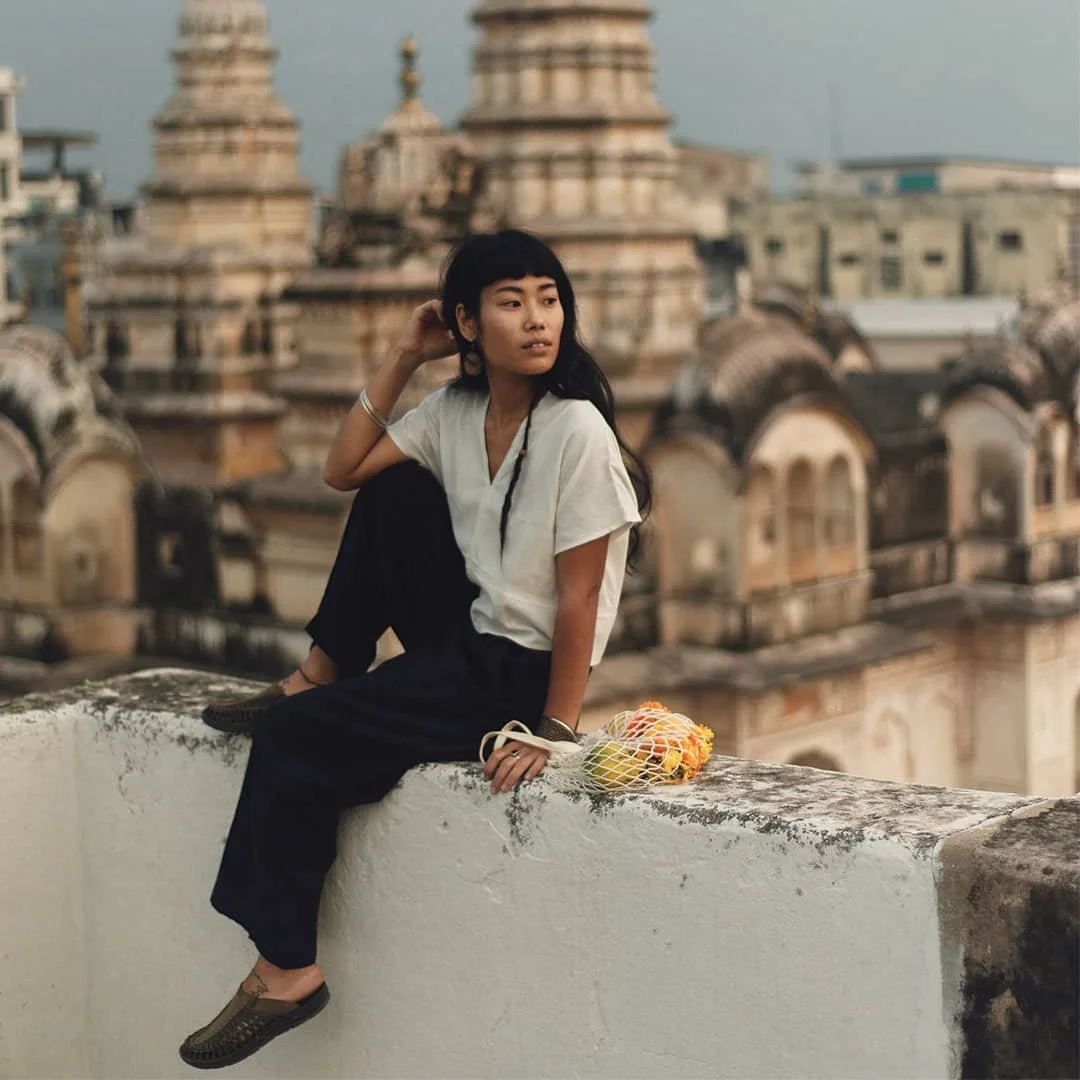
#pantstoseetheworldin. Image taken from @matterprints on Instagram.
Fittingly, it was a 3000km charity fundraising roadtrip adventure across the Indian subcontinent on a tuk-tuk undertaken by co-founder Ho and her husband that catalysed the brand’s fruition, with Ho describing the discovery of production partners in the artisan communities of Rajasthan, India as ‘‘a series of serendipitous introductions as well as knocking on several doors.”¹ From the start, MATTER’s positioning as a fashion brand was rooted in a romantic idealism of discovering purpose and impacting meaningful change, forming human connections and developing an openness and respect for humanity through travel.
Stitched onto every pair of pants are double-lines of red stitching – identifiable brand markers with symbolic import – derived from an adage that “an invisible red thread connects those who are destined to meet, regardless of time, place or circumstances. The thread may stretch or tangle, but it will never break…The parallel lines form a path and journey forever extending with each milestone we take towards expanding our mission.”²
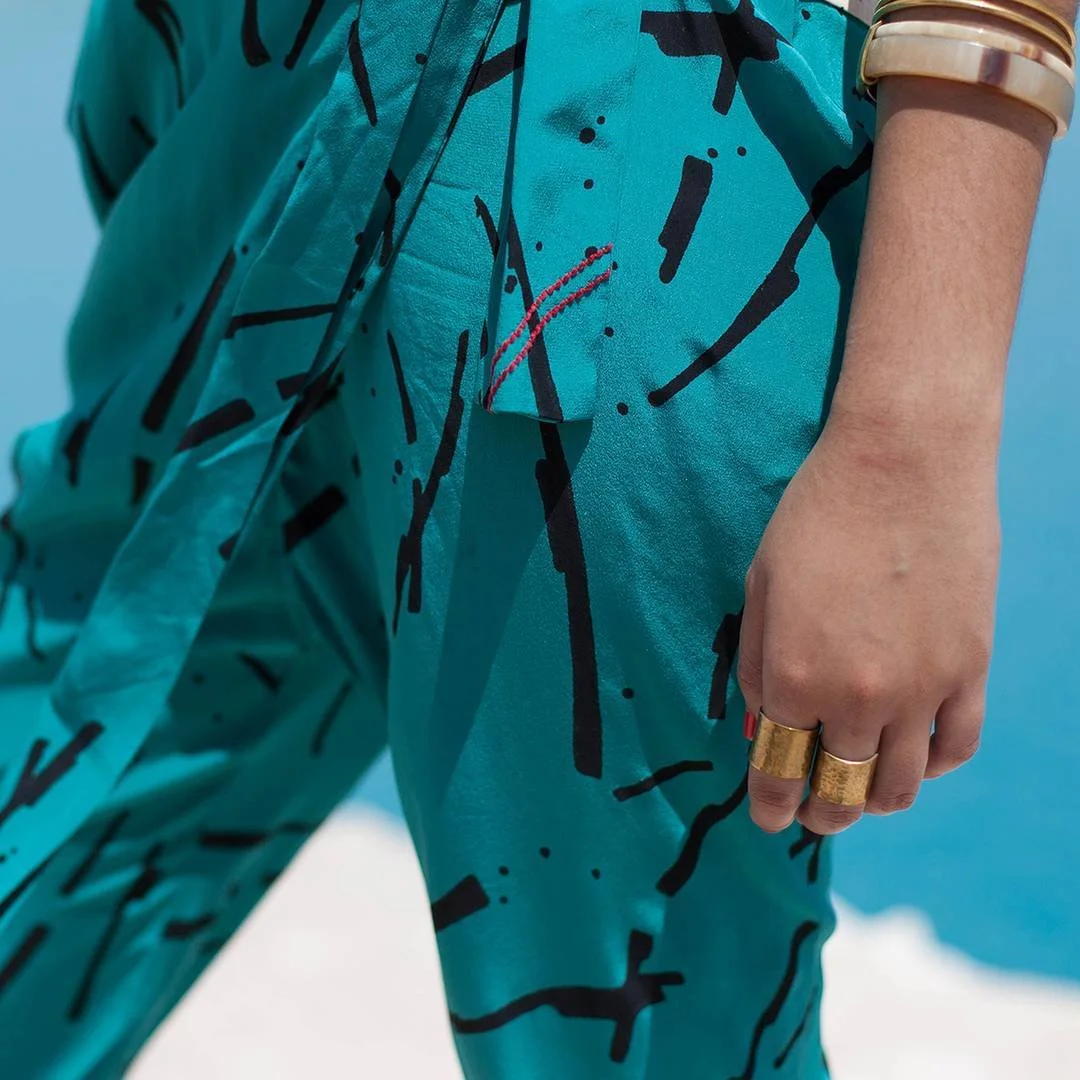
MATTER’s signature brand marker – two parallel lines of red stitched threads. Image taken from @matterprints on Instagram.
This core spirit of interconnectedness and social responsibility was also a brand philosophy in step with the times when slow fashion as a fashion movement gained significant traction; which envisioned “a different – and more sustainable – future for the textile and clothing sector and an opportunity for business to be done in a way that respects workers, environment and consumers in equal measure.”³
An Asian and Tropical Design Language
In alignment with slow fashion’s principles of thoughtful “trendless design”, MATTER debuts designs that become enduring perennials in its line-up. Working with Lisanne Stoop, an Amsterdam-born, Singapore-based designer, the team developed pants with flexible closures using tie-sashes or multiple buttonholes, allowing for adaptable sizing that could see the wearer through seasons in life, while encouraging size inclusivity. Pants were available initially in 2 sizes, subsequently 3 sizes, reducing the need to produce more stock in different sizes. In a 2014 interview with Time Out Singapore, designs were described as “inspired by what already exists, time-tested styles of pants, as well as heritage prints and motifs that have been used for centuries. Our philosophy is about creating connections between past and present, and not just creating something for the sake of originality.”⁴
Its “time-tested styles” were modern evocations of traditional designs from across Asia, giving due credit to their source inspirations. Take for instance the Lounge Lunghi design launched in 2015, which drew from the shared inheritance of the lunghi or sarong worn in tropical climes from “South Asia to the Horn of Africa and [the] southern Arabian peninsula”. The pants are described as “tailored without side seams and a straight leg cut that fold flatteringly when wrapped”⁵ to reference this garment and celebrate a sartorial commonality that is distinctively tropical. Garments are made in biodegradable natural fabrics like lightweight, breathable organic cotton voile, chambray and silk – textiles best suited for tropical weather, all dyed with environmentally-friendly Azo-free dyes.
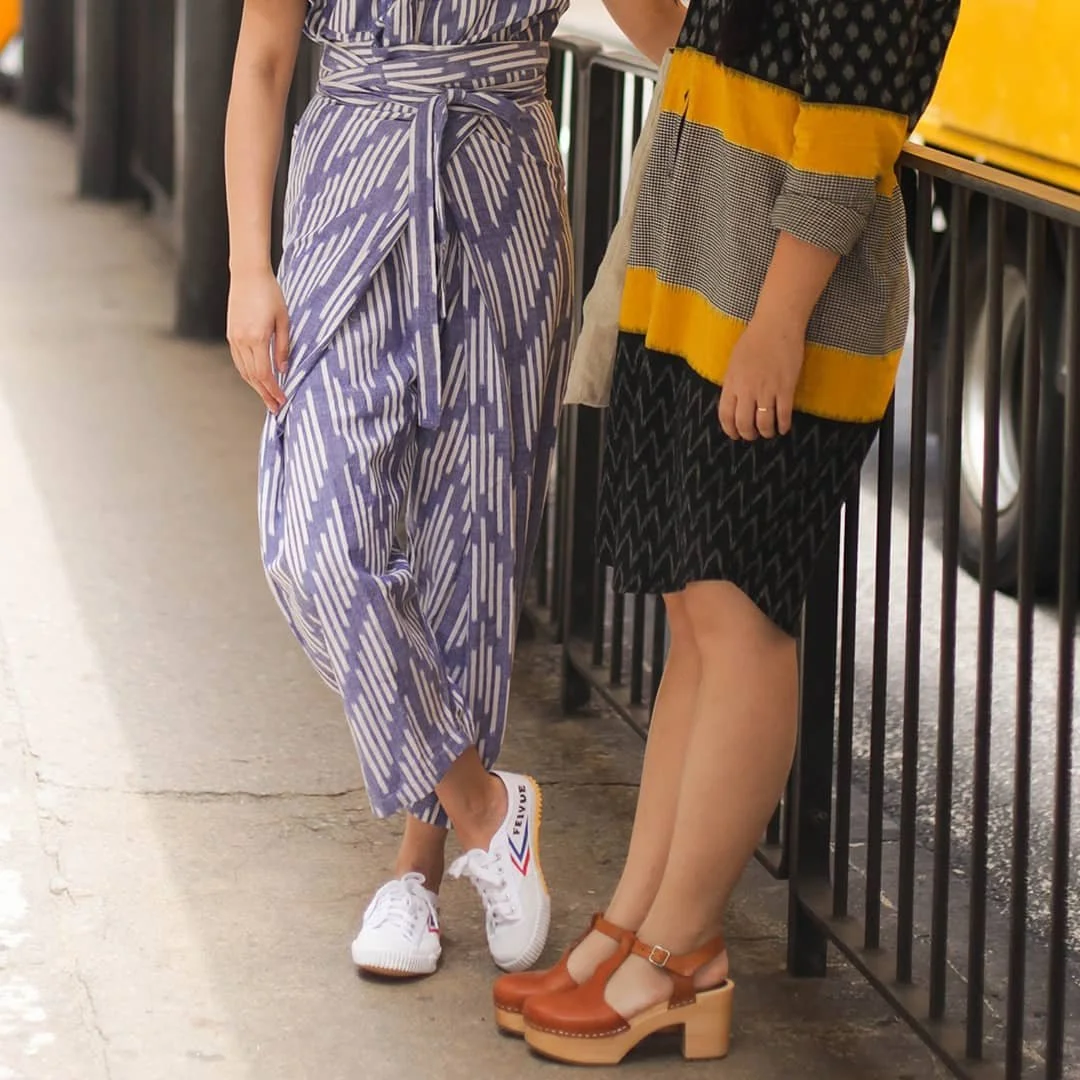
The Lounge Lunghi (left) and the Simple Shirt Dress (right). Image taken from @matterprints on Instagram.
Jumpsuits featured fashionable cut-outs for ventilation in hot tropical climes and mindful of the practicalities of wear, were bathroom-friendly. The brand also showed efforts at inclusivity and customer empowerment, producing a line of headscarfs in direct response to a Muslim customer’s wish for block-printed and artisan-made hijabs.
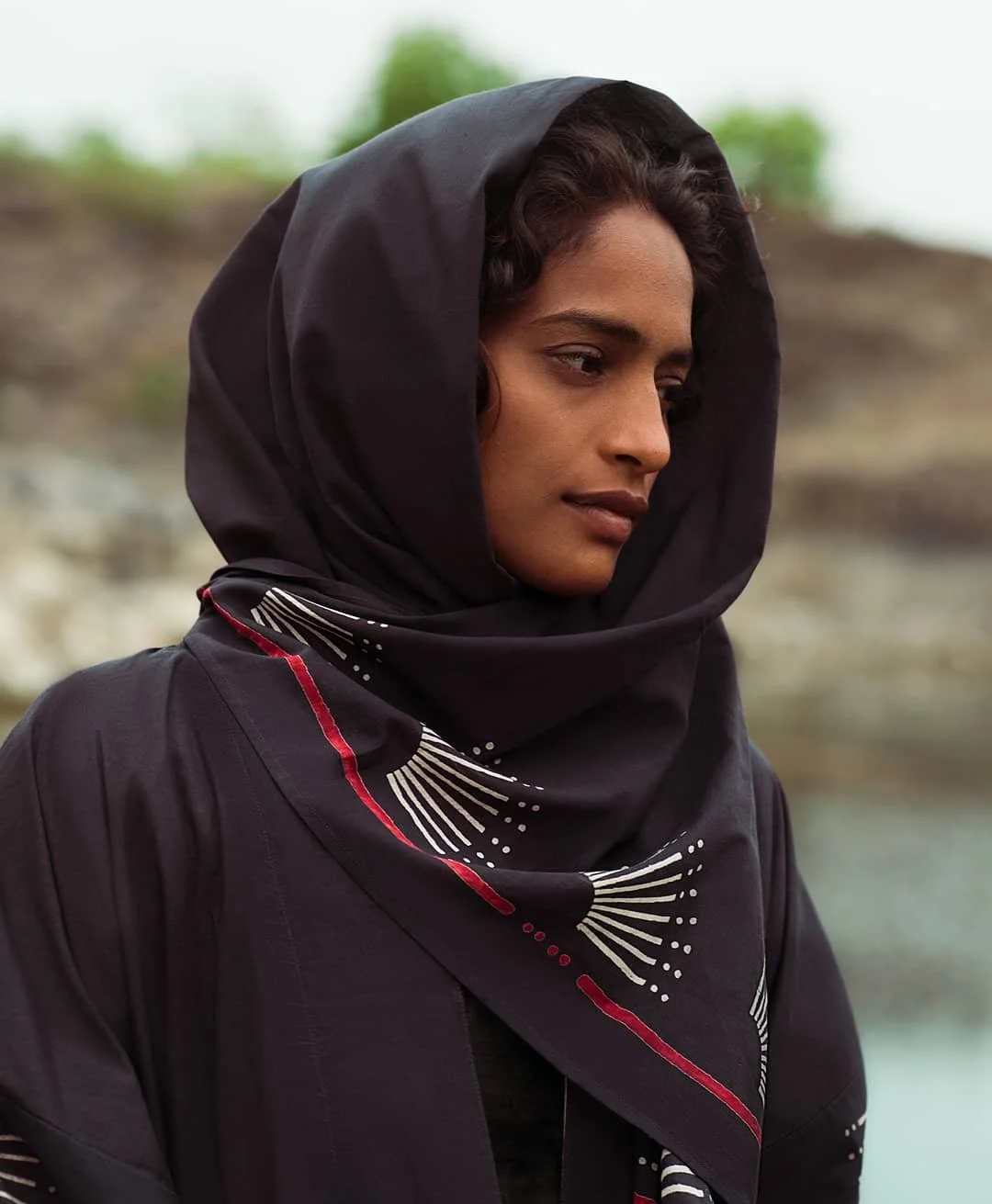
A MATTER abaya or hijab made for Muslim customers. Image taken from @matterprints on Instagram.
Weaving a Narrative: Visual and Written Storytelling
Woven into the fabric of MATTER are the narratives behind the clothing which made their clothing compelling items to own for its customers. Garments were sent packaged in reusable, fully biodegradable cloth drawstring bags with a notecard attached providing the provenance of garments’ textile artisanship and artisan locales: where the garment was woven, printed and stitched, and their geographical latitudes. Cards also stated the inspiration for each print – the Mobi print’s three-petals motifs reference the Meghwal community’s traditional symbols depicting a ripe cotton bol; the 26A print drew inspiration from the roof tiles of the Pagoda Street shophouse where the brand was headquartered.
Marketing video campaigns were craft-centred, showcasing stories behind the clothes’ production of cloth weaving, block printing, or interviews with the artisans behind the clothes, paralleling dedicated craftsmanship video content and digital storytelling put out by luxury fashion houses⁶.
Social Media – The Power of #hashtags
Leveraging on the disruptive advertising force that was Instagram in its early years, MATTER harnessed an unprecedented borderless reach that Instagram afforded small brands, without the hefty marketing costs of traditional media outlets.
Their early posts feature on-the-fly travel shots of the founders on sourcing trips to India, grainy photos of friends, appointed #fieldtesters, trying out the pants on their travels. In these pre-brand saturation days, before the days of “going viral”, #hashtags were a means to travel and discover the novel, to forge like-minded communities based on shared values. Growing a following felt more organic. MATTER created its own community base, #mattertribe, with a slogan, urging customers to #matteron. Quotes from sources ranging from philosophers and poets, Lao Tzu and Maya Angelou, to pop culture figures, like Don Draper and Frank Ocean, propound a lifestyle of self-empowerment, reflectiveness, being a force for change on its social media page. Customers tagging themselves wearing MATTER with #mattertribe, were featured on the brand’s feed, forming a brand community that celebrated racial, gender and age inclusivity.
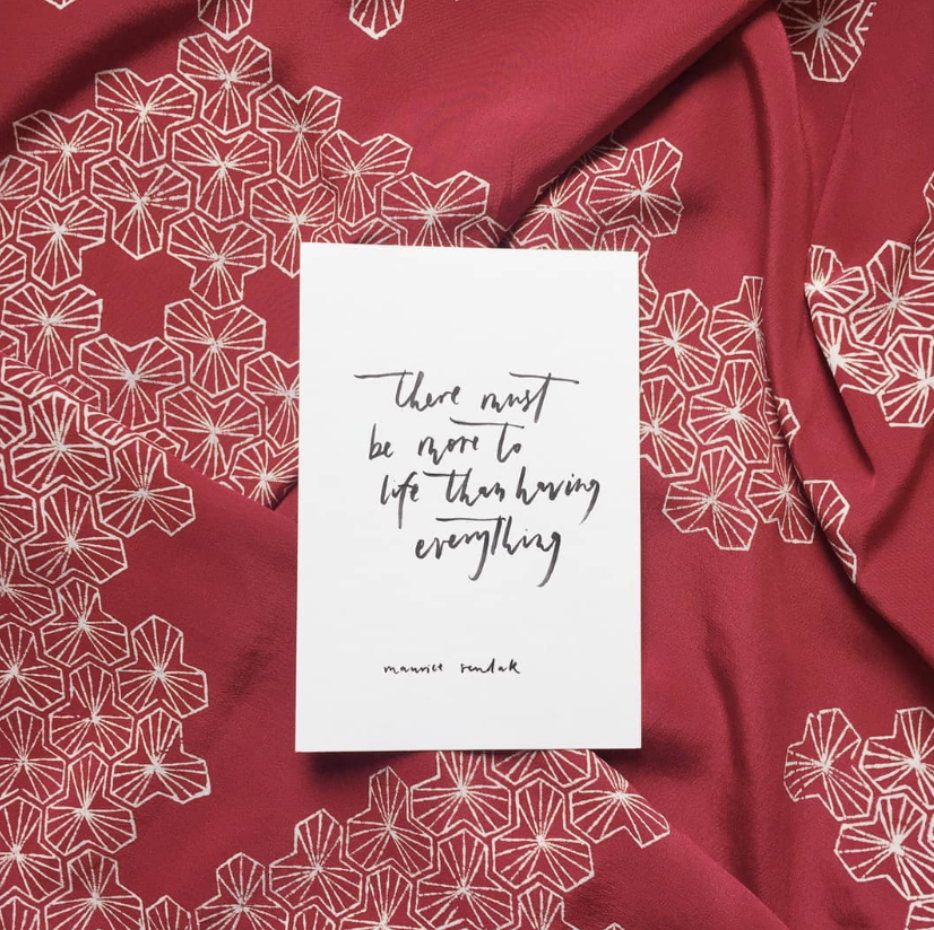
A #mondayquote set on the brand’s Mobi print. Image taken from @matterprints on Instagram.
Instagram also provided a fertile ground for involvement in social media activism. In 2013, Fashion Revolution launched an online campaign #whomadeyourclothes. Participating brands, like MATTER, respond with photos of their workers holding signs that read “I made your clothes”, forefronting the humanity of clothesmakers normally overlooked in the fashion ecosystem.

A worker from Mega Vick Wear factory in Delhi. Image taken from @matterprints on Instagram.
As part of its mission of #changebeyondtextiles, MATTER leveraged on its platform to showcase marginalised voices, profiling activists from around the world championing not just environmental rights, but social issues like gender and racial injustices. MATTER was certainly not the only Singaporean socially-motivated sustainable brand to emerge in the mid-2010s but it became a prominent key player, achieving an international reach of over 40 countries by 2016⁷.
For its Singaporean customers, wearing MATTER’s bold recognisable prints was a way to signal support for a burgeoning landscape of new independent local brands catering to a local audience. Donning a pair of woven ikat pants or a block-printed pyramid top signalled possessing an ethical awareness, a feel-good socially responsible consumption.

Capsule collection cheongsam piece from a collaboration with Singapore label, The Missing Piece.

Singaporean influencer, Aarika Lee models her #MATTERwraps collaboration with MATTER and Indonesian ethical fashion brand SukkhaCitta.
A Pause
In June 2020, the brand abruptly announced on its social media page and website the decision to go on hiatus. Like its launch in 2014, its break seemed symptomatic of the times, with each month bringing news of more independent businesses’ announcements of closures. The post ends poignantly, “This is not goodbye forever. This is goodbye, for now.” MATTER Prints delivers its last restock in December 2020. Commendably, the brand takes a firm stance on how it would handle the winding down of its operations. Stock would not be sold at cut-throat prices out of respect to the labour poured into production.
Five years later, in August 2025, as suddenly as it announced its break, MATTER Prints returned with an announcement on its social media page. “We are not broken. We are in a state of repair.” In its new iteration, the brand held a collaborative event with FIN Crafted Goods Co. to launch a re:Pair programme. The message conveyed in this new project is one of salvaging – buying what is needed, prolonging the life of a treasured garment, not desiring to possess the new.
Apart from some posts thereafter, the #mattertribe still awaits news of MATTER’s return, and perhaps the symbolism of the path drawn by its signature double-line of stitched red threads could be borrowed to describe the brand’s pause – connections, if destined, will reveal themselves with time.
Notes
Rana Wehbe, "MATTER: Sustainable Eco-Friendly Fashion Label from Singapore," Marie France Asia, 10 April 2014, https://www.mariefranceasia.com/fashion/asia-style/singapore-designers/matter-the-new-fashion-with-conscience-brand-from-singapore-11272.html.
"Red Threads: A Story That We Have Not Yet Told," Journal, MATTER Prints, archived 20 October 2019, accessed 30 August 2026, https://web.archive.org/web/20191020085056/https://matterprints.com/journal/making/red-threads-a-story-that-we-have-not-yet-told/.
Kate Fletcher, "Slow Fashion," The Ecologist, 1 June 2007, https://theecologist.org/2007/jun/01/slow-fashion.
Benita Lee, "Interview with MATTER," Time Out Singapore, 19 November 2014, https://www.timeout.com/singapore/shopping/interview-with-matter.
"A Modern Twist on Tradition: The Lounge Lunghi," MATTER Prints, accessed 30 August 2026, https://www.matterprints.com/collections/the-lounge-lunghi.
Reuters, "Meet the Artisans: LVMH Fires New Shot in Luxury Marketing War," Business of Fashion, 14 June 2013, https://www.businessoffashion.com/news/news-analysis/meet-the-artisans-lvmh-fires-new-shot-in-luxury-marketing-war/.
Melissa Heng, "Dress Me in Green," Straits Times (Singapore), 6 October 2016.
Sources
Benson, Sophie. "Why This Decade We Finally Started Caring About Fashion and Sustainability." AnOther, 16 December 2019. https://www.anothermag.com/fashion-beauty/12153/why-2010s-decade-we-finally-started-caring-about-fashion-and-sustainability.
Fletcher, Kate. "Slow Fashion." The Ecologist, 1 June 2007. https://theecologist.org/2007/jun/01/slow-fashion.
Heng, Melissa. "Dress Me in Green." Straits Times (Singapore), 6 October 2016.
Lee, Benita. "Interview with MATTER." Time Out Singapore, 19 November 2014. https://www.timeout.com/singapore/shopping/interview-with-matter.
MATTER Prints. Home page. Accessed 30 August 2026. https://www.matterprints.com/.
Reuters. "Meet the Artisans: LVMH Fires New Shot in Luxury Marketing War." Business of Fashion, 14 June 2013. https://www.businessoffashion.com/news/news-analysis/meet-the-artisans-lvmh-fires-new-shot-in-luxury-marketing-war/.
Sek, Victoria. "This Singaporean Worked Her Pants Off for Her $50K Business—Broke Even in 6 Months." Vulcan Post, 8 September 2017. https://vulcanpost.com/619933/matter-prints-renyung-ho/.
Wehbe, Rana. "MATTER: Sustainable Eco-Friendly Fashion Label from Singapore." Marie France Asia, 10 April 2014. https://www.mariefranceasia.com/fashion/asia-style/singapore-designers/matter-the-new-fashion-with-conscience-brand-from-singapore-11272.html.
About the writer
Hui Ran is an educator and writer with an abiding passion for fashion, art, education and culture.