
Mental Health in Fashion
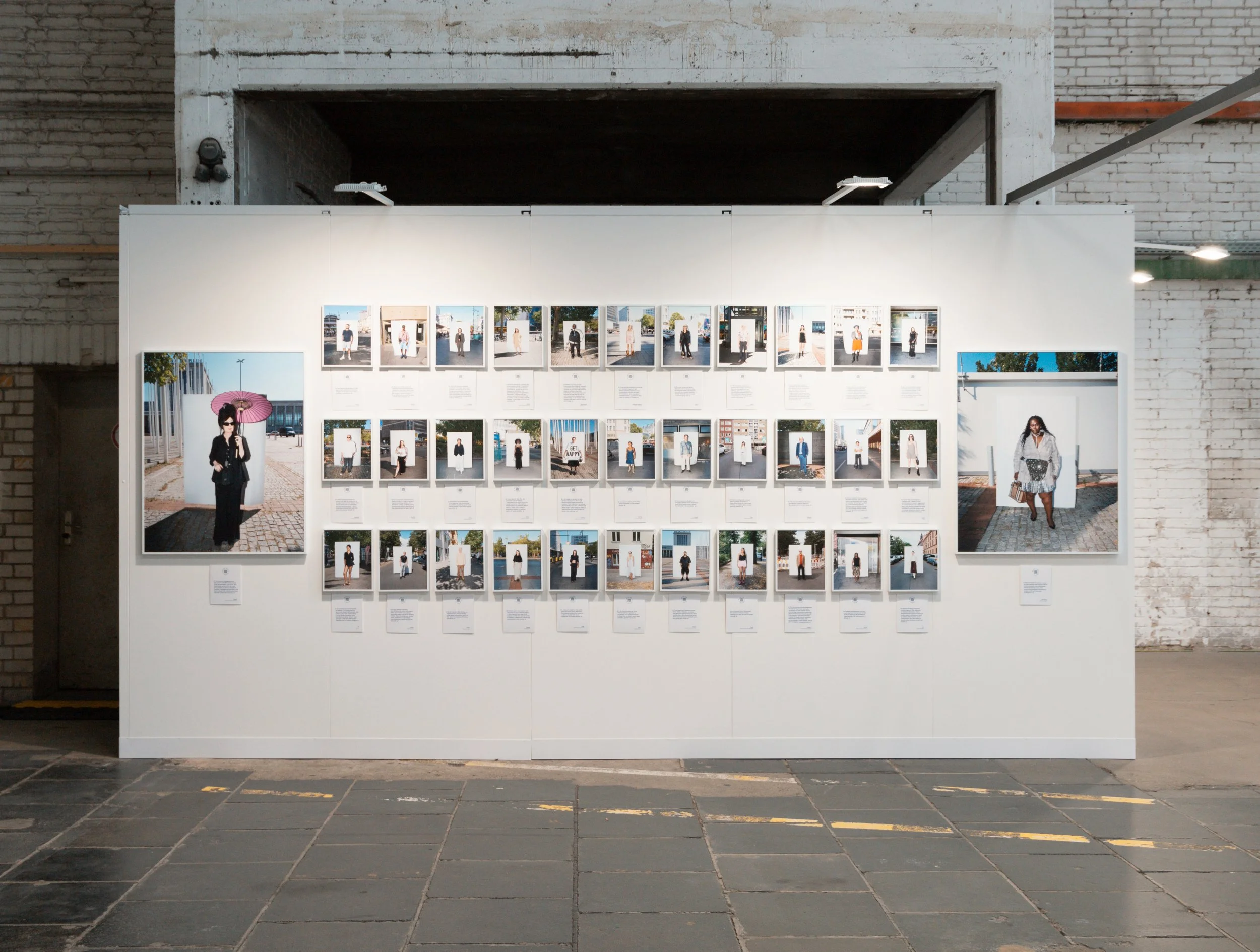
FASHION POSITIONS 2026 art exhibition with One person. One voice. by Claudia Malecka and Florian Müller. Photo by Paula Reschke. Image courtesy of Florian Müller.
While the fashion industry projects an image of effortless polish and exclusivity, its day-to-day operations are frequently marked by accelerated production cycles and workplace strain. Within this environment, personal sacrifice is often normalised as a prerequisite for career advancement, leaving underlying conditions largely unaddressed.
Florian Müller examines these dynamics through a dual background in industry operations and psychology. After spending more than two decades working in luxury fashion PR, guest management, and communications in Berlin and Paris, Müller trained in psychology and psychotherapy. Through his initiative, Mental Health in Fashion, he shifts the conversation away from individual stress management and resilience training, focusing instead on structural reform, fair remuneration, and workplace literacy across the fashion supply chain and educational institutions.
Ahead of his participation in Business of Design Week (BODW) in Hong Kong, Fashion & Market spoke with Müller about the operational realities behind fashion’s public image, the intersection of well-being and sustainable design, and how independent brands and studios can evaluate their internal workflows across markets.
You spent over two decades working in luxury fashion PR, guest management, and communications in European hubs like Berlin and Paris before training in psychology and psychotherapy. What patterns or working conditions did you observe during that time that prompted you to focus on mental well-being in the industry?
A career in fashion was never something I had dreamed of. I originally went to Paris to continue studying business administration and psychology, and it was there that I ended up working in the industry. My studies had already given me a psychological perspective, which meant that alongside my fascination with fashion, I was surprised from the outset by what I discovered behind its glamorous façade. It was only much later, particularly through my involvement in sustainability, that I gained more detailed insights into the complexity of the entire sector.
Yet one question had accompanied me from the beginning: Why did a world that presented itself through beauty have so many unattractive sides? And why were people prepared to endure them? I encountered individuals impeccably dressed in designer clothes they had either borrowed or received in lieu of payment for their work, while struggling to cover their rent or telephone bills. These contradictions eventually led to my university thesis exploring what motivates people to seek belonging and recognition within the fashion world, even at the expense of their own health.
Over the years, my work gave me an increasingly comprehensive understanding of the industry, revealing further problems and working realities throughout its extensive supply chain, far beyond the glamorous environment in which I had first encountered fashion.
Fashion PR centres on presenting an image of ease and exclusivity. Does maintaining this public image make it harder for professionals in the industry to openly discuss workload and workplace stress?
I see this as one of the industry's central problems. How do you challenge a world so obsessed with perfection, illusion and desire, with the promise of belonging to an exclusive circle that so many aspire to enter? Fashion has mastered the art of creating an idealised reality in which there is hardly any room to acknowledge what might be wrong. Even dystopia, when presented through a collection or runway show, can be executed with such aesthetic perfection that the underlying problems remain invisible. This applies not only to consumers, whose desire the industry seeks to cultivate, but equally to those working within it.
While certain mechanisms of suppression may be deliberate, I believe many people genuinely fail to recognise these contradictions. There is a particular irony in the industry's growing emphasis on inclusivity, which too often remains superficial. Occasionally featuring diversity in a lookbook or on a catwalk for publicity purposes does little to dismantle the exclusivity that continues to characterise fashion.
At the same time, the industry constantly sends signals suggesting that we are not quite good enough, attractive enough or young enough. For consumers, this can create a desire to purchase more in the hope of meeting those ideals. Within the profession, it may encourage people to push themselves further, sometimes even accepting unpaid work simply to remain part of that world. These pressures take different forms and vary considerably depending on someone's position along the supply chain. Yet the mechanisms that sustain them can be more powerful than the willingness to create an environment in which their consequences can be openly discussed.
“Even dystopia, when presented through a collection or runway show, can be executed with such aesthetic perfection that the underlying problems remain invisible.”
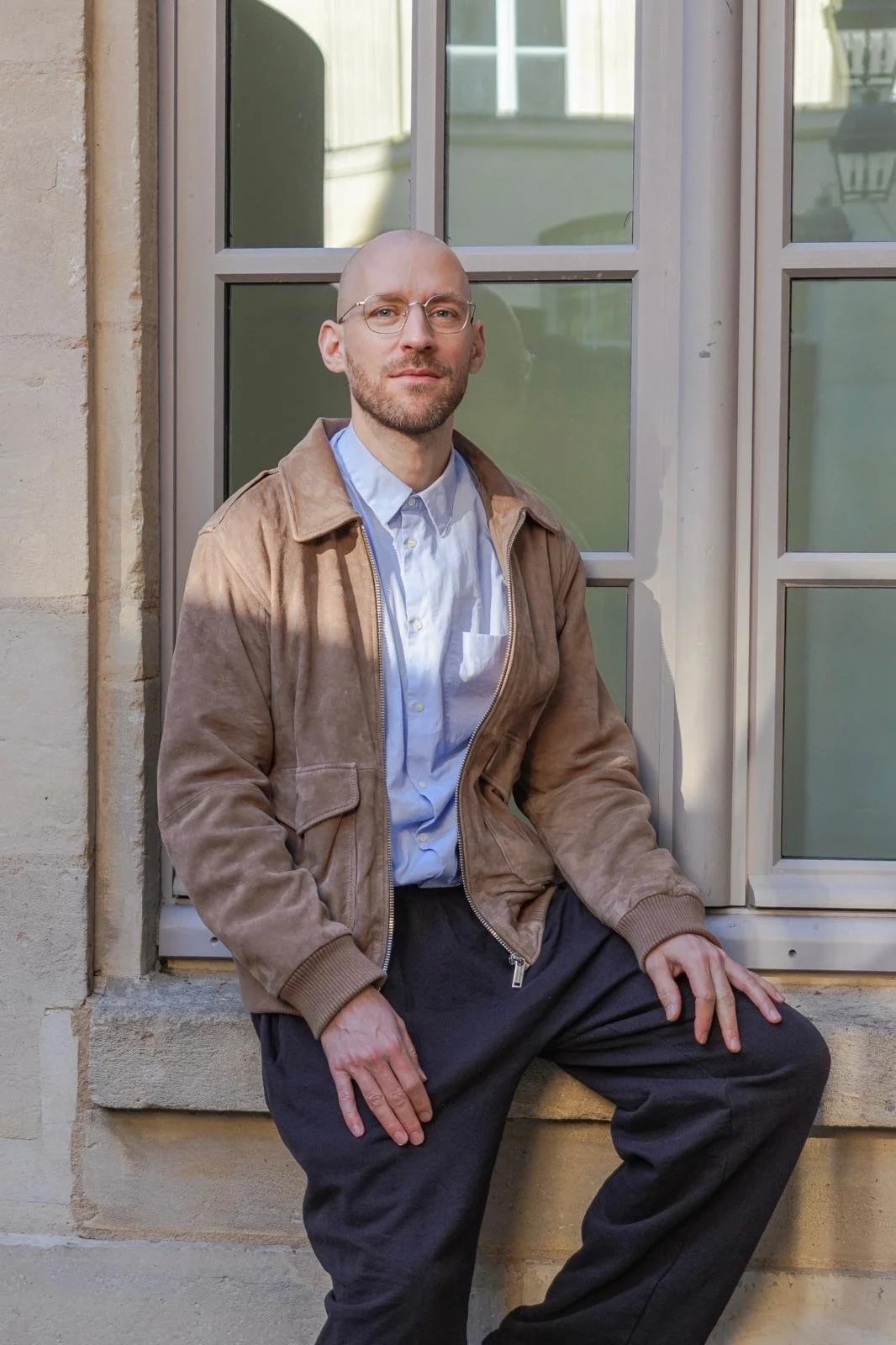
Florian Müller at ASVOFF film festival at Dover Street Market Paris. Photo by Christian TARRO TOMA @ctarrotoma. Image courtesy of Florian Müller.
With your initiative, Mental Health in Fashion, you focus on organisational and structural workplace dynamics rather than individual wellness solutions. What does addressing mental well-being on an operational level look like for fashion businesses?
In conversations about mental health, I repeatedly encounter an emphasis on strengthening individual resilience, while the circumstances that make such resilience necessary are left largely unquestioned. I have no objection to the concept itself, but we cannot seriously propose making people stronger merely to expose them to even greater exploitation. Structural improvements must reflect the particular field and its realities.
My primary concern is to identify unhealthy practices, bring them into the open and, ideally, help initiate change. Fair remuneration is one obvious example, especially the widespread acceptance of unpaid labour. Across fashion, people routinely contribute their time and expertise without compensation, or are explicitly expected to do so, because an association with a prestigious name supposedly provides sufficient reward. However, professional reputation cannot cover living expenses.
More troubling still, some contributors never receive even the recognition or visibility used to justify the arrangement. Working hours, management culture, unrealistic expectations and the way responsibility is distributed also deserve examination. What matters is recognising that mental well-being cannot be separated from the conditions under which people are expected to work.
Another concern is that some organisations have very little understanding of mental illness, leaving them ill-equipped to accommodate employees who may already be affected. What happens when someone becomes unable to work during a deadline-driven project because of a psychological condition? How would a team respond if a colleague suddenly experienced an acute psychotic episode at the office? And how does a workplace generally deal with mental illness, including its possible implications for other staff members?
Without sufficient knowledge, understanding and clear procedures, difficulties that could otherwise be addressed are often almost inevitable. This is also why I believe we need to begin addressing mental health and the structures of the fashion industry much earlier, during education. Through fireside chats and guest lectures at institutions including the Fashion Institute of Technology in New York, Institut Français de la Mode in Paris, Bunka Fashion College in Tokyo and Hong Kong Polytechnic University, I bring these questions into an academic setting. I also developed concepts for ongoing teaching formats that integrate mental health into fashion education, examining both the industry's working culture and the challenges people may face throughout their professional lives.

Fireside chat at PolyU in Hong Kong. Image courtesy of PolyU.
The conversation around industry pressure often centres on creative directors. In your work, how do you see workplace strain affecting other parts of the chain, such as pattern makers, garment workers, agency staff and models?
The supply chain is extensive, encompassing countless people whose existence we may scarcely consider. It is remarkably easy to overlook experiences beyond our immediate surroundings, including the burdens others carry. But I would hesitate to frame the subject exclusively in terms of occupational stress. Some individuals already live with psychological conditions when entering employment; others may become ill as a consequence of the structures in which they work.
Fashion also communicates ideals to society that can contribute, among other factors, to the development of mental disorders. Our purchasing habits form another part of this picture, with potential consequences for our own well-being and for people involved throughout the entire supply chain, from the earliest stages of sourcing and manufacturing to distribution, retail and beyond. These dimensions are deeply interconnected, and looking away does nothing to diminish their complexity. Before distinguishing between the difficulties faced by individual professions, it is essential to acknowledge both their shared concerns and their very different circumstances. The responsibility is to establish conditions that protect people rather than make them ill, not to turn workplaces into therapy centres.
With the demand for frequent collection drops and continuous digital content, production schedules have accelerated. Is it commercially viable for an independent brand today to adopt a slower, more deliberate schedule?
Perhaps the more interesting question is whether continuing to obey these rules is economically sensible in the first place. Does the relentless pursuit of new collections and constant output invariably generate greater revenue? And when it does, at what point do those responsible begin paying a personal price because their health can no longer withstand the demands? Not to mention the many others involved throughout the process, who may also bear the consequences of this acceleration.
Competitive pressure, fear for one's livelihood and, in some cases, the pursuit of ever-higher profits can trap people in a cycle of perpetual performance from which escape seems increasingly difficult. Choosing not to participate may have serious consequences, potentially even forcing someone to leave the industry. I recognise that risk. Nevertheless, personal well-being should be worth protecting. There is also another possibility worth considering: departing from established conventions may itself offer a commercial advantage. An independent brand's willingness to operate differently could become a distinguishing quality rather than a weakness. Following everyone else's rhythm is not necessarily the only route to creating value.
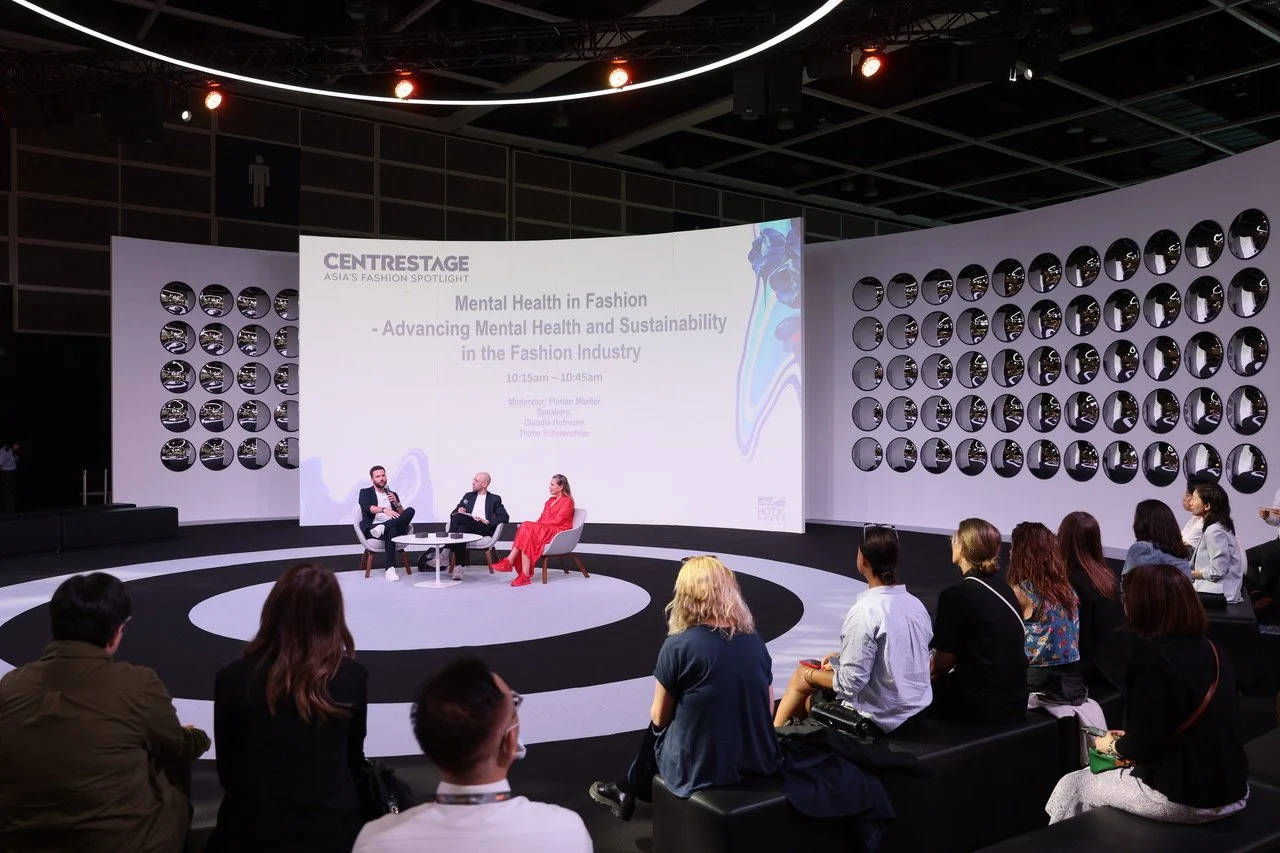
Mental Health in Fashion Panel Talk at CentreStage in Hong Kong. Image courtesy of CentreStage by Hong Kong Trade Development Council.
You are participating in Business of Design Week (BODW) in Hong Kong, where the agenda often highlights circularity, materials and technology. How do you integrate workforce well-being into broader discussions about sustainable design?
Receiving the invitation to Business of Design Week meant a great deal to me because its interdisciplinary approach reflects values that are also fundamental to my work. BODW brings together perspectives extending beyond aesthetics and products, exploring the connections between design, business, education and societal development. I find this particularly relevant because Mental Health in Fashion likewise operates across different fields rather than concentrating on a single dimension.
Sustainability cannot be understood solely through materials, circular processes or technological advances; the circumstances of the people involved deserve equal attention. Fashion possesses an extraordinary ability to communicate ideas beyond its immediate professional environment, and I deliberately use that influence to address subjects that might initially seem unrelated to clothing. My objective is to encourage changes whose significance is not determined by monetary profit. My upcoming activities in Hong Kong, supported by the German Consulate General in Hong Kong and Macao and Germany's Federal Foreign Office, are one example of how I pursue this approach internationally, bringing different perspectives together and extending the discussion beyond the fashion industry itself.
In your coverage of Taipei Fashion Week for A Shaded View on Fashion (ASVOF), you noted local sustainable initiatives and emerging creative talent. What were your impressions of the working realities and commercial pressures facing designers working outside Western fashion capitals, specifically in Taiwan?
In Germany, designers often have their collections manufactured abroad, depending on the scale of their businesses, partly because lower production costs can help them remain competitive. My visit to Taipei Fashion Week, however, was primarily devoted to the runway presentations and the collections themselves, rather than an examination of the working conditions behind them. What caught my attention were initiatives linking local production facilities and textile suppliers directly with emerging labels. Whether these arrangements make establishing a commercially viable business easier than elsewhere is something I cannot reliably judge. More generally, I frequently encounter a desire among creative professionals worldwide to build relationships and pursue opportunities in other markets. It reminds me of the familiar expression that the grass is always greener on the other side. Through my teaching activities at institutions around the world, as well as my involvement in fashion shows, panel discussions and other industry projects, I increasingly find myself questioning which markets can genuinely be considered successful and, perhaps more importantly, who actually earns the money.
In your writing on Robert Wun’s show in Hong Kong, you touched on the balance between personal identity and global commercial visibility. In your personal exchanges with design communities in Europe and Asia, do you see common challenges around career expectations, or do approaches to workplace stress differ by market?
What I find particularly interesting in exchanges with fashion communities across Europe and Asia is how strongly professional expectations can be shaped by the environment in which someone develops their career. Cultural and economic circumstances naturally differ, and I would be reluctant to suggest that designers in one market experience pressure in a fundamentally different way from those elsewhere. What I do recognise is that the challenges of reconciling creative ambitions with commercial demands are not confined to any particular region. The expectations placed on designers can come from many directions, including the industry itself, their professional surroundings and their own aspirations.
At the same time, people may interpret and respond to these demands differently depending on their individual situations. My international exchanges have made me increasingly aware of how important it is to listen before drawing conclusions. Rather than assuming that one market has found a better way of working, I am interested in understanding the different realities people face and what we might learn from one another.
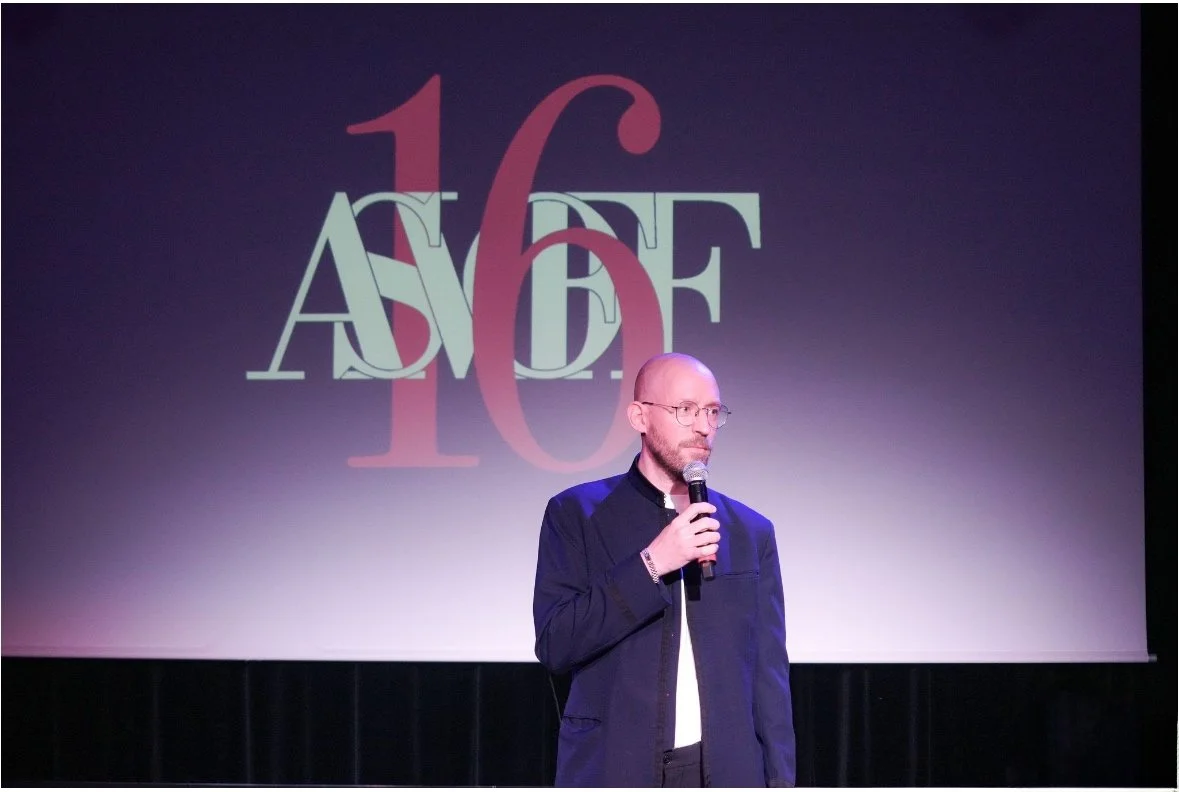
At ASVOFF film festival at Dover Street Market Paris. Photo by Christian TARRO TOMA @ctarrotoma. Image courtesy of Florian Müller.
As curator of the Mental Health in Fashion category for Diane Pernet’s A Shaded View on Fashion Film Festival, how do you see film and visual storytelling contributing to more constructive conversations around body image and workplace transparency?
When I introduced the Mental Health in Fashion category at the festival, I was looking for a way to give visibility and a voice to experiences for which people sometimes struggle to find the right words. Film offers an artistic language through which difficult subjects can be approached without requiring everything to be expressed verbally. That possibility was particularly important to me given the many different aspects of mental health that deserve attention.
A comparable idea developed when I met the artist Claudia Malecka and introduced her to my campaign. Together, we created One person. One voice., combining her artistic direction, photography and set design with my interviews and curatorial work. The series consists of 35 portraits accompanied by 35 individual statements relating to Mental Health in Fashion. While Claudia's visual interpretation makes the participants visible, their words allow them to express their own perspectives. Both projects provide different ways of bringing experiences into public discussion that might otherwise remain unheard.
For independent designers and small creative studios reading Fashion & Market, what is one operational boundary or workflow change that can improve day-to-day team sustainability?
I am generally reluctant to propose solutions that claim to apply universally, because the circumstances of individual businesses and the people involved can differ enormously. One recurring problem I encounter, particularly in discussions about sustainability, is the tendency to preserve unhealthy patterns while presenting them under more appealing terminology. A different name does not necessarily represent a substantive improvement.
For an independent designer or small creative studio, I would therefore begin by examining existing working practices and questioning whether arrangements that have become customary are actually appropriate. This includes looking at whether deadlines are realistic, whether responsibilities are clearly defined and whether people are expected to remain constantly available, even when this is neither necessary nor sustainable. Such questions should be addressed within the realities of each business, rather than answered through additional rules or obligations disguised as measures to improve well-being.
What matters is recognising where existing structures may be contributing to unhealthy conditions and being willing to address them. There is also something I often say that may sound rather simple: ask yourself whether you would want to be treated the way you treat others. If the answer is no, perhaps you have already taken the first step towards recognising what needs to change.
Business of Design Week (BODW) 2026 takes place from 18 to 20 November 2026 at the Hong Kong Convention and Exhibition Centre. Learn more and register at 2026.bodw.com.
The author was invited on a press trip to attend BODW 2026.