
Fashion & Memory: Faisal Shah of DIBBA
Turning cultural memory into contemporary fantasy

Faisal Shah in Singapore, Oct 2025 wearing a custom tenun suit, ruffled cotton shirt, belt, and bag all from DIBBA. Image courtesy of DIBBA.
As the creative director behind Jakarta-based brand DIBBA, Faisal Shah designs clothing that moves through Indonesian flora and fauna, Javanese histories, Silk Road exchange and natural landscapes. His work is vivid, sculptural, and often fantastical. Yet behind the experimental looks lies a persistent concern with heritage preservation: how can histories of textiles, objects, and craft be translated into pieces that feel desirable, contemporary, and alive?
DIBBA was founded in 2016, at a moment when Shah felt fashion was becoming too serious. Minimalism and muted palettes dominated luxury fashion and he remembers wondering what had happened to the colour and joy he grew up with. “All the Southeast Asian countries are so rich in history, textiles, prints,” he says. “Colours and prints are in our DNA. Whatever happened to that?” For Shah, DIBBA became a way to return to fashion’s emotional and narrative possibilities: clothing as a vessel for storytelling, identity and pleasure.
When the brand first launched, many people suggested that DIBBA begin with batik. Shah resisted the obviousness of that route. “What can we do to represent Indonesia that is a little bit more unique?” he remembers thinking. The answer was the brand’s first collection, Primal, which was inspired by flora and fauna endemic to Indonesia. Rather than using a textile immediately recognisable as “traditional”, DIBBA began by imagining another visual language for Indonesian identity rooted in nature and print.
“When the brand first launched, many people suggested that DIBBA begin with batik. Shah resisted the obviousness of that route. ‘What can we do to represent Indonesia that is a little bit more unique?’”
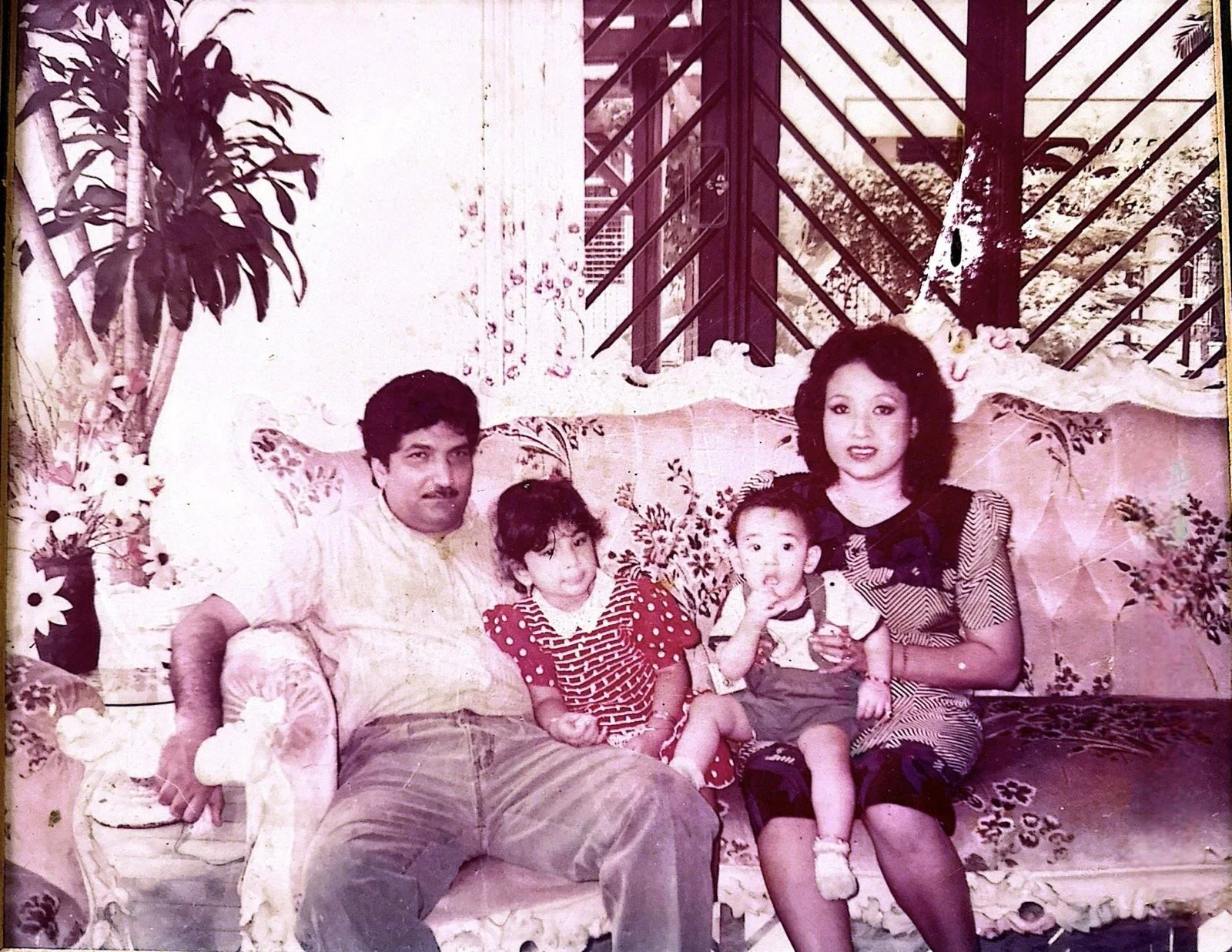
Archival family photo of Faisal Shah. Image courtesy of DIBBA.
In its earliest years, DIBBA was more ready-to-wear and print-based, shaped by the team’s art and illustration backgrounds. Over time, the brand became increasingly more sculptural and experimental, a shift connected to Shah’s own training. Born in Jakarta, he later went to school in Australia before attending university and working in London. Although he studied fine jewellery rather than fashion, that background became an important component of DIBBA’s design language. The art of jewellery taught him to think closely about surface, structure, and detail.
Shah also grew up surrounded by a diverse cultural vocabulary of dress, food, film and family memory. His mother’s side is Javanese and Chinese, while his father’s side carries Pakistani and Arabic heritage. “There was a lot of cross-cultural interaction, and I loved growing up with it,” he says. “If we are talking about textiles and dress, it was cheongsam, saris and more.” These early encounters with clothing and visual culture later became part of DIBBA’s emotional landscape shaped by inherited aesthetics and cross-cultural exchange.
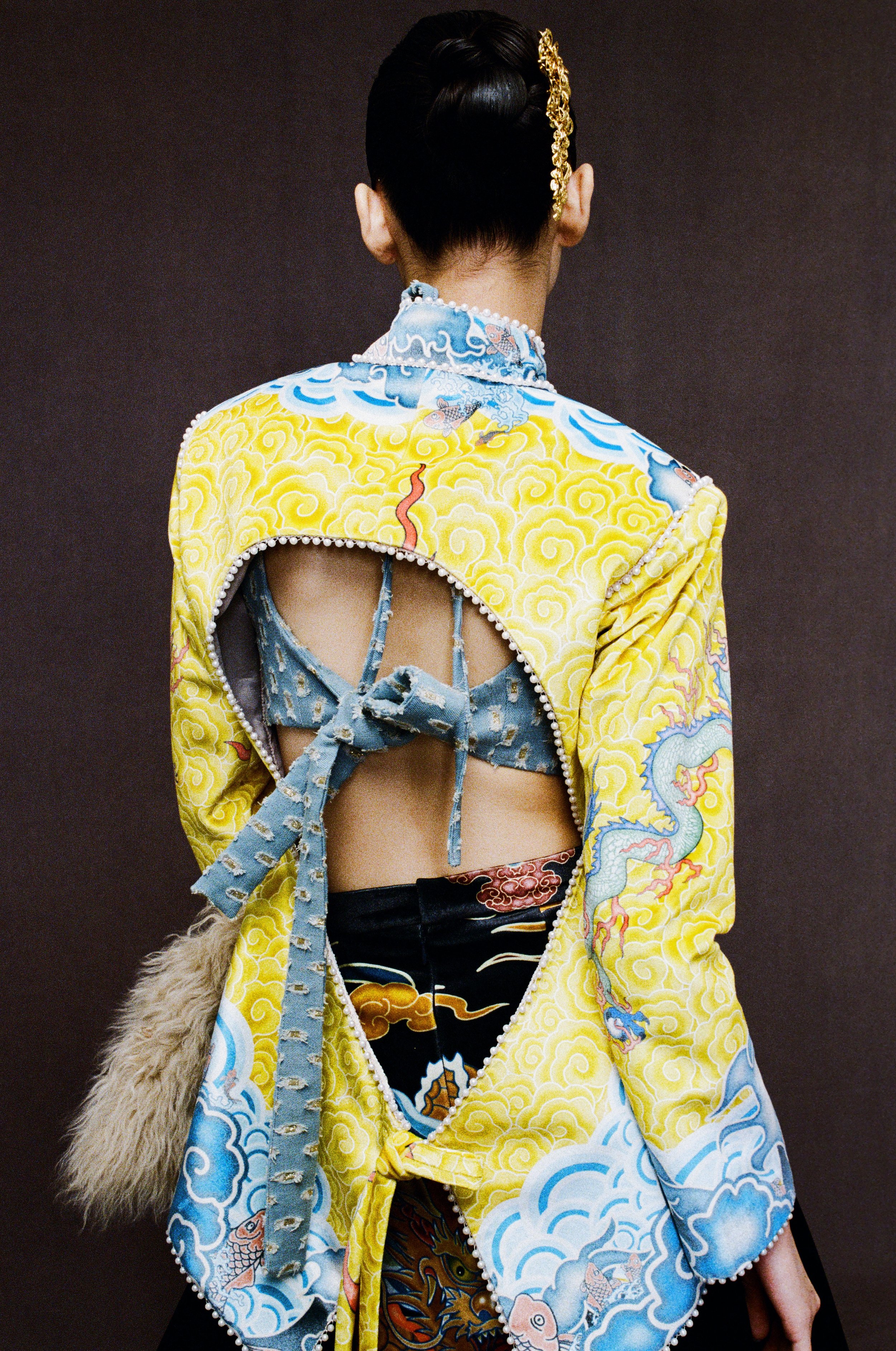
Original Xi’an DIBBA printed velvet blazer with back cut-out and crystal trimming. Photo by Leandro Quintero. Image courtesy of DIBBA.
Shah’s love of global histories also shapes his creative process. He describes himself as a thrifter, or a collector of antiques and visual culture. Museums, textile collections and local historical sites all influence the stories behind his collections. When he references a particular period, he does not simply look at images, but immerses himself in that world. “I get obsessed with the time period,” he says. “I will watch documentaries, find books, and visit museums. That is the most fun part of the creative process: to immerse myself in research and the world.” Through this process, research becomes a way of understanding why objects and garments took particular forms in the past, allowing Shah to transform historical references into contemporary design.
Although Shah’s references move across geographies, Indonesia remains the emotional and historical centre of DIBBA’s work. He remembers reading somewhere that Indonesia is the largest invisible country in the world, and that has tayed with him. For Shah, it captures a frustrating contradiction: a country immense in cultural diversity, but still too often underrepresented within global fashion narratives. “We have different dialects, we have different cultures within our country,” he says. “Those cultures include stories, legends, fabric, artefacts and they are so different.”

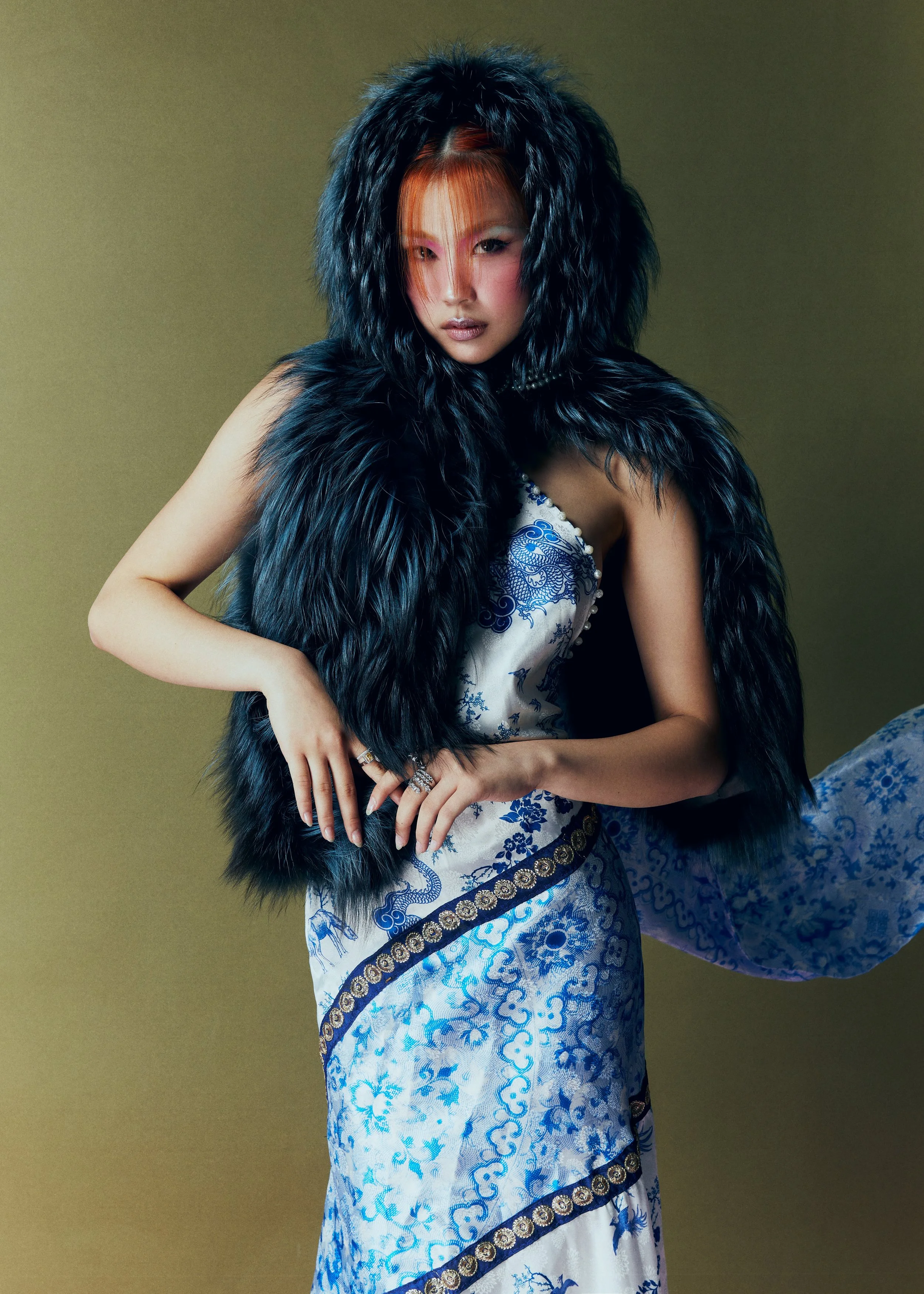
The Komarov sequined top (left) and Khanka dress (right) from DIBBA’s AMUR Chinese New Year 2026 collection. Named after the Amur River, which moves through the borderlands of Northeast Asia, the collection reflects movement, renewal, and cultural convergence through Chinese-inspired prints, velvet, fur and light-catching sequins. Photo by Torik Danumaya. Image courtesy of DIBBA.
For Shah, translating those references into contemporary fashion requires both experimentation and respect. Southeast Asian textiles have long moved across borders, carrying histories of trade and migration. He is drawn to those connections: the way textiles, dress forms, and motifs echo one another across different cultures. “We are all kind of interlinked, especially in textiles," he says. “So, why don't we remix it a little?” Yet remixing does not mean treating cultures as free material. Some batik motifs, for example, have specific orientations or meanings, while certain cloths may have ceremonial or cultural restrictions. “There is weight and respect for traditional fabrics,” he says. “I would not take the motif and just digitally print it.”


Looks from the DIBBA x Yayasan Batik Indonesia collection, 2024. Left: crystal-embellished tenun Gedog cropped jacket and velvet pants with cowrie shell trimmings. Right: 3D sculpted kemben bustier with Borobudur temple relief and beaded tenun Gedog skirt. Photos by Leandro Quintero. Image courtesy of DIBBA.
That respect is clear in his 2024 collaboration with the nonprofit organisation Yayasan Batik Indonesia, which introduced him to Batik Gedog Tuban, a textile tradition he had never encountered before. Shah learned that the craft could become extinct within ten to fifteen years, as its artisans were ageing and no younger generation had emerged to continue the work. Made by farmers during the rainy season to supplement their income, the cloth was thick, expensive, and often considered more suitable for tablecloths than garments. Shah saw possibility where others saw difficulty. “Personally, I love this,” he remembers thinking. “This is perfect for corsets. This is perfect for sculptural pieces.” In DIBBA’s hands, the heaviness of the fabric became structure.
This interest in craft collaboration continued into DIBBA’s 2025 collaboration with Cita Tenun Indonesia. For the By the Docks of Time collection, the team worked with fabrics provided by the organisation, including Tenun Garut and Tenun Lurik made by Indonesian artisans. Shaped by maritime references and hand-crafted embellishment, it extended DIBBA’s interest in storytelling through material and surface. Shah also worked with an artisan from Bali who specialises in shell and bone carving. Shell inlays were cut and engraved for garments, while embellishments were carved from materials such as fossilised wood. “I would not be here as a designer if it were not for everyone else involved in this entire process,” he says.

Faisal Shah in the DIBBA Studio, Jakarta. Image courtesy of DIBBA.
Even DIBBA’s studio belongs to a world of layered memory. The brand is based in an older area of Jakarta, surrounded by 1970s buildings, fashion studios and traces of the city’s past. Shah describes a neighbourhood that once drew Indonesian recording artists, later fell out of fashion, and has since become home to young creatives and coffee shops. The original buildings remain. “How times have turned,” he says.
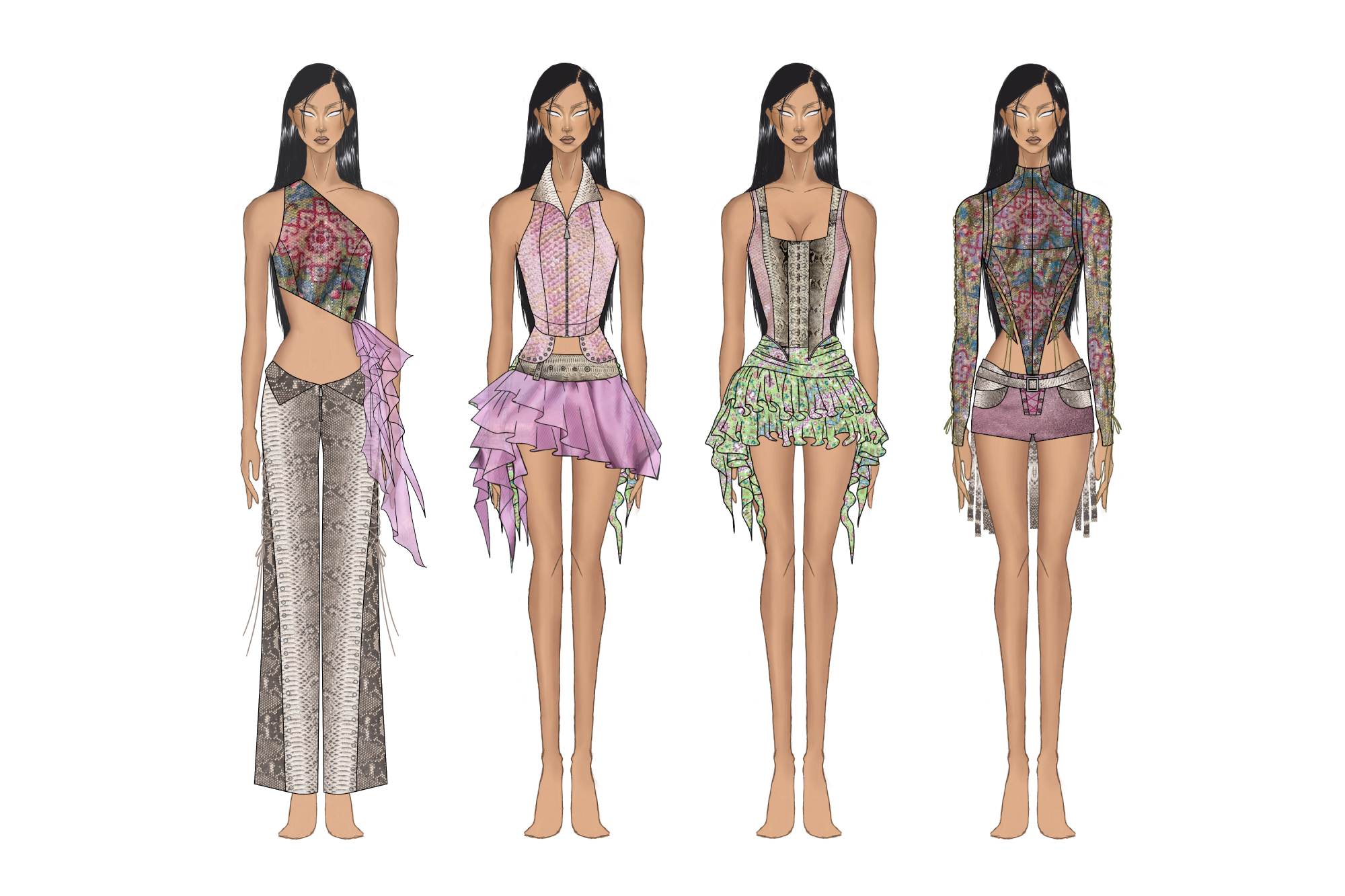
DIBBA’s sketch of costumes for no na’s Head In The Clouds performance in Tokyo, Japan. Image courtesy of DIBBA.
Looking ahead, Shah is interested in expanding DIBBA’s product line while returning to his first love, jewellery. He imagines the brand moving more fluidly across garments, accessories, performance, and costume, with experimentation remaining central to its future.
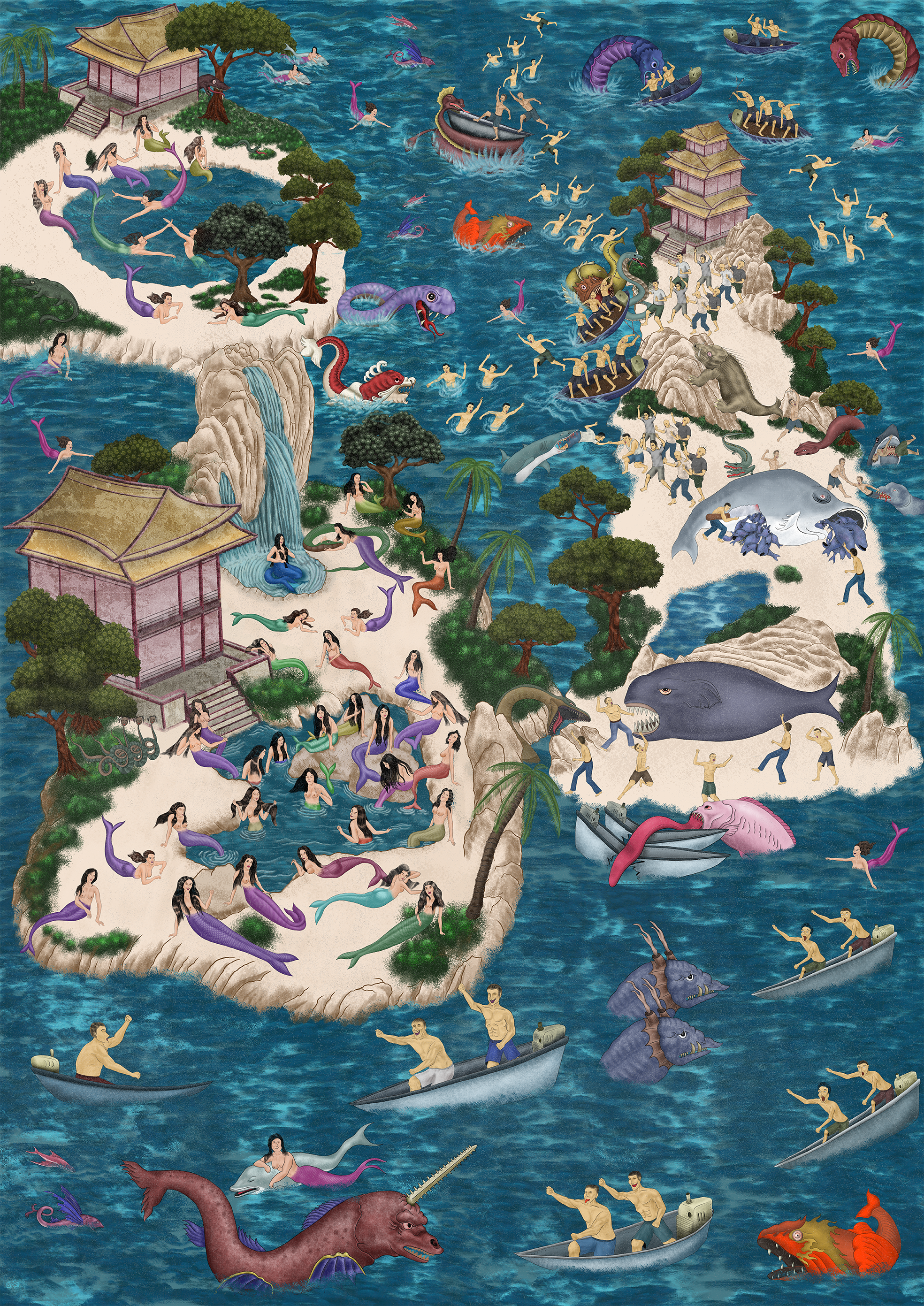
Original DIBBA digital art print for their upcoming resort collection. Image courtesy of DIBBA.
Toward the end of our conversation, Shah returns to the people behind the work. “It is something beautiful, but personally, it is beyond the garment,” he says. “These are the stories that came beforehand.” For Shah, clothes become a way to interpret and honour those stories. The garments are, as he puts it, “the flowers”, a tribute to the artisans, collaborators, family memories, and histories that shape DIBBA’s world.
This is perhaps the most moving way to understand the brand. Behind the sequins, sculptural corsets, shell inlays, and vivid prints are the many hands and memories that risk being forgotten if they are not carried forward. For DIBBA, memory is preserved through colour and fantasy, and the many hands that transform a story into something that can be worn.
To learn more about DIBBA, follow the brand on Instagram @dibbaofficial.
About the Writer
Faith Cooper is the creator of the Asian Fashion Archive. She holds master’s degrees from the Fashion Institute of Technology (FIT) in New York and from Fu Jen Catholic University in Taiwan, where she researched Taiwanese fashion and cultural identity as a Fulbright Student. Faith is now pursuing a PhD in history at the National University of Singapore, focusing on the cultural history of women’s sartorial developments in mid-twentieth-century Singapore.