
Fashion Footnotes: What’s Inside a Stylist’s Bag?
A closer look at the tools and essentials
Styling is a practice shaped as much by what is seen as what remains outside the frame. What we see in the final image is only a fraction of the work, with much of it happening just beyond it. The process unfolds through the adjustment of small details: how a hem is pinned, a silhouette refined, or an object positioned. These gestures often go unnoticed, but they shape how the subject is ultimately composed. It is anchored by a styling kit, the stylist’s equivalent of a photographer’s camera or a designer’s sewing machine.
As Art Director at Fashion & Market, I look at fashion beyond garments, focusing on the objects, references, and rituals that shape how we dress and live. In my column, Fashion Footnotes, I explore the intersection of style, culture, and everyday life in Southeast Asia. Each quarter, the format shifts among edited finds, behind-the-scenes perspectives from the industry, and notes on personal style from practitioners working within it.
Alongside my role at F&M, I am a stylist based in Jakarta. I work across a range of shoots, including editorial, lookbooks, still life, and food styling, where the practice is grounded in adjustment and attention to detail. For this installment, I turn to the tools that support my work. My styling bag has been with me since 2021. Modest in appearance, it is able to accommodate more tools than expected. It now functions less as a bag and more as a working system. While every stylist’s kit differs, these are the items I consistently rely upon on set.
My styling bag from Uniqlo. Image courtesy of Sharrona Valezka.

Clockwise: sewing thread and needle, dressmaker pins, safety pin, and ball pins. Image courtesy of Sharrona Valezka.
Pins and Needles
As I have spent more time working in the field, I have come to recognise the different types of pins that exist. I keep a mix of standard safety pins, ball pins for thicker materials, and finer dressmaker pins, which sit almost invisibly against the body when shaping garments. A needle and thread also remain essential for quick, temporary alterations. Though rarely visible, they are integral to how the final composition comes together.

Left to right: two thread cutters, general scissors, fabric scissors, and a roll of invisible thread. Image courtesy of Sharrona Valezka.
Scissors
I carry multiple pairs, each serving a distinct purpose. I started with one, but gradually added more as the work required: fabric scissors for clean, precise cuts; a general one for standard tasks; a heavier pair reserved for tape, plastic, or wire; thread cutters for loose ends and fine adjustments. With continued use, their roles have become second nature, and I reach for each instinctively. From experience, there is rarely such a thing as having too many scissors on hand.
Invisible Thread
Frequently used in still-life work, it serves to create the impression of objects suspended mid-air. Before working as a stylist, I often wondered how such complex constructions were achieved. In practice, much of it comes down to simple rigging, with some post-production support. At times, it also requires a practical way of thinking, making small adjustments to achieve the intended effect. The thread is tethered and tensioned with control, creating a sense of suspension without drawing attention to the mechanism itself. It introduces a subtle yet effective element within the image.

Clockwise: clear double-sided tape, black fabric tape, masking tape, and paper double-sided tape. Image courtesy of Sharrona Valezka.
Tapes
Over time, my tapes have come to form a structure of their own. Black fabric tape is used when strength and durability are required, particularly in rigging. Thick double-sided clear tape, often referred to as magic tape, allows for discreet corrections that sit cleanly within the image and can be refined in post-production. Paper double-sided tape is ideal for paper materials without damaging delicate surfaces. Masking tape is the most adaptable, utilised to secure backdrops, mark positions, and protect the soles of loaned footwear, among many other uses.

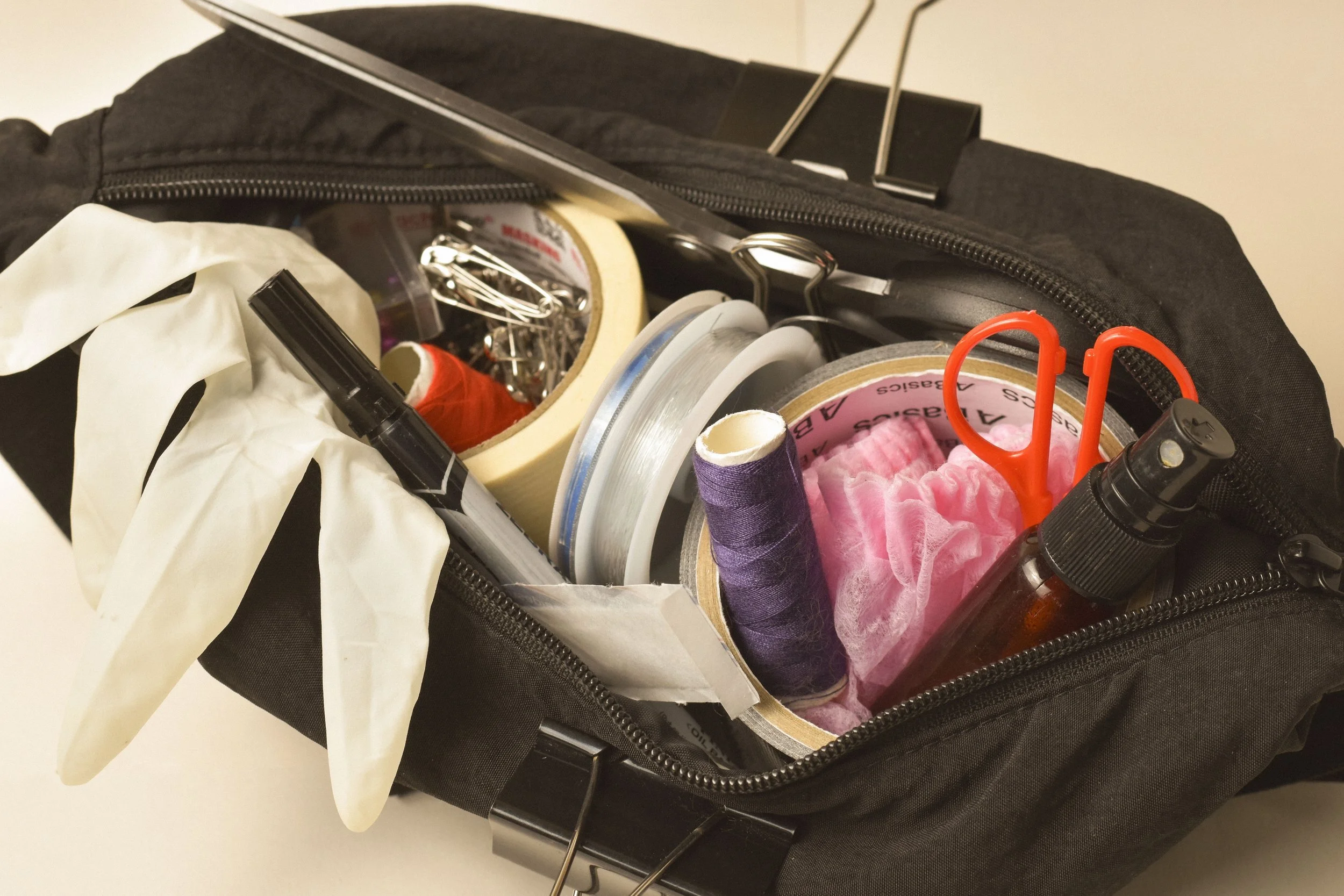
Clockwise: binder clips, band-aids, marker, bug spray, shower cap, and surgical gloves. Image courtesy of Sharrona Valezka.
Miscellaneous Items
This is a category defined by experience rather than intention, bringing together items that prove useful in practice. For one, bug spray is essential for outdoor shoots, particularly in Indonesia where foliage is often part of the setting. A shower cap helps prevent makeup transfer during outfit changes, while surgical gloves are for handling delicate items such as jewellery without leaving marks. Binder clips, in various sizes, are a versatile tool to secure backdrops or threads to stands, or as a makeshift solution to adjust oversized garments on models. A marker is also kept on hand to track shots and make quick notes on set. Lastly, I carry a few band-aids as a precaution for the occasional styling mishap, as has happened a few times.
Gradually, the styling kit shifts from the objects themselves to how they are used. Each item reflects a way of working, shaped through the realities of the job, and refined with experience. In that sense, the styling kit becomes an extension of the practice itself.
I hope you enjoyed this edition of Fashion Footnotes. See you in the next one!